

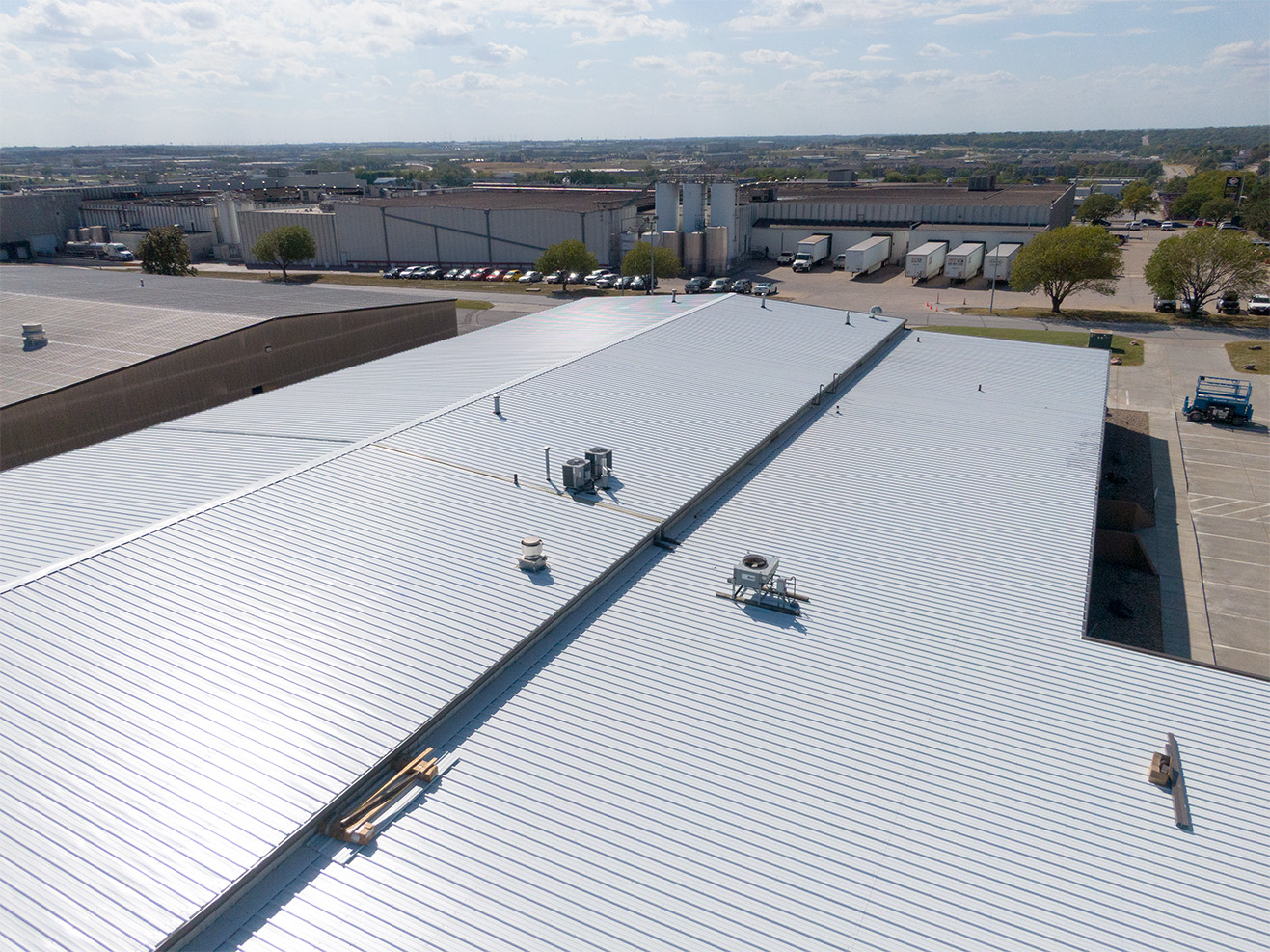
Standing Seam Metal Roof Systems
Standing seam metal roofing for Charlotte commercial buildings - Galvalume and Kynar-coated steel and aluminum systems for low-slope commercial applications, with wind-uplift engineering for Mecklenburg County and manufacturer
Commercial Roofers Charlotte
Standing seam metal roofing for Charlotte commercial buildings - Galvalume and Kynar-coated steel and aluminum systems for low-slope commercial applications, with wind-uplift engineering for Mecklenburg County and manufacturer warranty closeout.
Standing Seam Metal Roof Systems decisions should account for roof traffic, drainage, substrate condition, chemical exposure, warranty goals, and ownership horizon.
Standing seam metal on commercial buildings in the Charlotte metro is specified where the combination of 40-plus-year service life, zero gravel or granule debris, and hard-surface durability under heavy maintenance foot traffic justifies the higher installed cost over single-ply membrane alternatives.
Standing seam metal roofing on Charlotte commercial buildings is a different product category from the exposed-fastener metal roofing you see on agricultural buildings and older Charlotte warehouses. Standing seam systems - where the fastener is hidden inside the seam and the panel surface has no penetrations - are the commercial standard. The concealed-fastener panel eliminates the fastener-penetration failure mode that makes exposed-fastener metal roofing a maintenance liability. On a standing seam system, the only penetrations through the metal are at flashings, curbs, and transitions - which is where our detail work is concentrated.
Charlotte commercial applications where standing seam gets specified over single-ply: mixed-use and retail buildings in South End and NoDa where the visible roofline is a design element and the owner values the aesthetic differentiation; medical office buildings and institutional facilities where the 40-year service life and minimal maintenance profile matches the owner's capital planning; Ballantyne campus expansion buildings where a tenant's design standard requires metal; and industrial buildings in the Steele Creek and Westinghouse corridors where rooftop mechanical density and foot traffic make membrane systems a maintenance problem.
The installed cost of standing seam on a Charlotte commercial building is higher than single-ply membrane - typically by 40-70% depending on panel profile, substrate, and building complexity. That premium buys service life (Galvalume steel with Kynar 500 coating carries 40-plus-year paint warranties and 60-year or better metal life), near-zero ongoing maintenance in the membrane field (no seam welds, no membrane aging), and a roof system that does not require planned replacement within a 30-year ownership horizon under normal conditions. The premium is justified by the building's ownership horizon - a 10-year holding period is not the right ownership profile for standing seam specification.
For occupied buildings, staging, access, odor control, and tenant communication are part of the roof plan before crews arrive.
For portfolio owners, the goal is consistent documentation across properties, not a one-off opinion that cannot be compared later.
The first visit produces a practical roof record: current conditions, visible failure points, drainage notes, access concerns, and the repair or replacement path that fits the building.
Owners get a written scope that separates urgent water-control work from longer-term capital planning, so the roof decision is not made from guesswork.
The closeout package keeps the next decision clear with before photos, after photos, material notes, warranty coordination, and recommended maintenance timing.
Standing Seam Panel Profiles and Materials for Charlotte
Galvalume steel with Kynar 500 fluoropolymer coating is the standard Charlotte commercial specification - Galvalume's zinc-aluminum alloy coating provides base-metal corrosion protection beyond what galvanized steel delivers, and Kynar 500 paint systems carry 40-year no-fade, no-chalk warranties from major coil coaters. Standard panel widths are 12 and 16 inches for most Charlotte commercial applications, with seam heights of 1.5 and 2 inches. Seam height matters for water shedding at lower slopes - Charlotte's 100-year storm event delivers 3.8 inches per hour according to current ASCE 7-22 data for Mecklenburg County, and a 1.5-inch seam at 1:12 slope handles that load differently than a 2-inch seam.
Aluminum standing seam is specified for Charlotte buildings near salt exposure - Lake Norman lakefront buildings and any commercial property within the secondary aerosol influence zone of Charlotte's occasional coastal-air events. Aluminum does not rust and it does not require the Galvalume coating that steel depends on for base-metal protection. The tradeoff is cost (aluminum is more expensive than Galvalume steel) and thermal expansion rate (aluminum expands and contracts more than steel per degree of temperature change, which drives clip design and seam profile selection).
Substrate and Underlayment for Charlotte Standing Seam
Standing seam on commercial buildings in Charlotte is typically installed over rigid insulation board on a structural metal deck, over a nailable substrate on a wood-frame structure, or as a re-cover system over an existing low-slope membrane. In every configuration, the underlayment between the metal panel and the substrate is critical for condensation control in Charlotte's climate - the Piedmont's high summer humidity creates significant condensation risk at the cold underside of a metal roof panel in winter, and a proper vapor-permeable or vapor-impermeable underlayment depending on the assembly design is not optional.
Re-cover of existing flat membrane with standing seam is a viable path for some Charlotte commercial buildings - it eliminates the tear-off cost, adds insulation R-value above the existing system, and delivers the metal system's long-term maintenance profile without the debris and disruption of a full tear-off. We assess re-cover feasibility on the existing system's moisture status (core samples), drain height to accommodate the added profile, and structural loading. Re-cover is not always the right path - but when the existing system is dry and the geometry works, it is the most cost-efficient path to a 40-year metal system on an existing Charlotte commercial building.
Does standing seam metal work on the low-slope roofs common on?
Yes, down to approximately 1:12 slope (1 inch of rise per 12 inches of run) for most standing seam profiles. Below 1:12, standing seam requires special seam configurations and underlayment selection for reliable water shedding in Charlotte's rainfall intensity. Some panel manufacturers certify specific profiles to lower slopes - we verify slope compliance against the manufacturer's published design criteria for every Charlotte commercial application.
What maintenance does a standing seam metal roof require?
Significantly less than single-ply membrane. The metal field itself requires virtually no scheduled maintenance - no seam probing, no membrane patching. What requires attention is the flashings at penetrations, curbs, and perimeter terminations, the gutters and internal drains, and any sealant at transition joints. Annual inspection to document flashing condition and clear drains is good practice. Charlotte's tree canopy - the urban forest that makes the city distinctive - generates significant leaf and debris accumulation in gutters and drains on commercial buildings with standing seam. That debris needs clearing in the fall after leaf-down.
Is standing seam metal appropriate for a Charlotte office building in South End or NoDa?
In the right application, yes. The adaptive-reuse building category in South End and NoDa often features visible rooflines from adjacent taller buildings and from street level on multi-story structures, and standing seam metal is a design-appropriate choice for buildings where the roof is visible and the owner wants the aesthetic to match the building's adaptive-reuse character. The structural and slope questions need to be answered on a case-by-case basis - not every South End building has the framing to support the metal panel loads or the slopes to shed water correctly.
Standing seam metal scope for a Charlotte commercial building?
We assess slope, substrate, structural capacity, and wind-uplift requirements and produce a standing seam specification with panel profile, clip pattern, and warranty path for any Charlotte commercial building where the application fits. Our office is at Uptown Charlotte. Call 704-710-8487.
Request a Written Scope