

Modified Bitumen Roof Systems
Modified bitumen commercial roof system installation and recover for Charlotte commercial buildings - SBS and APP sheet systems with documented Charlotte Piedmont climate performance data and NDL warranty
Commercial Roofers Charlotte
Modified bitumen commercial roof system installation and recover for Charlotte commercial buildings - SBS and APP sheet systems with documented Charlotte Piedmont climate performance data and NDL warranty options.
Modified Bitumen Roof Systems decisions should account for roof traffic, drainage, substrate condition, chemical exposure, warranty goals, and ownership horizon.
Modified bitumen - SBS and APP polymer-modified asphalt sheet - is the recover and replacement specification for Charlotte commercial buildings where the existing deck or substrate is best served by a multi-ply asphaltic system rather than a single-ply membrane. It is also the specification that most of Charlotte's 1980s and early 1990s commercial stock runs today.
Modified bitumen is not the newest commercial roofing technology, but it is the system that covers a significant percentage of Charlotte's mid-generation commercial buildings - the office and light industrial stock built across Arrowood, South Boulevard, University Research Park, and the Eastland corridor between 1985 and 2005. That generation of buildings ran SBS modified bitumen on four-ply BUR bases as their original specification, or got modified bitumen as a recover layer when the original BUR reached end of life in the late 1990s and early 2000s. The Charlotte buildings running 1990s-era modified bitumen are now in active replacement cycles.
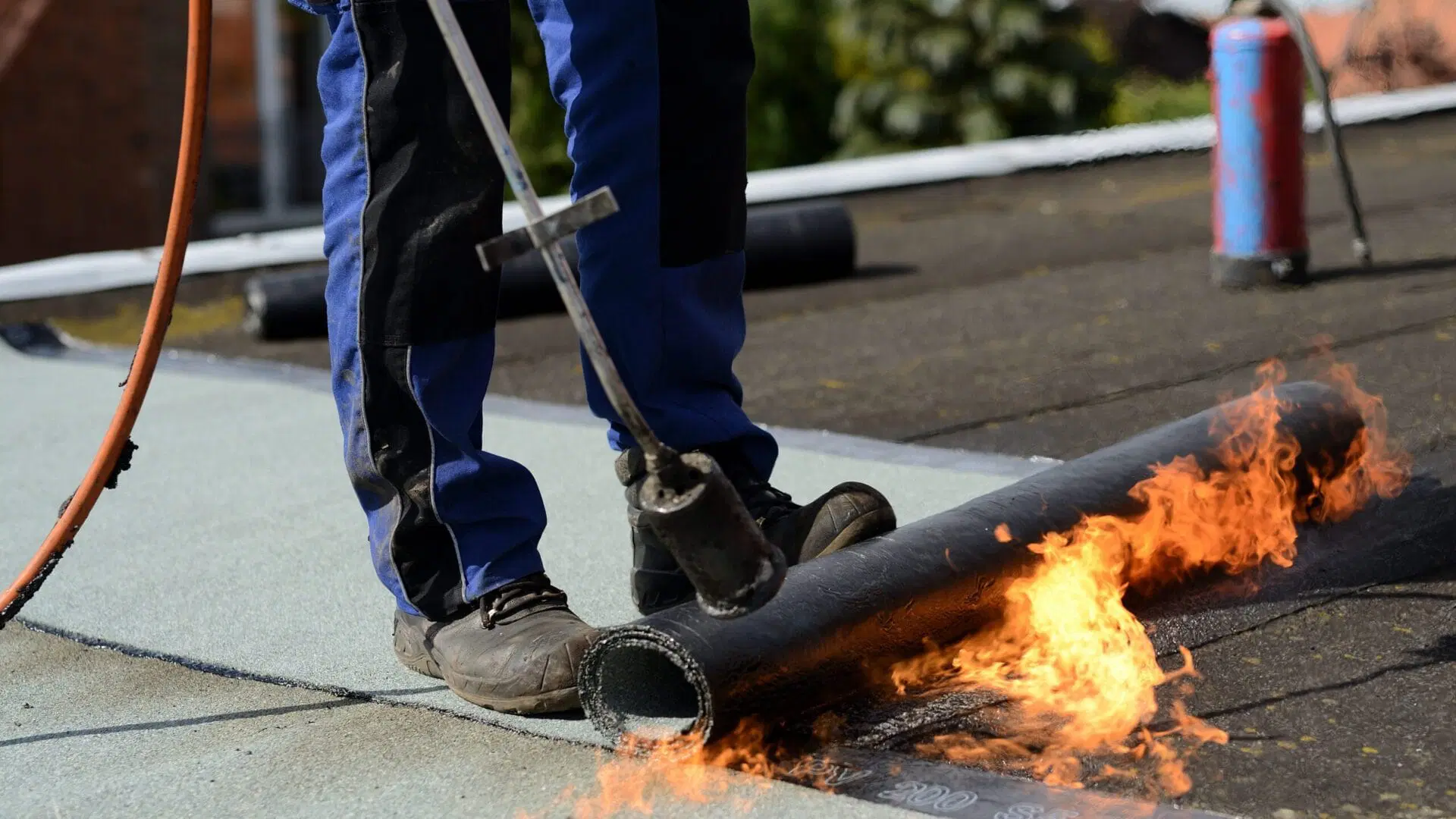
SBS (styrene-butadiene-styrene) modified bitumen is the dominant specification in the Charlotte market. SBS sheet is torch-applied, cold-applied with adhesive, or heat-welded in some configurations, and it performs well in Charlotte's thermal cycling range - the Piedmont's temperature swings between winter lows and summer highs are within the range SBS elastomers handle without cracking. APP (atactic polypropylene) modified bitumen is the alternative - stiffer and more UV-resistant, but less flexible in cold temperatures. In Charlotte's climate, where hard freezes are infrequent but real, SBS is the more conservative specification for buildings that will not receive annual maintenance.
Modified bitumen systems installed in Charlotte in the 1990s are now approaching a condition threshold where recover is no longer the cost-effective path. A single-ply TPO or EPDM recover over a dry existing modified bitumen base is viable if moisture cores are clean, but adding a third asphaltic layer over two existing layers raises issues with combined roof weight, drain height above the existing surface, and code compliance in jurisdictions that restrict the number of recover cycles. We assess existing modified bitumen systems against those criteria and recommend accordingly.
The first visit produces a practical roof record: current conditions, visible failure points, drainage notes, access concerns, and the repair or replacement path that fits the building.
Owners get a written scope that separates urgent water-control work from longer-term capital planning, so the roof decision is not made from guesswork.
The closeout package keeps the next decision clear with before photos, after photos, material notes, warranty coordination, and recommended maintenance timing.
For occupied buildings, staging, access, odor control, and tenant communication are part of the roof plan before crews arrive.
For portfolio owners, the goal is consistent documentation across properties, not a one-off opinion that cannot be compared later.
SBS Modified Bitumen Installation
Torch-applied SBS is the most common installation method on new modified bitumen work in Charlotte. The torch application melts the back surface of the sheet and bonds it to the substrate - base sheet, existing modified bitumen cap, or BUR surface. Torch application requires a hot-work permit from the City of Charlotte and most Charlotte commercial property insurers, and it requires a fire watch after the crew leaves the roof on torch-down installations. We manage the hot-work permit process and the fire watch as part of scope - neither is optional.
Cold-applied modified bitumen using two-part adhesive is the alternative for buildings where torch application creates fire risk - above occupied spaces, in buildings with active overhead mechanical systems, or where the insurer's policy prohibits open-flame roofing work. Cold-applied systems take longer to install than torch-applied and require careful attention to ambient temperature - adhesive application in Charlotte's winter ambient temperatures below 40F requires heated product storage and conditioned application equipment.
Modified bitumen cap sheets in Charlotte are specified with granulated surface in most cases - the granules protect the asphalt from UV degradation and provide some slip resistance for maintenance foot traffic. Smooth-surface cap sheets are available and occasionally specified for reflective coating applications, but smooth-surface modified bitumen exposed without a coating degrades faster under Charlotte's UV load than granulated cap.
Modified Bitumen Failure Modes on Charlotte's Existing Buildings
Alligatoring at the cap sheet surface is the most visible failure mode on aging modified bitumen systems in Charlotte. UV degradation causes the asphalt binder to oxidize and shrink over time, producing a cracked surface pattern that resembles alligator hide. Alligatored cap sheet has lost its waterproofing integrity at the surface - it is not immediately leaking, but it is within a few seasons of producing seam splits and field cracks that will. Charlotte's UV intensity accelerates this degradation cycle on south-facing roof planes and on buildings in open exposure.
Flashing failure at parapet walls is the second most common Charlotte modified bitumen failure mode. The parapet flashing - the sheet that runs up the vertical face of the parapet wall - is subject to more thermal movement than the field membrane. On Charlotte's unreinforced masonry parapets, that movement is amplified by the masonry wall's seasonal expansion and contraction. Flashing splits at the termination line are predictable on 20-plus-year-old modified bitumen systems in Charlotte if the flashing has not been re-bedded.
Standing water and drain blockage: Charlotte's summer thunderstorm events deliver concentrated rainfall in short durations. Modified bitumen systems that have settled over time, or that were installed without tapered insulation, can develop ponding areas that the drain cannot clear between events. Persistent ponding accelerates modified bitumen surface degradation at the pond edge and creates the hydrostatic pressure that drives seam failures. Any modified bitumen building we scope with a history of interior leaks gets a drain-flow test and a surface levelness survey as part of the assessment.
Can modified bitumen be coated to extend its life on a Charlotte building?
Yes, if the existing cap sheet is still structurally sound - not alligatored through to the base sheet, not cracked, and with moisture cores showing dry insulation. A silicone or acrylic coating applied to a cleaned and primed modified bitumen cap sheet can add 10-15 years of service life and restore reflectance. If the cap sheet is already beyond the threshold for coating adhesion, coating is a short-term fix that will fail within a few years as the underlying substrate continues to deteriorate. We assess the cap sheet condition and moisture status before recommending a coating or a full replacement.
How many recover cycles can a Charlotte modified bitumen building take?
Most Charlotte jurisdictions - City of Charlotte, Mecklenburg County - follow the IBC and NC Building Code limit of two roofing applications total, meaning one recover over the original roof. If your building is already at two layers, the next scope is tear-off and full replacement. We verify the existing layer count during the initial inspection by pulling a core at the drain sump, where the layer stack is cleanest to read.
Is modified bitumen still a viable specification for new Charlotte commercial construction?
Yes, in specific applications. Multi-ply modified bitumen on a BUR base is specified on complex institutional buildings where the redundancy of multiple plies is valued and where the single-ply warranties are not the primary driver. It is also specified on some historic adaptive-reuse buildings in Charlotte's South End and NoDa districts where the existing rooftop details were designed around asphaltic systems and the structural constraints make a single-ply system impractical. It is not, however, the standard specification on new Charlotte commercial construction - TPO holds that position.
Modified bitumen inspection or replacement scope for a Charlotte building?
We assess existing modified bitumen systems against recover, coating, and replacement thresholds - with moisture cores, drain-flow tests, and written documentation - for any Charlotte commercial building in Mecklenburg County and the surrounding metro. Call 704-710-8487.
Request a Written Scope