

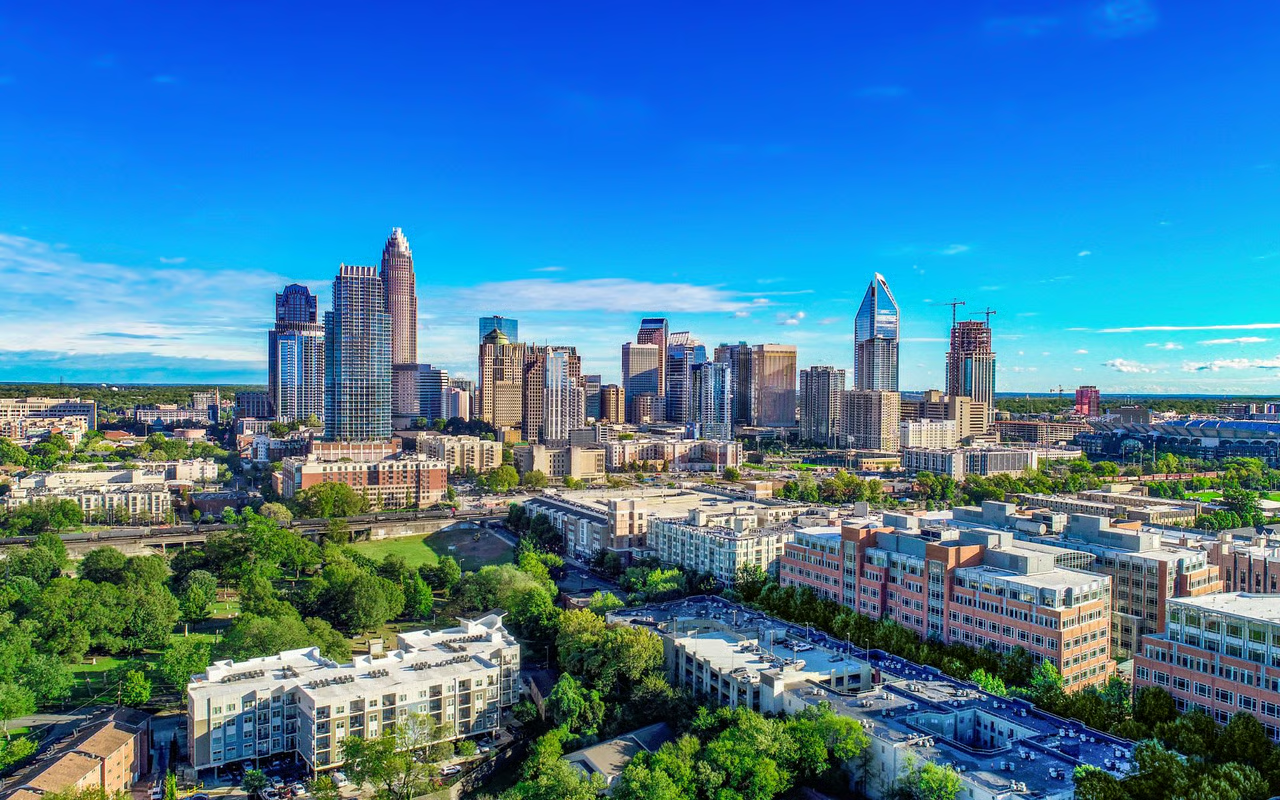
Commercial Roofers in Ballantyne, NC
Commercial roofing in Ballantyne, NC should begin with a documented assessment of membrane condition, seams, flashings, drainage, penetrations, and moisture before repair, coating, or replacement is selected. Commercial roofing contractors serving Ballantyne, NC with commercial roof repair, replacement, coatings, maintenance programs, inspections, and documented roof reports.
Commercial Roofers Charlotte
Commercial Roofing Contractors Ballantyne, NC
Commercial roofing contractors serving Ballantyne, NC with commercial roof repair, replacement, coatings, maintenance programs, inspections, and documented roof reports.
Roof work in Commercial Roofing Contractors Ballantyne, NC is planned around access, response timing, commercial building mix, and the condition of the existing roof system.
Commercial roofing in Ballantyne, NC should begin with a documented assessment of membrane condition, seams, flashings, drainage, penetrations, and moisture before repair, coating, or replacement is selected. Ballantyne's private corporate campuses - the south Charlotte cluster of financial services, insurance, and healthcare employer buildings - have large, mid-vintage TPO and EPDM roofs that are entering first major maintenance and early replacement cycles.
Ballantyne is not a municipality. It is a planned corporate development zone that straddles the southern boundary of Charlotte in Mecklenburg County, roughly bounded by Johnston Road to the west, Rea Road to the east, I-485 to the north, and the South Carolina state line to the south. The commercial roof inventory in this zone is dominated by two building generations: the 2000-2012 first-wave corporate campus buildings that established the Ballantyne brand - healthcare campus, LendingTree, MetLife, Synchrony Financial - and the 2015-2024 second wave of speculative office product and employer campuses that filled in the remaining greenfield sites.
The first-wave buildings are running 60-mil TPO or 60-mil EPDM installed between 2001 and 2012 with 15-year or 20-year manufacturer warranties. Those 15-year warranties are expired. The 20-year warranties are approaching expiration or are already past it. Many of these buildings have not had a documented manufacturer-aligned warranty maintenance visit in three or more years - which means the warranty may already be void, even if the expiration date has not technically passed. A warranty that requires documented annual maintenance and did not get it is not a 20-year warranty. It is a warranty that expired the first year the maintenance was skipped.
The second-wave buildings are 5-10 years into 20-year NDL warranty cycles. The work on these buildings is documented annual maintenance - drain inspections, seam probe tests, flashing condition photos, and warranty registration updates - not replacement. We run a structured annual maintenance program for buildings in this category.
Owners get a written scope that separates urgent water-control work from longer-term capital planning, so the roof decision is not made from guesswork.
The closeout package keeps the next decision clear with before photos, after photos, material notes, warranty coordination, and recommended maintenance timing.
For occupied buildings, staging, access, odor control, and tenant communication are part of the roof plan before crews arrive.
For portfolio owners, the goal is consistent documentation across properties, not a one-off opinion that cannot be compared later.
The first visit produces a practical roof record: current conditions, visible failure points, drainage notes, access concerns, and the repair or replacement path that fits the building.
Ballantyne Corporate Campus Roof Conditions by Corridor
Ballantyne Corporate Park (Johnston Road / Ballantyne Commons Parkway): The original corporate campus development. Buildings here range from 2001 to 2010 vintage, most on 15-year EPDM or early 60-mil TPO. Most of the EPDM on these buildings is past warranty. The TPO generation from 2005-2010 is at or past 15-year warranty expiration and is approaching the end of its serviceable life. Replacement cycles are active here now.
Ballantyne Crossing and the Rea Road corridor: Mixed office and medical office buildings from 2008-2018. A wider range of conditions - some buildings on first-generation TPO approaching end of life, some on newer TPO systems with active warranties. The medical office buildings in this corridor have infection-control scheduling requirements that affect how we plan any roof work above occupied clinical areas.
The newer speculative office product along Sam Neely Road and Ardrey Kell Road: 2016-2024 vintage, mostly 60-mil or 80-mil TPO on 20-year NDL warranties. These buildings are in the maintenance phase. Annual documented maintenance visits are the work here, not replacement.
Ballantyne Blakeney and the Johnston Road retail corridor: Strip centers, grocery-anchored retail, and freestanding commercial buildings that are structurally different from the campus office product. Shorter roof spans, more complex drain layouts, and tenant-operation scheduling constraints. We sequence retail roof work around store hours and delivery schedules, not around an office building's 9-to-5.
What We Do Differently on Ballantyne Corporate Buildings
Warranty audit before any scope: On every Ballantyne building we are asked to inspect for the first time, we ask for the original warranty document before we walk the roof. This tells us what the manufacturer requires for warranty maintenance - whether it is annual inspections by an approved contractor, specific drain maintenance intervals, or other documented care requirements. We then compare the warranty requirements against what the building's maintenance records show. The gap between what the warranty requires and what actually happened in the field is usually the most important information we produce for a building owner.
Coordination with corporate facility teams: The Ballantyne campus buildings are predominantly occupied by corporate tenants with professional facility management teams. These teams have their own roof maintenance contractors, their own inspection schedules, and in some cases their own manufacturer warranty relationships. We work within existing structures rather than displacing them - our role is often to provide the documented condition assessment that the facility team's own contractor does not produce.
Avoiding campus-wide replacement surprises: A building owner with five corporate campus buildings in Ballantyne that all went up in 2005 should not be discovering that all five are in replacement cycle at the same time - but that is what happens when condition assessments are deferred. We provide capital planning assessments that forecast replacement timing across a portfolio of buildings, so ownership can sequence capital expenditure rather than react to simultaneous failure.
Climate Conditions Affecting Ballantyne Roofs
Ballantyne sits at approximately 700-750 feet elevation on the southern Mecklenburg plateau, slightly higher than Uptown Charlotte. This elevation difference is small but it affects thermal cycling - Ballantyne can see more temperature differential between daytime highs and nighttime lows than the lower-elevation buildings in the Catawba River valley. That cycling accelerates seam fatigue on mechanically attached TPO systems over time.
The I-485 corridor that bounds Ballantyne to the north creates open exposure conditions for the buildings just south of the interchange. Wind-uplift requirements for those buildings are in the higher exposure category - closer to ASCE Exposure C than to the Exposure B that applies to the denser campus interiors. If a building in this zone was specified to the interior campus fastener pattern rather than to the correct open-exposure density, it is carrying an installation deficiency that may not show up until the next significant wind event.
Ballantyne's detention ponds and the Rea Road creek system mean that the area's site drainage is generally better designed than older Charlotte commercial zones. But that does not translate to roof drainage - the commercial buildings here have internal roof drains, not surface drainage, and the sizing of those drains to current ASCE 7-22 rainfall intensity standards is a separate question from the site drainage design.
How do you handle roof work on occupied Ballantyne corporate campuses?
With a pre-construction meeting that involves the corporate facility team, the building management team, and any relevant tenant facility contacts. We produce a written sequencing plan that identifies crane and material staging areas, tenant notification requirements, parking impact, and daily production start and end times. Most Ballantyne corporate tenants need written notification 72 hours before any work begins - we provide that as a standard deliverable.
My Ballantyne building has a 20-year manufacturer warranty that expires in two years. What do I need to do?
First, pull the warranty document and confirm what maintenance was required to keep it active. If documented annual maintenance was required and did not happen, the warranty may already be void regardless of the expiration date. Second, schedule a condition assessment now - not in two years - so that any end-of-warranty repair claims can be documented and submitted before expiration. Most manufacturers will respond to a documented repair claim submitted before expiration. Claims submitted after expiration are typically declined regardless of when the damage occurred.
Do you handle multiple buildings across a Ballantyne corporate campus?
Yes. We manage multi-building portfolios across single ownership groups and provide a consolidated condition report that forecasts replacement timing and maintenance needs for each building in the portfolio. We schedule inspections across all buildings in a single mobilization when geography allows - which reduces per-building inspection cost and produces a comparable data set across the portfolio.
Request a Written Scope