

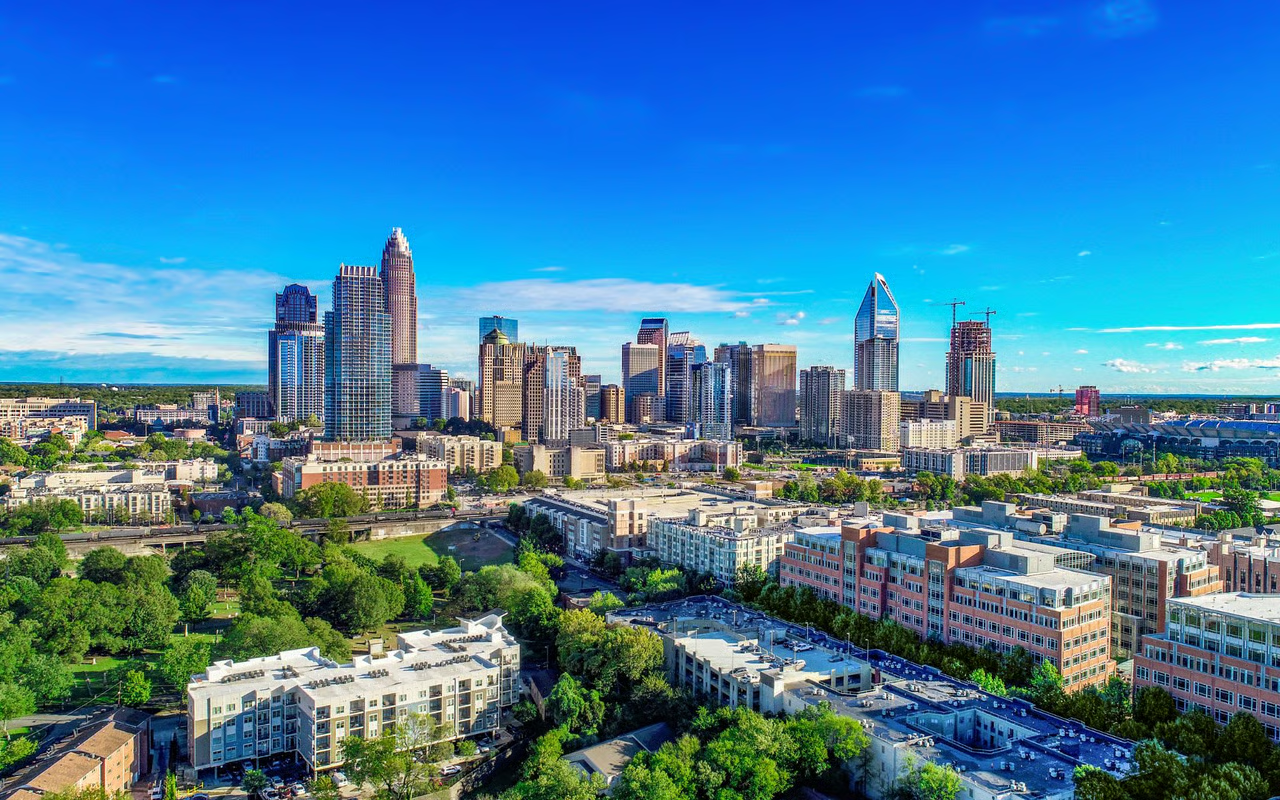
Commercial Roofers in Charlotte
Commercial roofing in Charlotte should begin with a documented assessment of membrane condition, seams, flashings, drainage, penetrations, and moisture before repair, coating, or replacement is selected. Commercial roofing contractors serving Charlotte, NC with commercial roof repair, replacement, coatings, maintenance programs, inspections, and documented roof reports.
Commercial Roofers Charlotte
Commercial Roofing Contractors
Commercial roofing contractors serving Charlotte, NC with commercial roof repair, replacement, coatings, maintenance programs, inspections, and documented roof reports.
Roof work in Commercial Roofing Contractors is planned around access, response timing, commercial building mix, and the condition of the existing roof system.
Commercial roofing in Charlotte, NC should begin with a documented assessment of membrane condition, seams, flashings, drainage, penetrations, and moisture before repair, coating, or replacement is selected. Our office is at Uptown Charlotte in Uptown Charlotte, one block from the Uptown office towers. Our crews mobilize across Mecklenburg County for emergency response, planned replacement, and the documented maintenance that keeps manufacturer warranties intact.
Charlotte's commercial roof inventory was assembled in four distinct waves, each with its own material profile. The 1970s Uptown office construction - the buildings that predated the BofA and financial district towers - ran built-up roofing (BUR) on poured concrete and steel deck. Many of those roofs were recovered with modified bitumen in the late 1980s and early 1990s and are now approaching second reroof cycles. The 1990s suburban office and light-industrial buildout across South End, Arrowood, and the early Ballantyne corridor ran first-generation TPO and EPDM at 45-mil - thinner and shorter-warranted than current specifications - and that generation of roofs is now in active replacement cycles. The 2000s buildout across University Research Park, the Steele Creek warehouse corridor, and the Westinghouse Boulevard logistics zone ran 60-mil TPO and EPDM with 15-year or 20-year warranties, and that generation is approaching first major maintenance milestones.
The 2010s and current construction wave - the South End mixed-use towers, the NoDa adaptive reuse buildings, the Ballantyne corporate expansions, and the wave of distribution centers lining I-485 and the South Carolina corridors - runs modern 60-mil and 80-mil TPO with 20-year NDL warranties. These buildings are in the first five years of their warranty cycle and the work is documented annual maintenance, not replacement.
For portfolio owners, the goal is consistent documentation across properties, not a one-off opinion that cannot be compared later.
The first visit produces a practical roof record: current conditions, visible failure points, drainage notes, access concerns, and the repair or replacement path that fits the building.
Owners get a written scope that separates urgent water-control work from longer-term capital planning, so the roof decision is not made from guesswork.
The closeout package keeps the next decision clear with before photos, after photos, material notes, warranty coordination, and recommended maintenance timing.
For occupied buildings, staging, access, odor control, and tenant communication are part of the roof plan before crews arrive.
Where We Run Charlotte Routes
Uptown Charlotte: The Uptown office towers, the financial district Capitol, the utility corridor Center, and the surrounding Class A and B office stock. Most of the Uptown buildings above ten stories run membrane roofing on sections of their flat roof area - the rest is occupied terrace or mechanical penthouse. Work in Uptown requires crane permits from the City
South End and NoDa: The adaptive-reuse former industrial buildings converted to office and creative use in the 2010s have the most complex existing roof conditions in Charlotte. Many were built on unreinforced masonry with parapet walls that predate current code. Roof drains were sized for 1960s-era rainfall assumptions. TPO and modified bitumen recovers were done in the 1990s and early 2000s without proper moisture surveys. We do a thorough moisture core survey before specifying any scope in these buildings - the existing conditions routinely surprise owners.
Ballantyne Corporate Cluster: The private corporate campuses south of I-485 - the large financial services, healthcare, and insurance employer campuses - have large, relatively young TPO roofs (mostly 2005-2020 vintage) that are approaching first major maintenance milestones. Our work here is predominantly documented annual maintenance, warranty coordination, and drain maintenance - not replacement.
University Research Park and UNC Charlotte Corridor: The North Tryon corridor from UNC Charlotte south to University Research Park includes a mix of university-affiliated research buildings, medical office, and light industrial. Work in this corridor often involves coordination with university facilities teams who have their own maintenance schedules and contractor approval processes.
Charlotte Climate and Building Conditions
Carolina Piedmont thunderstorm season runs May through September, with peak frequency in July and August. Afternoon cells can build from clear sky to lightning in under 45 minutes. Our crews monitor Weather.gov mesoscale discussions starting at 6 AM on every production day - we do not wait for a National Weather Service watch to pull the crew. Any mesoscale convective discussion that puts Charlotte in an afternoon storm risk window gets a modified production plan before the first tear-off begins.
Hurricane Hugo in 1989 remains the benchmark event in Charlotte commercial roof history. Hugo made landfall near Charleston as a Category 4 and tracked directly over Charlotte still at tropical storm force - unprecedented for an inland Piedmont city. The commercial roof stock it damaged was almost entirely low-slope BUR and early modified bitumen, most of which was already near end of life. The wave of insurance-funded replacements that followed Hugo built most of the 60-mil EPDM and early TPO inventory that is now approaching its own end-of-life cycle.
Tornado risk: Charlotte sits in the Southeast's secondary tornado corridor. Spring outbreaks - the 2011 and 2016 events that put tornadoes on the ground in Cabarrus and Iredell Counties - can put EF1 and EF2 tornadoes through commercial buildings. We document wind damage separately from pre-existing condition on every post-storm inspection because the insurance-grade documentation is different when the damage is event-related vs. deferred maintenance.
Is a North Carolina roofing contractor license required?
Yes. North Carolina requires a General Contractor license for commercial roofing work above $30,000 in contract value. We carry a current NC General Contractor license, general liability, workers' compensation, and umbrella coverage. Certificates of insurance and license documentation are provided before any contract is signed.
Do you pull permits for Charlotte commercial roof work?
Yes, for all replacement projects and for repair work above the City of Charlotte's permit threshold. We handle permitting as part of scope - not as an add-on charge - and we coordinate with the relevant jurisdiction whether that is the City of Charlotte, Mecklenburg County, or one of the surrounding towns in the metro.
Need a Charlotte commercial roof inspection?
Our project managers will walk the roof, document the condition, and produce a written report - for capital planning, warranty support, or insurance documentation - for any commercial building in Charlotte or the surrounding Mecklenburg County metro.
Request a Written Scope