

Wind Damage Roof Repair
Charlotte's exposure to Piedmont straight-line thunderstorm winds, occasional high-wind events from weakened Atlantic systems, and the spring tornado corridor makes wind-uplift damage a recurring issue on commercial flat
Commercial Roofers Charlotte
Charlotte's exposure to Piedmont straight-line thunderstorm winds, occasional high-wind events from weakened Atlantic systems, and the spring tornado corridor makes wind-uplift damage a recurring issue on commercial flat roofs across Mecklenburg County.
Straight-line thunderstorm winds in Charlotte's Piedmont climate produce localized gusts in the 50 to 70 mph range on a routine basis during summer convective season - May through September. At those speeds, a mechanically attached TPO or EPDM membrane that is installed to the minimum fastener density for the building's field zone, not to the edge-zone and corner-zone densities that ASCE 7-22 requires, will fail at the perimeter first. The membrane peels back from the edge, water enters the insulation before the storm is over, and the building owner is looking at a water intrusion problem - not just a membrane problem - when the rain stops.
The Charlotte market also sees episodic high-wind events from weakened Atlantic systems tracking inland. Hurricane Hugo's 87-mph gusts in 1989 are the historic benchmark, but post-tropical systems routinely produce 40 to 60 mph gusts across Mecklenburg County as they dissipate over the Piedmont. These events expose installation deficiencies that summer thunderstorm winds were not strong enough to reveal. A building that survived 15 years of thunderstorm season with an under-fastened edge zone may lose that edge flashing in the first 60-mph post-tropical event that tracks over it.
My wind damage inspection protocol distinguishes two separate questions: what failed in this event, and why did it fail. The first question produces the repair scope. The second question produces the documentation that determines whether the failure was event-caused, installation-related, or maintenance-deferred - and that distinction matters when the building owner is working through an insurance claim or a warranty dispute with the membrane manufacturer.
Buildings where the installed fastener pattern does not match the design requirement are not just damaged - they are underbuilt. Repairing the damage without correcting the fastener deficiency means the next significant wind event produces the same failure. My repair scope on these buildings includes a written fastener pattern correction that brings the installation to current ASCE 7-22 standard, with a stamped engineering drawing on projects above 20,000 square feet. I document the original installed pattern and the corrected pattern separately so that the building owner, the membrane manufacturer, and the carrier's adjuster each have a clear record of what changed and why.
The first visit produces a practical roof record: current conditions, visible failure points, drainage notes, access concerns, and the repair or replacement path that fits the building.
Owners get a written scope that separates urgent water-control work from longer-term capital planning, so the roof decision is not made from guesswork.
The closeout package keeps the next decision clear with before photos, after photos, material notes, warranty coordination, and recommended maintenance timing.
For occupied buildings, staging, access, odor control, and tenant communication are part of the roof plan before crews arrive.
For portfolio owners, the goal is consistent documentation across properties, not a one-off opinion that cannot be compared later.
Wind Damage Patterns on Charlotte Commercial Flat Roofs
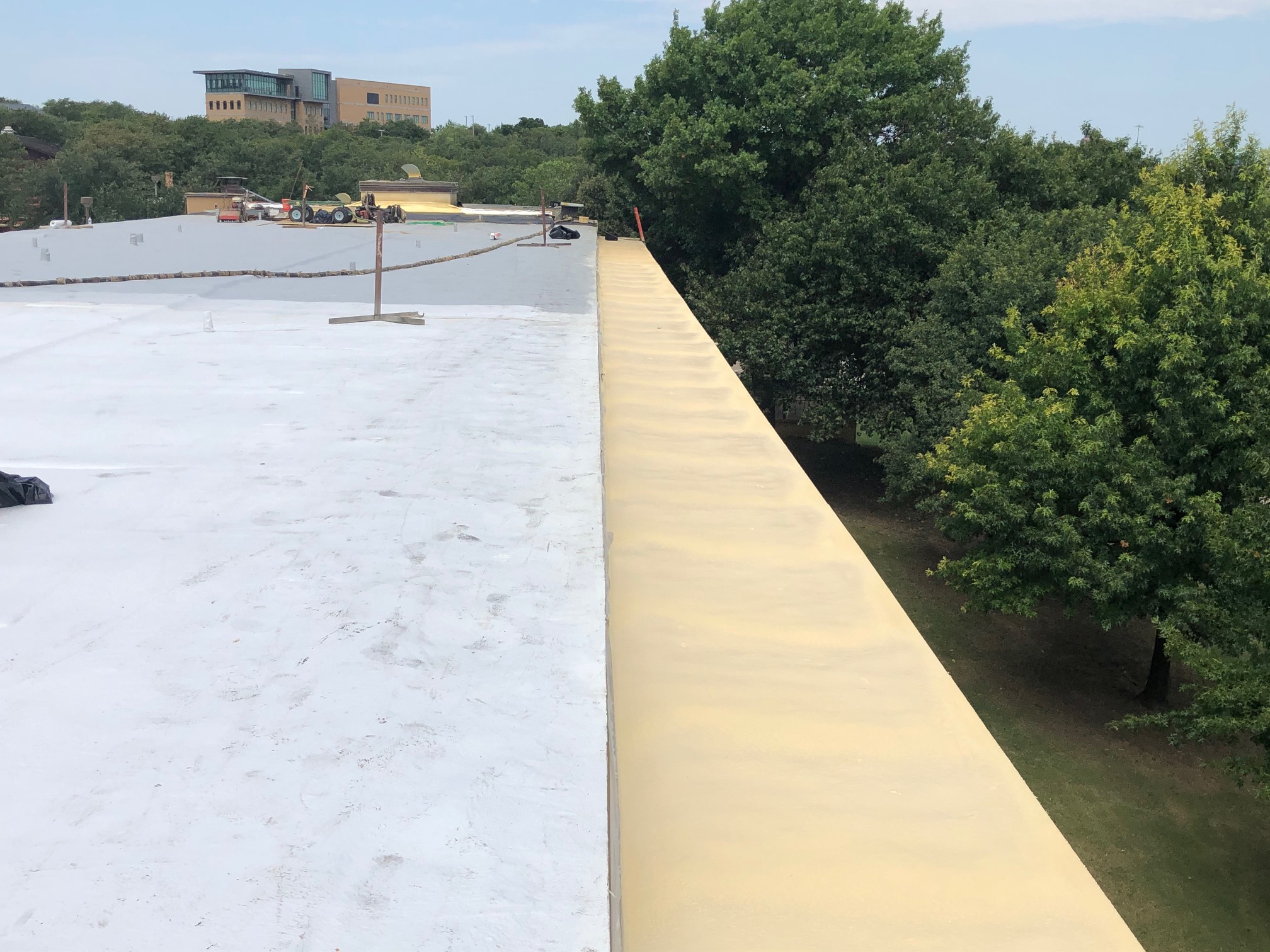
Perimeter edge metal and termination bar failure: The corner zones and edge zones of a mechanically attached single-ply membrane carry roughly twice the wind-uplift load that the field zone carries under ASCE 7-22 design. Buildings that were installed with uniform fastener density across all zones - a common shortcut that reduces material cost at installation - are underbuilt at the perimeter. In a significant wind event, the membrane peels back from the edge inward. This produces a characteristic damage pattern: the field zone is intact, the edge zone is peeled or fully detached, and the insulation is exposed along a band that follows the roof perimeter.
Parapet flashing uplift: Charlotte's older commercial buildings in the Uptown, NoDa, and Independence Boulevard corridors have unreinforced masonry parapet walls. Coping cap flashings on these parapets are often clinched to the wall with termination bar and caulk rather than counterflashed into the masonry. In winds above 55 mph, the coping cap generates uplift as a sail - the wind catches the leading edge of the cap, lever-arms the rear cleat off the parapet, and the cap flashing lifts away from the wall. Water then enters the parapet core and migrates down the wall into the roof assembly.
Rooftop equipment curb flashing displacement: Charlotte's commercial buildings - particularly the office corridor buildings in Ballantyne, University Research Park, and the SouthPark corporate zone - have high mechanical densities on the roof. HVAC curb flashings on equipment installed after the original roof system are vulnerable to wind-induced displacement when the flashing transition detail between the equipment manufacturer's curb and the membrane system does not follow the primary membrane manufacturer's specifications. Equipment flashing failure in a wind event typically produces water intrusion that is initially attributed to the equipment itself rather than the roof system - this diagnostic confusion delays the correct repair.
Distinguishing Wind Damage from Installation Deficiency
Insurance carriers distinguish between damage caused by a covered wind event and damage caused by poor installation. A membrane that peeled at the perimeter in a 55-mph storm because the fastener pattern was half what ASCE 7-22 required is a mixed claim - the storm may have been the trigger, but the installation deficiency is the cause. Carriers can and do deny the portion of the claim attributed to installation deficiency rather than event severity.
My inspection report addresses this distinction directly. I document the installed fastener pattern by physically probing the membrane in representative locations - probe test every 24 inches across the field zone, every 12 inches in the edge zone, every 8 inches in the corner zone - to establish what was there before the storm separated the membrane from the deck. I photograph the exposed deck surface after peeling for pull-out evidence of original fastener locations. I record the wind speed reported at the nearest NWS station for the event date and time. With those three data sets, I can write a scope that any adjuster can follow from event, to condition, to cause.
My Charlotte building had membrane peeling at the edges after a storm. Is this covered by insurance?
Perimeter and edge zone membrane failure after a wind event is covered if the failure is attributable to the wind event rather than to an installation deficiency or pre-existing condition. The documentation that establishes this is a post-event inspection report that records the installed fastener pattern, the reported wind speed, and the failure pattern - and distinguishes event-caused failure from pre-existing edge flashing deterioration. I produce that documentation as part of every wind damage inspection.
How long does a wind damage inspection take on a Charlotte commercial building?
For a building up to 50,000 square feet: two to four hours on-site for the roof walk, documentation, and probe testing, plus one to two business days for the written report. Larger buildings or buildings with complex mechanical densities take longer on-site. I give a time estimate before scheduling.
Can you repair wind-damaged Charlotte roofs without replacing the entire membrane?
Yes, if the damage is confined to the perimeter or specific zones and the field membrane is sound and dry. A zone repair - replacing the perimeter section, correcting the fastener pattern in the edge and corner zones, and reinstalling edge metal - is a legitimate repair scope on many post-wind-event Charlotte commercial buildings. Full replacement is the right scope when the field membrane is at end of life, the insulation under the peeled zones is saturated, or the damage pattern reveals a systemic installation deficiency across the entire roof.
Wind damage inspection for your Charlotte commercial roof?
My crews conduct post-event roof walks, document wind damage against ASCE 7-22 fastener pattern requirements, and produce a written scope that works for insurance adjusters and capital planning - for any commercial building in the Charlotte metro.
Request a Written Scope