

Commercial Roof Inspections
Documented commercial roof inspections for Charlotte buildings - condition reports for capital planning, warranty support, insurance claims, and lender due diligence across Mecklenburg County.
Commercial Roofers Charlotte
Commercial Roof Inspections gives owners a clearer way to compare roof conditions, budget timing, warranty requirements, and repair priorities.
A roof inspection that produces a verbal summary and a handshake is not a roof inspection - it is a sales visit. I have been on both sides of that dynamic in the Charlotte market and the building owner always loses. The verbal summary does not survive a personnel change at the property management company, does not satisfy a lender's inspector, does not support an insurance claim, and does not give the capital planning team the data it needs to sequence a roof replacement into the five-year budget.
Charlotte's commercial roof inventory spans extensive construction and four major membrane technology generations. The oldest inventory - built-up roofing on Uptown office buildings from the 1970s, recovered with modified bitumen in the late 1980s and early 1990s - is now entering third-cycle replacement or facing complete system overhaul. The 1990s-generation TPO and EPDM on the first wave of South End, Arrowood, and early Ballantyne suburban commercial is in active end-of-life replacement. The 2000s warehouse and distribution inventory along Steele Creek Road and the I-485 corridor is in first major maintenance. A single inspection protocol does not serve all of these building generations equally. We calibrate inspection scope to the building's age, material profile, and the purpose the report will serve.
Owners get a written scope that separates urgent water-control work from longer-term capital planning, so the roof decision is not made from guesswork.
The closeout package keeps the next decision clear with before photos, after photos, material notes, warranty coordination, and recommended maintenance timing.
For occupied buildings, staging, access, odor control, and tenant communication are part of the roof plan before crews arrive.
For portfolio owners, the goal is consistent documentation across properties, not a one-off opinion that cannot be compared later.
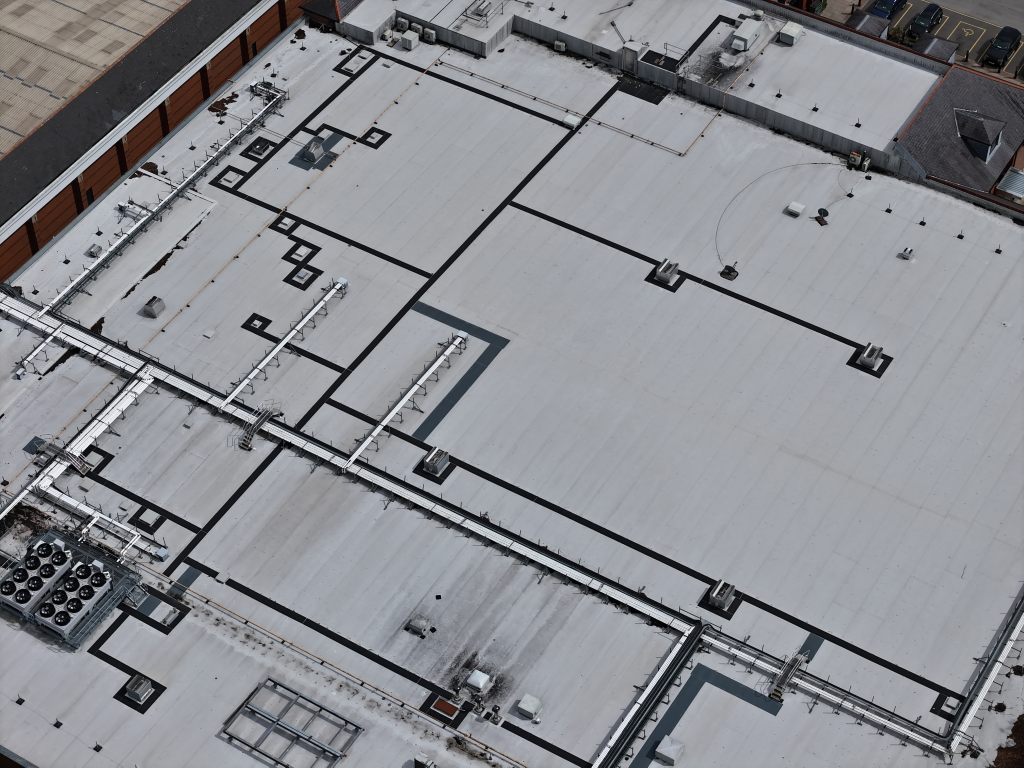
The first visit produces a practical roof record: current conditions, visible failure points, drainage notes, access concerns, and the repair or replacement path that fits the building.
What a Commercial Roof Inspection Covers
Field membrane: We document surface condition across each zone - UV chalking, alligatoring, granule loss, blistering, open laps, and mechanical damage. Charlotte's summer UV load and thermal cycling accelerates surface degradation on membranes approaching end of life. We record what we see zone by zone, not in aggregate, because the roof field is rarely uniform. A Steele Creek warehouse with 400,000 square feet of TPO often has three or four distinct condition zones depending on installation phase, drain loading, and rooftop equipment concentration.
Flashing and terminations: Parapet cap flashings, penetration boots, curb flashings, and termination bar conditions are inspected at every location. Charlotte's older commercial districts - South End, NoDa, and the Uptown office towers north of Trade Street - have masonry parapet walls that move seasonally. Those walls defeat standard termination bar detail over time. We photograph every flashing failure individually and map it to the zone diagram.
Drains and drainage: Drain cover condition, ponding radius, and measured sump depth at every drain. We run a flow test on any drain where debris accumulation or sump depth raises a concern. After the 2024 Helene remnant rainfall exposed how many Charlotte commercial drains were undersized for actual Piedmont rainfall intensity, we now flag every drain that does not
Penetrations and equipment: Every rooftop HVAC curb, exhaust fan, pipe penetration, and conduit sleeve. The Ballantyne corporate campus buildings and University Research Park office buildings have high rooftop mechanical density. We document the condition of every curb flashing and the clearance between the rooftop mechanical equipment and the membrane - because a mechanical contractor's service visit is the most common cause of puncture damage on maintained commercial roofs.
Inspection Types We Provide
Capital planning inspection: Full roof walk with zone-by-zone condition documentation, moisture cores at suspect areas, drain flow tests, and a written report that ranks zones by remaining service life. The output feeds the five-year capital budget - the report tells the owner what needs attention now, what can be maintained for two to three years, and what is in replacement cycle in the next planning horizon. We provide these for single buildings and for multi-building portfolios.
Post-storm inspection: Documented condition assessment after a named storm, tornado event, or significant hail event - formatted for insurance claim submission. Charlotte's secondary hail corridor and the annual tropical remnant rainfall risk from weakened Atlantic systems mean post-storm inspection is a recurring need across the metro. We document event-related damage separately from pre-existing condition in every post-storm report, because the insurance carrier will challenge any commingled documentation.
Warranty inspection: Formal inspection against the manufacturer's documented maintenance requirements. Required by most commercial roofing warranties to keep the warranty active. We provide the photo documentation and written log that the manufacturer's warranty department requires - not a general condition report that falls short of what the warranty administrator actually needs to see.
What Differentiates a Documented Charlotte Inspection
Photo count and organization: We do not provide a 15-photograph summary for a 50,000-square-foot roof. A thorough inspection of that building produces 60 to 100 condition photographs, organized by zone and labeled with the condition being documented. The photo log is the inspection's primary record - the written narrative summarizes and interprets it.
Moisture core documentation: When we pull cores, we photograph the core pull location before and after, record the reading instrument, and note the depth at which moisture was encountered. We do not provide a moisture reading number without the supporting photograph of the core and the location in which it was pulled. The interpretation of moisture data without that documentation is not defensible in a capital planning context or an insurance dispute.
How long does a commercial roof inspection take for a Charlotte building?
For a typical single-story commercial building up to 50,000 square feet with no major moisture investigation, the roof walk takes two to three hours and the written report is delivered within five business days. Larger buildings - 100,000 square feet and above, which is common in the Steele Creek and I-485 distribution corridor - take a half day on the roof and a week to ten days for the full written report with zone diagram and photo log. Moisture core investigations add time proportional to the number of cores pulled and the lab turnaround if samples are sent for thermal analysis.
Do you provide inspection reports for buildings you did not install?
Yes. Most of our inspection work is on buildings whose roofs were installed by other contractors. We do not require an existing relationship with the building to produce an objective written condition report. The report tells you what the roof is doing and what it needs - manufacturer, installing contractor, and prior service history are documented where they are available, but the condition report stands on its own observations.
Can your inspection report be used for insurance claims?
Yes, when the inspection is scoped for that purpose. Post-storm insurance documentation requires that we separate event-related damage from pre-existing condition - that distinction is the one the carrier's adjuster will focus on. We document both, separately, with photographs and written condition notes. If a claim is already in progress, we recommend scheduling the inspection before any emergency repairs are made, so we can document the event damage in its original state.
Need a written roof inspection report for your Charlotte building?
Our project managers walk the roof, document every zone, and deliver a written report usable for capital planning, insurance, lender due diligence, or warranty support - for any commercial building in Mecklenburg County or the surrounding metro.
Request a Written Scope