

Commercial Roof Moisture Surveys
Core-sample and electronic moisture surveys for Charlotte commercial flat roofs - locating wet insulation before recover or replacement to define scope accurately and avoid insulating over saturated systems.
Commercial Roofers Charlotte
Commercial Roof Moisture Surveys gives owners a clearer way to compare roof conditions, budget timing, warranty requirements, and repair priorities.
Wet insulation hidden under a dry-looking membrane surface is the most common cause of scope surprises on Charlotte commercial roof projects. We locate saturated insulation before we specify a recover or replacement - so the scope reflects what is actually there.
The most expensive mistake on a commercial roof recover project is recovering over wet insulation. Wet insulation compressed under a new membrane traps moisture against the underside of the new system, accelerates insulation R-value loss, promotes biological growth in the insulation layer, and voids the new membrane warranty from the day the project closes out. The building owner pays for a new roof and gets a system that begins degrading immediately - and the warranty that was supposed to protect that investment is worthless.
A moisture survey before the recover decision closes is not optional work - it is the only honest basis for a recover scope. Charlotte's commercial roof inventory has a particular moisture survey challenge: the adaptive reuse buildings in South End and NoDa, the 1990s-generation suburban commercial in Arrowood and Westinghouse, and the first-wave Ballantyne campus buildings were all recovered at some point in the 1990s or early 2000s, in many cases without adequate moisture documentation. Those buildings now carry at least one recover layer over the original system - and the moisture condition of that buried insulation layer is not visible from the roof surface. A membrane that looks serviceable from the outside may be sitting over a saturated insulation core that has been wet for a decade.
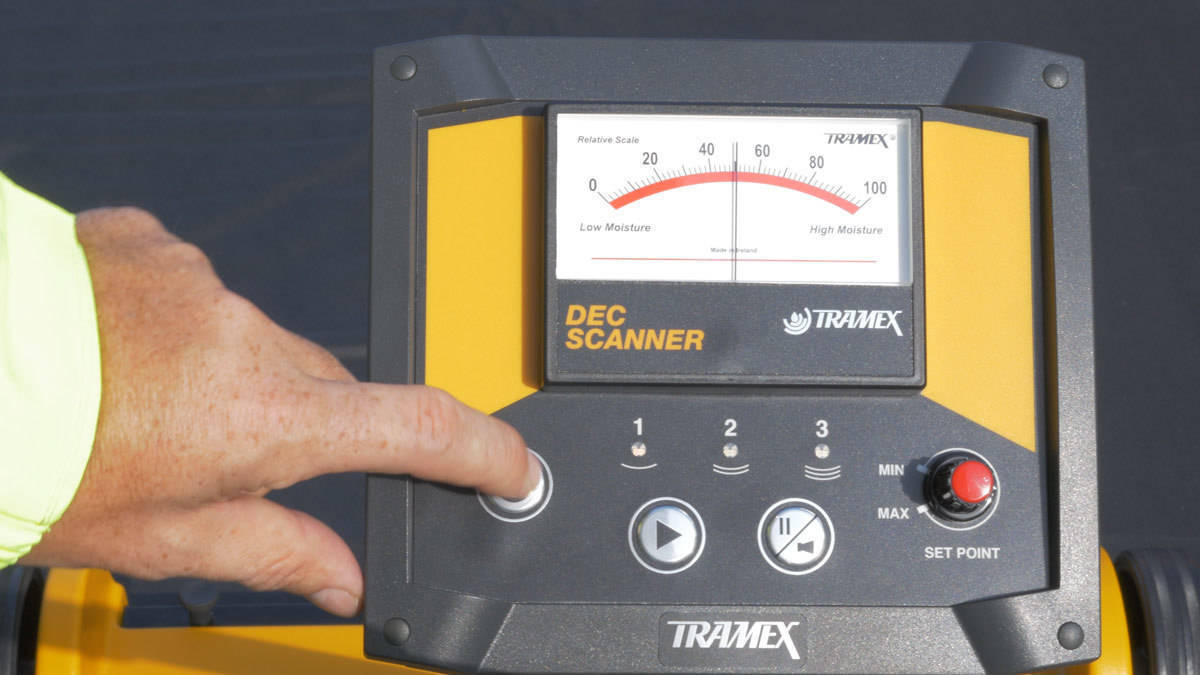
We run two types of moisture surveys depending on the building, the scope decision at hand, and the accuracy requirement. Core sampling pulls physical sections of the roof assembly and provides a definitive moisture reading at each pull location. Electronic moisture survey - nuclear backscatter, electrical capacitance, or infrared scan - covers more area more quickly and is the right tool for large-footprint buildings where core sampling every 1,000 square feet is not feasible. We use both methods and combine them when the building configuration calls for it.
The first visit produces a practical roof record: current conditions, visible failure points, drainage notes, access concerns, and the repair or replacement path that fits the building.
Owners get a written scope that separates urgent water-control work from longer-term capital planning, so the roof decision is not made from guesswork.
The closeout package keeps the next decision clear with before photos, after photos, material notes, warranty coordination, and recommended maintenance timing.
For occupied buildings, staging, access, odor control, and tenant communication are part of the roof plan before crews arrive.
For portfolio owners, the goal is consistent documentation across properties, not a one-off opinion that cannot be compared later.
Core Sampling: The Definitive Moisture Assessment
Core sampling is destructive - each pull location leaves a hole in the roof that is patched immediately. We photograph each core pull location before and after the patch, record the reading instrument and the measurement, and note the depth at which moisture was encountered in the insulation stack. The core itself is photographed and the photograph is included in the moisture survey report with the location the project team from the zone diagram.
For the Steele Creek distribution corridor buildings - large-footprint TPO systems from the 2005-2015 installation period that are approaching first major recover decisions - we run core grids at 10,000-square-foot spacing across the field, with closer spacing at any area showing surface ponding, membrane discoloration, or prior repair patches. The pattern concentrates sampling where the statistical likelihood of wet insulation is highest based on the surface observation.
Electronic Moisture Survey Methods for Large Charlotte Buildings
Nuclear backscatter: A nuclear densitometer measures the hydrogen content of the roof assembly - water increases hydrogen content, so elevated readings indicate moisture presence. Nuclear backscatter is the fastest method for large-area coverage and gives a continuous map across the roof field rather than point readings. The method requires a Nuclear Regulatory Commission-licensed operator and generates readings that are interpreted against baseline measurements on a confirmed-dry the project team area of the same building.
Electrical capacitance survey: A capacitance sensor measures the dielectric properties of the roof assembly - wet insulation has a different electrical signature than dry insulation. Capacitance survey is slower than nuclear backscatter but requires no licensing and generates a high-resolution map. It is the method we use most often on the mid-size Charlotte commercial buildings - 20,000 to 100,000 square feet - where the area is too large to core-sample thoroughly but not large enough to justify nuclear backscatter mobilization.
Infrared scan: A thermal imaging camera detects temperature differential in the roof assembly - wet insulation retains solar heat after sunset and shows as warm areas against a cooler dry field when scanned from a drone or from ground level at dusk. Infrared scan is the least precise of the three methods and is most useful as a screening tool to direct core sampling rather than as a standalone moisture determination. We use infrared scan in combination with core sampling on the South End and NoDa adaptive reuse buildings where the complexity of the existing assembly makes the other electronic methods more difficult to interpret.
Charlotte-Specific Moisture Survey Conditions
Helene remnant moisture impact: The 2024 Helene event deposited multi-inch rainfall across Mecklenburg County over a compressed period. Many Charlotte commercial buildings that were near end-of-warranty or operating with minor flashing deficiencies absorbed moisture at a rate that exceeded what normal weathering would have produced over several years. We have run moisture surveys on a range of Charlotte commercial buildings since the Helene event and documented elevated moisture levels in insulation that showed no surface indication of water infiltration. The buildings that look fine from the surface are not always fine.
Humidity and ambient moisture in the Charlotte survey environment: Charlotte's ambient humidity affects the calibration of electronic moisture survey equipment. Nuclear backscatter and capacitance readings need to be calibrated against a verified-dry the project team area on the same day and the same building - not against a standard table - because the ambient humidity at 85% on a July Charlotte day is different from the ambient humidity at the manufacturer's calibration test conditions. We recalibrate on every building before recording survey data.
Multi-layer recover stacks: Many Charlotte commercial buildings from the 1980s and 1990s carry more than one recover layer - modified bitumen over BUR, or first-generation TPO over modified bitumen - because a second recover was applied when the first ran out of serviceable life rather than replacing the full system. Moisture surveys on these buildings need to identify not just whether moisture is present but in which layer - because the repair scope for wet first-layer insulation is different from wet second-layer insulation, and the warranty path for a third recover depends on the condition of everything below.
How many core pulls does a Charlotte commercial roof moisture survey require?
For the recover-vs.-replace decision on a 50,000-square-foot building, we typically pull 10 to 15 cores in a grid pattern, with additional cores at any area showing surface indication of moisture - ponding radius, prior repair patches, membrane discoloration, or surface deflection. For a building where the recover decision is already made and the survey is documenting the extent of wet-area removal, we pull a denser grid - one core per 2,500 to 3,000 square feet in the suspect zones. The right number of cores is the number that produces a defensible moisture map for the scope decision at hand.
Can a moisture survey tell me whether my Charlotte building's leak is from the roof or from another source?
A moisture survey locates wet insulation - it tells you where moisture has accumulated in the roof assembly. It does not by itself determine whether the water entered through the roof membrane, through a parapet or wall flashing, through a window system, or from a rooftop mechanical unit. We combine moisture survey data with a flashing and penetration inspection to trace the likely entry path. In Charlotte's older urban commercial buildings - Uptown, South End, NoDa - moisture from facade and window system failures is sometimes misattributed to the roof. We do not assume the roof is the source until the survey and inspection support that conclusion.
How soon can you run a moisture survey after heavy rainfall?
We allow 48 to 72 hours after significant rainfall before running an electronic moisture survey - the surface pooling from recent precipitation affects both capacitance and nuclear readings. Core sampling can be run sooner because the core itself is a direct physical sample rather than an indirect measurement. Post-Helene and post-named-storm moisture surveys, where building owners need documentation quickly for insurance purposes, are scheduled as soon as the surface drainage clears - typically 48 hours after the rainfall event ends.
Need to know what is under your Charlotte roof before you specify a recover?
We run core and electronic moisture surveys for Charlotte commercial buildings and produce a written moisture report that gives you the data to scope a recover - or make the case for full replacement.
Request a Written Scope