

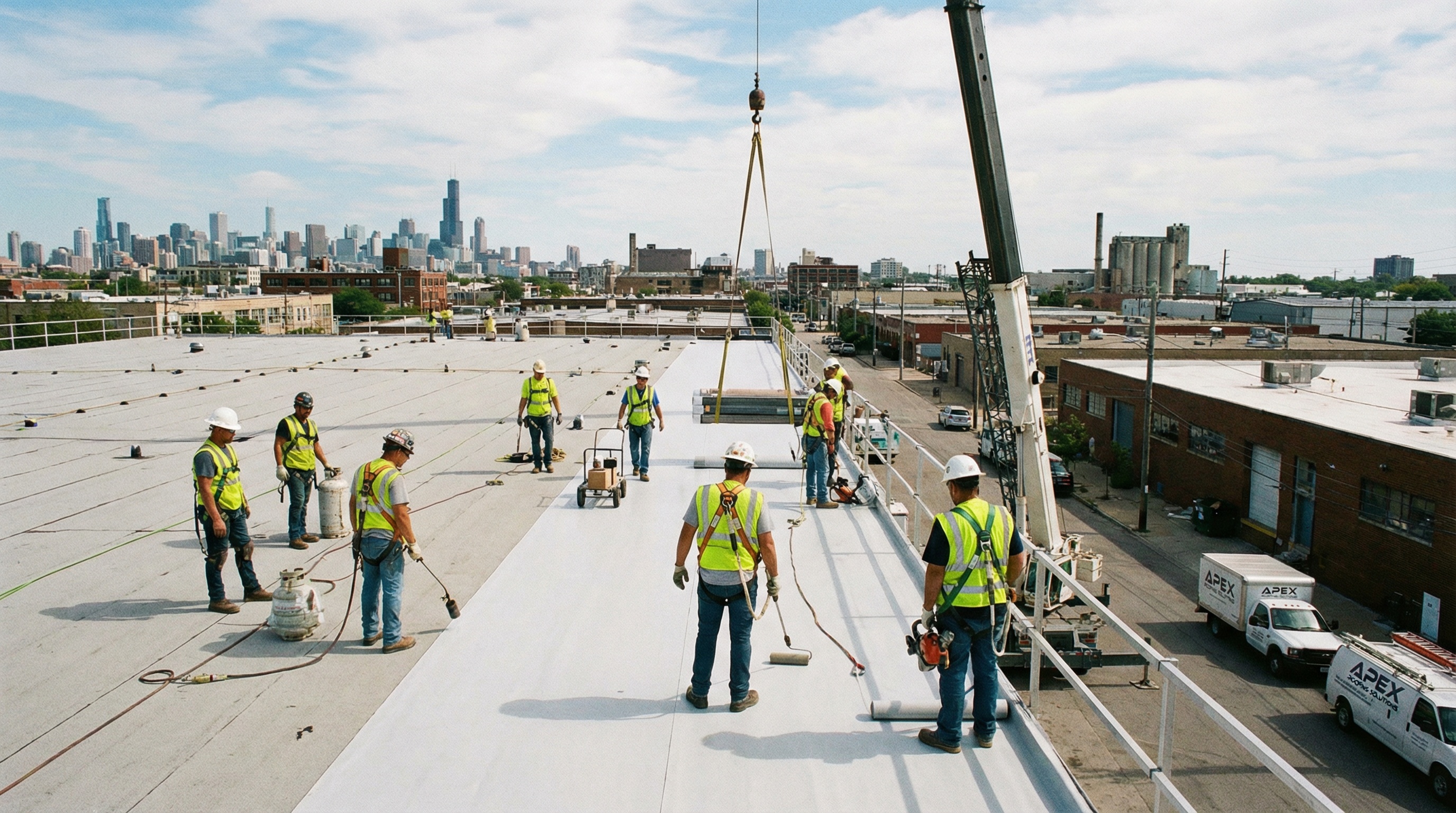
Replacement vs. Recover Analysis
Moisture core testing, deck condition assessment, and documented replacement-vs-recover recommendations for Charlotte commercial buildings - science-based decisions, not contractor guesswork.
Commercial Roofers Charlotte
Replacement vs. Recover Analysis gives owners a clearer way to compare roof conditions, budget timing, warranty requirements, and repair priorities.
The most expensive commercial roofing mistake in Charlotte is recovering over wet insulation. The second most expensive is replacing a dry roof that had 12 good years left. The difference between those outcomes is a moisture survey and a deck inspection - not a contractor's opinion.
The replace-or-recover decision on a Charlotte commercial roof is a capital allocation question, not a roofing pthe project team. Replacing a system that could have been recovered wastes capital. Recovering over a system with saturated insulation traps the moisture, accelerates insulation degradation, voids the new warranty from the day it is issued, and produces a roof that costs more to replace in eight years than a replacement today would have. Getting the decision right requires data - moisture core samples and deck inspection, not a visual walk and a contractor's gut feeling.
We conduct replacement-vs-recover analyses as standalone engagements when a building owner or facility manager needs a second opinion before committing to a scope, and as standard preconstruction work before we write any replacement or recover scope of our own. We do not quote a replace-or-recover scope before we have the moisture data. A scope written without moisture core data is a guess, and a $600,000 capital commitment should not be based on a guess.
Charlotte's commercial roof stock spans four distinct installation generations - BUR and modified bitumen on older Uptown and South End buildings, first-generation TPO and EPDM from the 1990s suburban buildout, the mid-2000s TPO generation on Ballantyne and Steele Creek buildings, and the current post-2015 generation on newer construction. Each generation has a different moisture accumulation profile, different deck condition risk, and different recover-path viability. The analysis framework is the same across all four generations; the findings are different.
The closeout package keeps the next decision clear with before photos, after photos, material notes, warranty coordination, and recommended maintenance timing.
For occupied buildings, staging, access, odor control, and tenant communication are part of the roof plan before crews arrive.
For portfolio owners, the goal is consistent documentation across properties, not a one-off opinion that cannot be compared later.
The first visit produces a practical roof record: current conditions, visible failure points, drainage notes, access concerns, and the repair or replacement path that fits the building.
Owners get a written scope that separates urgent water-control work from longer-term capital planning, so the roof decision is not made from guesswork.
Moisture Core Testing Protocol
We pull cores in a representative grid pattern calibrated to roof area and zone complexity - typically one core per 5,000 to 10,000 square feet of field membrane, with additional cores at any area showing visible deflection, prior repair activity, or surface staining that suggests moisture infiltration. Cores go through the full insulation assembly to the deck surface. We assess insulation saturation at each core pull, photograph the core, and record the deck condition directly beneath the core.
The 25% saturation threshold is the standard recover-vs-replace decision point: if more than 25% of cores show saturated insulation, full replacement is the defensible scope. This threshold comes from manufacturer technical guidance - it is the point above which recovering over the existing system reliably voids the new warranty from installation. Below 25% saturation, a partial replacement of wet zones followed by recover of the dry field is typically the more economical path, and it produces a warranty-qualified result.
Charlotte buildings with prior storm damage claims require additional coring density around any area included in a prior insurance repair. Storm-damage repairs that were executed without a full moisture survey - which describes most emergency-timeline Charlotte repairs - frequently have moisture infiltration extending beyond the visibly damaged zone. The core survey establishes the actual wet boundary, not the boundary the prior repair addressed.
Deck Condition Assessment
Charlotte's high ambient humidity means that steel deck on unventilated buildings accumulates more latent moisture exposure than the same building in a drier climate. Uptown Charlotte office buildings from the 1970s and 1980s - the generation that predated the BofA and financial district towers - frequently have deck corrosion more advanced than the exterior inspection suggests. We open the deck at any location showing surface deflection before finalizing the scope, because discovering corroded deck after the insulation is ordered changes the project in ways that are expensive to accommodate.
Structural concrete deck - common on older Uptown and South End adaptive-reuse buildings - has a different failure mode: delamination of the concrete surface, which undermines mechanical fastener holding capacity. We check fastener pull-out force at multiple locations on concrete deck buildings and compare against the manufacturer's published minimum for the intended fastener pattern. A fastener pattern designed for standard concrete deck that is pulling out at lower-than-spec force requires a different attachment method, which affects the recover-path viability.
What the Analysis Recommends and Why
Full replacement: When the moisture core survey shows saturation above 25% of the field, when deck condition requires significant replacement in multiple zones, when the existing insulation R-value is below current North Carolina energy code minimum (2021 NCBC R-25 for low-slope commercial), or when drain sizing is so inadequate that proper correction requires opening the existing system. Replacement is also the right call when the existing system is a BUR or early modified bitumen on a building that has not had a moisture survey in more than five years - the probability of finding wet field insulation is high enough that a recover scope is a financial risk.
Partial replacement plus recover: When the moisture survey shows isolated wet zones below 25% of total field area, deck condition is sound throughout, and drain sizing is adequate or can be corrected without opening the full system. This is the most common outcome on Charlotte commercial roofs in the 2005-2015 vintage - a generation of TPO and EPDM systems with dry field membrane and isolated wet areas near parapet walls or at past repair locations. The wet zones are removed and replaced with new insulation; the dry field receives a new cover board and recover membrane.
Recover only: When the moisture survey shows a dry field throughout, deck condition is sound, R-value meets current code, and drainage is adequate. This is the most economical path when the conditions support it. In our Charlotte field experience, it is the correct recommendation roughly 25-30% of the time on buildings where the owner expected to need a full replacement - meaning that a third of the time, the moisture survey produces a capital savings over what the owner anticipated.
How many cores do you pull on a typical Charlotte commercial building?
For a 50,000-square-foot building with no prior moisture survey and no specific areas of visible concern: six to ten cores in a distributed grid, with the option to pull additional cores in any location where the first-round data shows elevated moisture or ambiguous results. For a 200,000-square-foot Steele Creek warehouse, the core count scales proportionally - typically 20-30 cores for a building that size, with heavier density near the perimeter and any previously repaired zones. We provide the core location map and number of planned pulls before the site visit so the building owner knows what they are getting.
Can we recover a Charlotte roof that already has a recover system on it?
It depends on what the local jurisdiction's building code allows and what the deck's load-bearing capacity supports. The City of Charlotte and Mecklenburg County follow the 2021 North Carolina Building Code, which limits the number of roof system layers permitted - typically two layers maximum before full tear-off is required. An existing building with a BUR base and a modified bitumen recover is already at the limit - any additional recover layer requires a variance or a tear-off. We verify the existing layer count before recommending a recover path.
We have a roof report from another contractor recommending full replacement. Can you verify that recommendation?
Yes. We pull our own moisture cores on an independent grid and assess deck condition independently. If the prior recommendation was based on sound moisture data and the data supports full replacement, our analysis will confirm it. If the prior recommendation was based on a visual inspection without core data - which is common on Charlotte commercial buildings - our core survey may produce a different result. We charge for the independent analysis regardless of whether it confirms or challenges the prior recommendation.
Get the data before committing to a Charlotte roof scope.
We pull moisture cores, inspect the deck, and produce a written replace-or-recover recommendation backed by field data - for any commercial building in Charlotte or the surrounding Mecklenburg County metro.
Request a Written Scope