

Water Damage Roof Repair
Water damage on a Charlotte commercial roof is not always storm damage. Ponding from undersized drains, lateral moisture migration through wet insulation, and condensation trapped in aging assemblies
Commercial Roofers Charlotte
Water damage on a Charlotte commercial roof is not always storm damage. Ponding from undersized drains, lateral moisture migration through wet insulation, and condensation trapped in aging assemblies produce long-running water damage that appears as structural deterioration, not as an active drip.
The 2024 Helene event that devastated Asheville moved east across the mountains and deposited multi-inch rainfall totals across the Charlotte Piedmont. That event exposed a specific class of water damage that had been accumulating in Charlotte commercial buildings for years: drain systems sized to 1980s rainfall tables that were unable to handle current ASCE 7-22 design events, combined with membrane systems that had accumulated small penetrations and seam fatigue over 15 or 20 years of service. The Helene rainfall event was the trigger. The water damage it caused was often years in the making.
Water damage on a commercial flat roof exists on a spectrum. At one end is acute storm water intrusion - rapid, visible, attributable to a single event. At the other end is chronic moisture accumulation in the insulation assembly - slow, often invisible from the roof surface, and typically discovered only when the deck begins to corrode, the fasteners begin to lose pull-out resistance, or the ceiling tile in a specific zone starts to stain after every significant rainfall. Charlotte's high ambient humidity - particularly during the July-August peak humidity season - accelerates moisture migration into aged insulation assemblies and makes chronic water damage a more common finding on older Charlotte commercial buildings than owners expect.
My water damage assessment protocol addresses both ends of the spectrum. For acute post-storm intrusion, I identify the entry point, document the moisture spread, and specify the repair. For chronic insulation moisture, I conduct a full moisture survey using core sampling at a minimum of ten locations across the roof field, with additional cores at any zone showing surface deflection, prior repair patches, or roof drain proximity. The moisture survey data produces the recover-vs.-replace decision basis and the capital planning timeline.
The first visit produces a practical roof record: current conditions, visible failure points, drainage notes, access concerns, and the repair or replacement path that fits the building.
Owners get a written scope that separates urgent water-control work from longer-term capital planning, so the roof decision is not made from guesswork.
The closeout package keeps the next decision clear with before photos, after photos, material notes, warranty coordination, and recommended maintenance timing.
For occupied buildings, staging, access, odor control, and tenant communication are part of the roof plan before crews arrive.
For portfolio owners, the goal is consistent documentation across properties, not a one-off opinion that cannot be compared later.
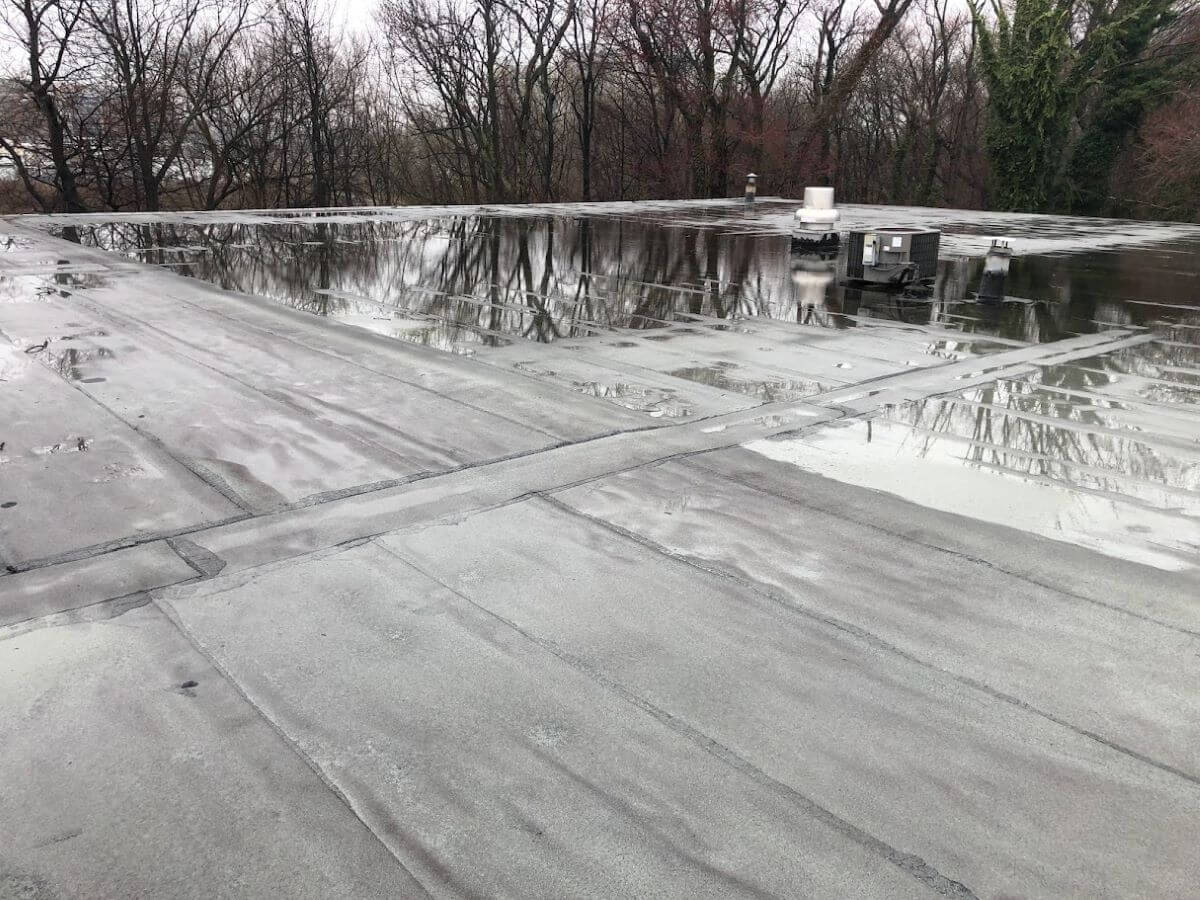
Drain System Failure and Ponding: Charlotte's Helene Legacy
The design event that Helene-level remnant rainfall produces at Charlotte commercial properties - sustained rainfall rates that exceeded 3 inches per hour at multiple Mecklenburg County stations during the 2024 event - was not the design event that most buildings' drain systems were sized to handle. Commercial buildings permitted before 2012 in Charlotte were typically designed to pre-ASCE 7-10 rainfall intensity tables that used a 2.5-inch-per-hour design event. That 20% gap between design capacity and actual event intensity caused drain overflow and membrane ponding that produced water intrusion on buildings whose membranes were otherwise weathertight.
The secondary drain systems on pre-2012 Charlotte commercial buildings are the critical failure point. Primary drains overflow into secondary drains when primary capacity is exceeded. If the secondary drain is also undersized, or if it was installed with a clamping ring that was never maintained and has debris accumulation, the overflow backs up across the roof surface and ponds to depths that pressurize any membrane imperfection. I assess both primary and secondary drain sizing on every water damage inspection - not just the primary - and compare current capacity against ASCE 7-22 requirements for Mecklenburg County's 100-year 1-hour rainfall intensity.
Buildings in Charlotte's older commercial corridors - the Eastland area, the Independence Boulevard strip, the older light industrial zone north of Uptown along the North Tryon corridor - have the highest concentration of undersized drain systems. Many of these buildings also have original steel deck that has been wet-dry cycling for 30 or more years under insulation that was partially saturated during prior heavy rainfall events. The combination of undersized drains and aging deck corrosion produces a water damage profile that is not addressable with membrane repair alone.
Wet Insulation: What the Surface Does Not Show
A commercial flat roof with saturated insulation often looks normal from the surface. The membrane may be intact - no visible punctures, seams probing clean, drains free-flowing. The water got in through a seam failure that was subsequently repaired, or through a drain that was temporarily blocked, or through a penetration flashing that was caulked after it leaked. The membrane path is closed. But the insulation is holding the water that entered before the path was sealed, and that water is migrating laterally through the insulation board joints.
Saturated insulation under a TPO or EPDM membrane does four things over time: it corrodes the steel deck beneath it, it reduces the membrane's thermal performance by eliminating the insulation R-value in the wet zones, it creates the freeze-thaw cycling in the assembly that accelerates both insulation delamination and membrane seam stress in winter, and it provides the biological substrate for mold growth that eventually reaches the building interior through deck penetrations and perimeter terminations. None of these consequences are visible from the roof surface. They require core sampling to detect.
My core sampling protocol for Charlotte buildings: minimum of ten cores distributed across a 50,000-square-foot roof in a grid pattern, with additional cores at every prior repair location, at every drain, at every zone showing surface deflection. Each core is assessed visually for moisture content and photographed. The core locations are mapped on a roof zone diagram that becomes part of the moisture survey report. Core results above 25% saturated area in the field recommend replacement over recover.
Water Damage Repair Scope vs. Full Replacement
The recover-vs.-replace decision on a Charlotte commercial building with water damage in the insulation assembly depends on three variables: percentage of field area with saturated insulation, deck condition at core pull locations, and the remaining membrane service life relative to the cost of repair vs. replacement. I document all three before writing a scope recommendation.
If less than 25% of the field area shows saturated insulation and the deck is sound at core pull locations, a targeted recover is legitimate - remove the wet insulation in isolated zones, replace with new insulation to match existing R-value, and apply a recover membrane over the dry field. If more than 25% of the field is wet, or if the deck shows corrosion at core pull locations that suggests broader corrosion below, full replacement is the defensible scope. Recovering over more than 25% wet field traps moisture against the new assembly and voids the new membrane warranty from the day of installation.
My Charlotte building had standing water on the roof after the 2024 Helene rainfall. What damage should I expect?
Ponding above two inches for extended periods can compress insulation, pressurize drain-flashing transitions, and drive moisture into any existing seam imperfections. The correct assessment starts with a drain flow test to confirm current drain capacity, a probe of every seam in zones where ponding occurred, and core sampling in a minimum of five locations in the highest-ponding areas. If the ponding was episodic and the membrane is under five years old, the damage may be limited to drain-related issues rather than field membrane failure.
Can wet insulation in a Charlotte commercial roof dry out on its own?
Not through the membrane side. The membrane is a vapor barrier on the exterior. Moisture that enters the assembly through a membrane failure can only exit downward through the deck - if the deck allows vapor transmission - or be removed mechanically by taking up the membrane and insulation in the wet zones. Saturated rigid foam insulation does not dry out in service. It holds the moisture until it is removed.
How do I know if my Charlotte commercial building has wet insulation if the membrane looks intact?
Surface signs include isolated areas of membrane deflection (low spots that appear slowly, not from the original drain design), drain areas that seem to be slightly lower than adjacent roof areas when viewed in afternoon light, ceiling staining that appears only after prolonged heavy rainfall rather than any rain event. Confirmatory diagnosis requires infrared thermography after a clear sunny day - wet insulation shows as a warmer zone in the post-sunset cooling thermal image - followed by core sampling in the flagged zones.
Suspected wet insulation or water damage on a Charlotte commercial roof?
My project managers conduct infrared thermography and core sampling to map wet insulation, assess drain capacity, and produce a recover-vs.-replace scope with capital planning timeline for any Mecklenburg County commercial building.
Request a Written Scope