

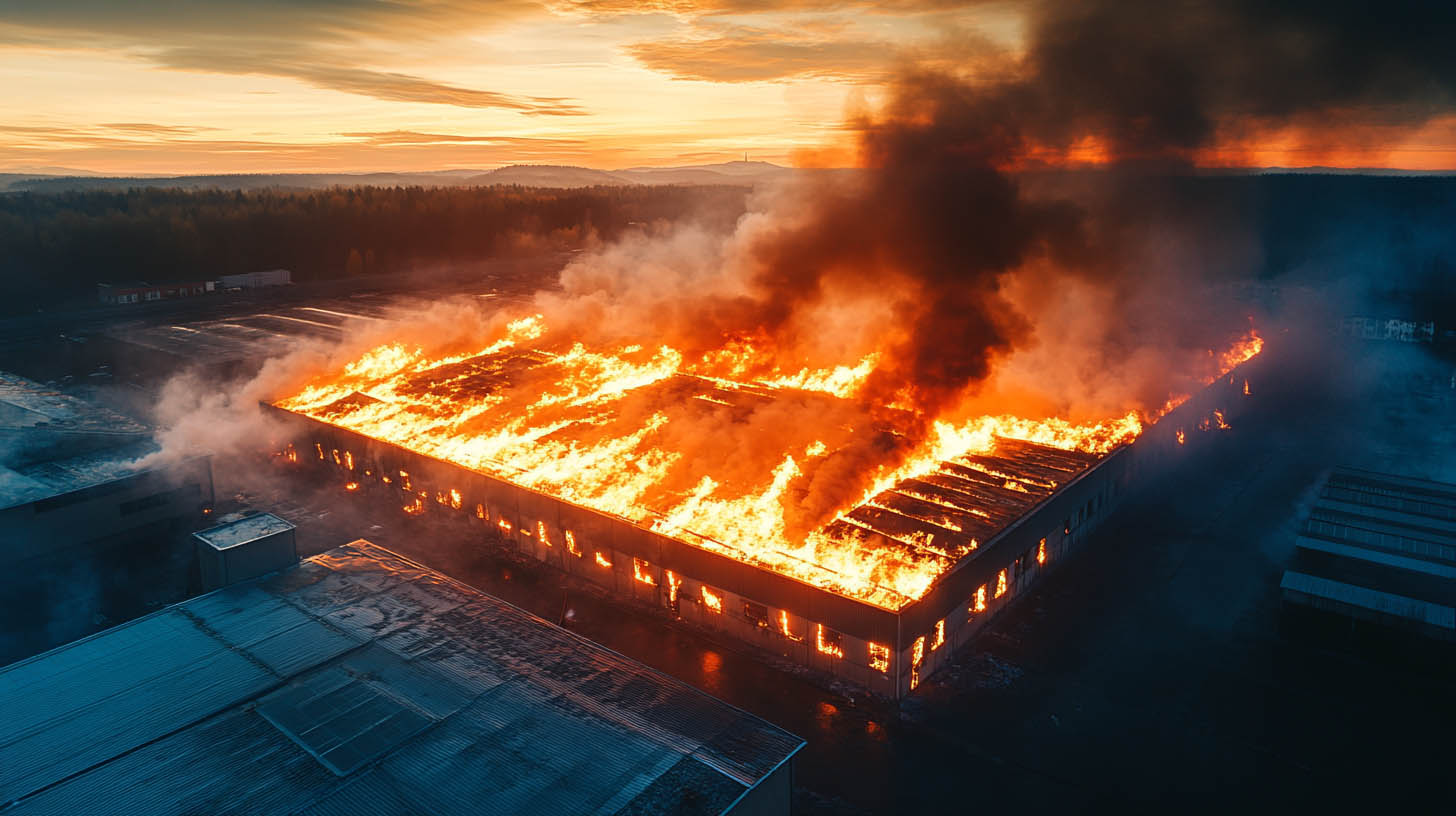
Fire Damage Roof Repair
Commercial roof repair and replacement after fire events in Charlotte - structural assessment, membrane replacement, NFPA-compliant scope documentation for Mecklenburg County buildings.
Commercial Roofers Charlotte
Fire damage on a commercial roof involves membrane destruction, thermal insulation damage, potential deck structural compromise, and the fire suppression water that saturates the assembly during the event. The repair scope has to address all four simultaneously.
Commercial roof fires in Charlotte follow predictable patterns: rooftop HVAC equipment electrical failures, lightning strikes concentrated by rooftop equipment, grease exhaust fires on restaurant and food-service buildings, and the occasional fire that originates in the building and reaches the roof assembly through combustible insulation. Each origin produces a different damage footprint on the membrane and deck, but they share a common aftermath: the membrane in the fire zone is destroyed, the insulation is thermally compromised in a zone wider than the visible char, and the fire suppression water - from sprinklers, suppression foam, or firefighting operations - has saturated the assembly beyond the fire zone boundary.
Fire damage repair on a Charlotte commercial building is not a roofing project that the fire restoration contractor can sequence after completing interior remediation. The roof assembly has to be addressed first - or simultaneously with interior remediation - because the saturated insulation above the fire zone is actively draining into the building interior through any fire-created deck penetrations. A restoration timeline that completes interior mold remediation before the roof assembly is sealed and dried is a timeline that will produce recurring mold from above.
My fire damage protocol starts with structural assessment of the deck in the fire zone before any crew walks the burned area. Fire can compromise steel deck structural integrity through heat-induced warping or through the burn-through of coated steel sections. I confirm deck structural integrity zone by zone before establishing the safe walking perimeter for the full roof inspection.
For portfolio owners, the goal is consistent documentation across properties, not a one-off opinion that cannot be compared later.
The first visit produces a practical roof record: current conditions, visible failure points, drainage notes, access concerns, and the repair or replacement path that fits the building.
Owners get a written scope that separates urgent water-control work from longer-term capital planning, so the roof decision is not made from guesswork.
The closeout package keeps the next decision clear with before photos, after photos, material notes, warranty coordination, and recommended maintenance timing.
For occupied buildings, staging, access, odor control, and tenant communication are part of the roof plan before crews arrive.
Thermal Damage Extends Beyond the Visible Char Zone
The visible char line on a commercial membrane after a fire is not the damage boundary. Heat radiates outward from the fire origin through the insulation assembly before breaking through the membrane surface. I pull cores in a pattern that extends 10 to 15 feet beyond the visible char perimeter to establish the actual thermal damage boundary. Insulation within the thermal damage zone - even if not visibly charred - has lost some portion of its R-value and may have begun to delaminate from the membrane above or the deck below. Including that zone in the replacement scope, not just the visible fire footprint, is what produces a code-compliant result with a manufacturable warranty.
Modified bitumen systems - common on Charlotte's 1990s commercial stock in the Uptown and South End corridors - pose an additional fire spread concern. Modified bitumen is torched-applied and contains petroleum-based modifiers. In a rooftop fire, the membrane itself can become a fuel source, spreading the fire across the roof surface in directions unrelated to the original fire origin. The thermal damage boundary on a modified bitumen fire is often larger than it would be on a TPO or EPDM system fire of equivalent origin intensity.
Fire Suppression Water: The Hidden Post-Fire Damage
Commercial building fires in Charlotte produce significant water damage beyond the fire zone because fire suppression - both automatic sprinkler discharge and fire department active suppression - applies large volumes of water to the building interior and the roof deck area near the fire. That water enters the roof assembly through any deck penetration created by the fire, through fire-damaged membrane seams, and through rooftop drain openings that the fire department may have used as an entry point for suppression water.
After the fire is extinguished and the building is cleared for entry, the insulation in a zone extending 20 to 40 feet from the fire perimeter - even beyond the thermal damage zone - is often saturated with suppression water. This moisture does not appear on the fire report as fire damage - it appears later as mold growth, deck corrosion, and ceiling staining that the restoration contractor and the building owner attribute to the fire event but cannot easily document for the fire insurance claim without a post-event moisture survey.
My fire damage assessment always includes a moisture survey of the insulation assembly in the suppression water zone beyond the visible fire damage. I core sample in a pattern from the fire perimeter outward until I find dry insulation, then map the moisture boundary on the roof zone diagram. That moisture survey is part of the fire damage claim documentation - it establishes the full replacement scope that the fire event actually requires, not just the visible char zone that a quick repair estimate would address.
NFPA and Building Code Requirements for Post-Fire Roof Replacement
Post-fire commercial roof replacement in Charlotte is subject to the 2021 North Carolina Building Code, which incorporates the fire-safety requirements for roof assemblies from the International Building Code. In some cases, a fire event triggers a requirement for a fire-rated assembly in the replacement that was not required in the original installation - particularly in buildings that have undergone a change of occupancy classification since original construction, or where the fire spread pattern revealed that the original assembly did not
How quickly can you respond to fire damage on a Charlotte commercial roof?
For active post-fire situations where the building has been cleared for entry, I can mobilize for a structural assessment and emergency dry-in staging the same day as the fire for buildings in Uptown, South End, and NoDa. The 485 ring is same-day to next-morning. I coordinate with the fire restoration contractor on timing to ensure the roof assessment happens before interior remediation begins - the sequence matters for moisture documentation.
The fire on my Charlotte building was small and confined to one HVAC unit. Does the whole roof need replacing?
Not necessarily. A confined rooftop equipment fire that did not spread to the membrane - or spread only to a small zone around the equipment curb - may be repairable with a zone replacement of the membrane and insulation in the fire and suppression water zones. I assess the actual thermal damage boundary and moisture boundary by core sampling before writing a replacement vs. repair scope. Equipment fires that suppression water contained may have more moisture damage than thermal damage in the surrounding zones.
Does fire damage on a Charlotte commercial roof affect the remaining manufacturer warranty on the undamaged sections?
It depends on the manufacturer's warranty language. Most commercial membrane warranties exclude fire damage from warranty coverage - the fire event is an excluded peril. But the warranty on the undamaged sections of the same roof system continues if those sections were not affected by the fire and the repair of the fire-damaged zone is done to manufacturer specification with compatible materials and documented by a manufacturer-approved contractor. I contact the manufacturer warranty desk as part of every post-fire repair scope to establish the path for maintaining the undamaged-section warranty.
Fire damage assessment for a Charlotte commercial building?
My project managers conduct structural assessment before crews go on the roof, map thermal and moisture damage beyond the visible char zone, and produce a documented scope for the fire insurance claim - for any commercial building in Mecklenburg County.
Request a Written Scope