

Hurricane Damage Roof Repair
Commercial roof inspection and repair after hurricane and tropical system events in Charlotte - photo-keyed documentation, event vs. pre-existing damage separation, and insurance-grade scope for Mecklenburg County buildings.
Commercial Roofers Charlotte
Hurricane Hugo in 1989 put Charlotte commercial roofs into emergency repair mode at a scale the Piedmont had never seen. The 2024 Helene remnant followed. We document hurricane and tropical system roof damage at insurance-grade standards and separate event-related damage from pre-existing condition on every inspection.
Charlotte is not a coastal city, but it sits directly in the path that weakened Atlantic hurricanes follow inland after landfall on the Carolina coast. Hurricane Hugo made direct landfall near Charleston as a Category 4 in September 1989 and tracked north-northwest through the South Carolina interior, arriving over Charlotte still carrying tropical storm-force winds. That event remains the defining storm in Charlotte's commercial roof history - it overwhelmed buildings that were on aging BUR and early modified bitumen systems, exposed deferred maintenance across a generation of flat roofs, and triggered an insurance-funded replacement wave that built most of the EPDM and early TPO inventory that is itself now approaching end of life.
The 2024 Helene event followed a different damage pattern. Helene made landfall on the North Carolina Gulf Coast, tracked northeast through Georgia and the Carolinas, and devastated Asheville before its remnant moisture produced multi-inch rainfall events across the Charlotte Piedmont. The damage was drainage failure rather than wind damage - buildings whose internal drains were sized to 1980s-era tables were overwhelmed by rainfall intensity that current ASCE 7-22 standards would have required larger drain capacity for. Both events left the same documentation challenge: separating what the storm caused from what was already failing before the event.
My inspection protocol on any hurricane or tropical system call starts with the event date and the National Weather Service storm archive. I establish what wind speeds and rainfall totals the building location recorded, then document every damaged condition against that baseline - membrane punctures, displaced flashings, standing water marks, and interior ceiling damage - separately from pre-existing surface wear, prior repair patches, or aging seam conditions that predate the event.
For portfolio owners, the goal is consistent documentation across properties, not a one-off opinion that cannot be compared later.
The first visit produces a practical roof record: current conditions, visible failure points, drainage notes, access concerns, and the repair or replacement path that fits the building.
Owners get a written scope that separates urgent water-control work from longer-term capital planning, so the roof decision is not made from guesswork.
The closeout package keeps the next decision clear with before photos, after photos, material notes, warranty coordination, and recommended maintenance timing.
For occupied buildings, staging, access, odor control, and tenant communication are part of the roof plan before crews arrive.
Hugo's Legacy's Commercial Roof Stock
Hugo's path through Charlotte on September 22, 1989 produced wind gusts recorded at Charlotte Douglas International Airport above 87 mph - the highest sustained wind event the Piedmont had measured in the 20th century. Commercial buildings in the Uptown office corridor, the South End light industrial zone, and the early suburban commercial stock along Independence Boulevard and the Albemarle Road corridor suffered damage on a scale that Charlotte's roofing contractors were not staffed to absorb simultaneously. Emergency tarping, interim repairs, and insurance-funded replacements ran for the better part of two years after the storm.
The replacement wave that followed Hugo installed most of Charlotte's 45-mil EPDM and first-generation TPO inventory - the roofs that were specified quickly, with whatever materials distributors could deliver, on buildings that had just experienced a major loss event. Some of that work was excellent. Some was hurried and short on documentation. The building owners who have those Hugo-era replacement roofs today are often working from warranty documents that were never fully closed out, on systems that were installed without the manufacturer field inspection that current warranty programs require. When the next significant storm arrives, the gap between what the original warranty said and what was actually documented will matter.
Buildings in the Independence Boulevard corridor, the older Albemarle Road commercial zone, and the Eastland area that have not had a formal condition assessment since the mid-2000s are the most likely to have Hugo-era or immediate post-Hugo replacement systems at end of life. I document these buildings zone by zone, photograph seam conditions and flashing details, and produce a written assessment that identifies which areas carry remaining serviceable life and which are in active deterioration.
How I Separate Event Damage from Pre-Existing Condition
Insurance adjusters work from the same question on every commercial roof claim: what did the storm cause, and what was already failing? The documentation that can answer that question is not the same as a standard repair scope. It requires establishing a pre-storm baseline - from prior inspection records, satellite imagery, or photographic evidence - and then mapping each documented damage condition against the storm event's timeline and intensity at the specific building location.
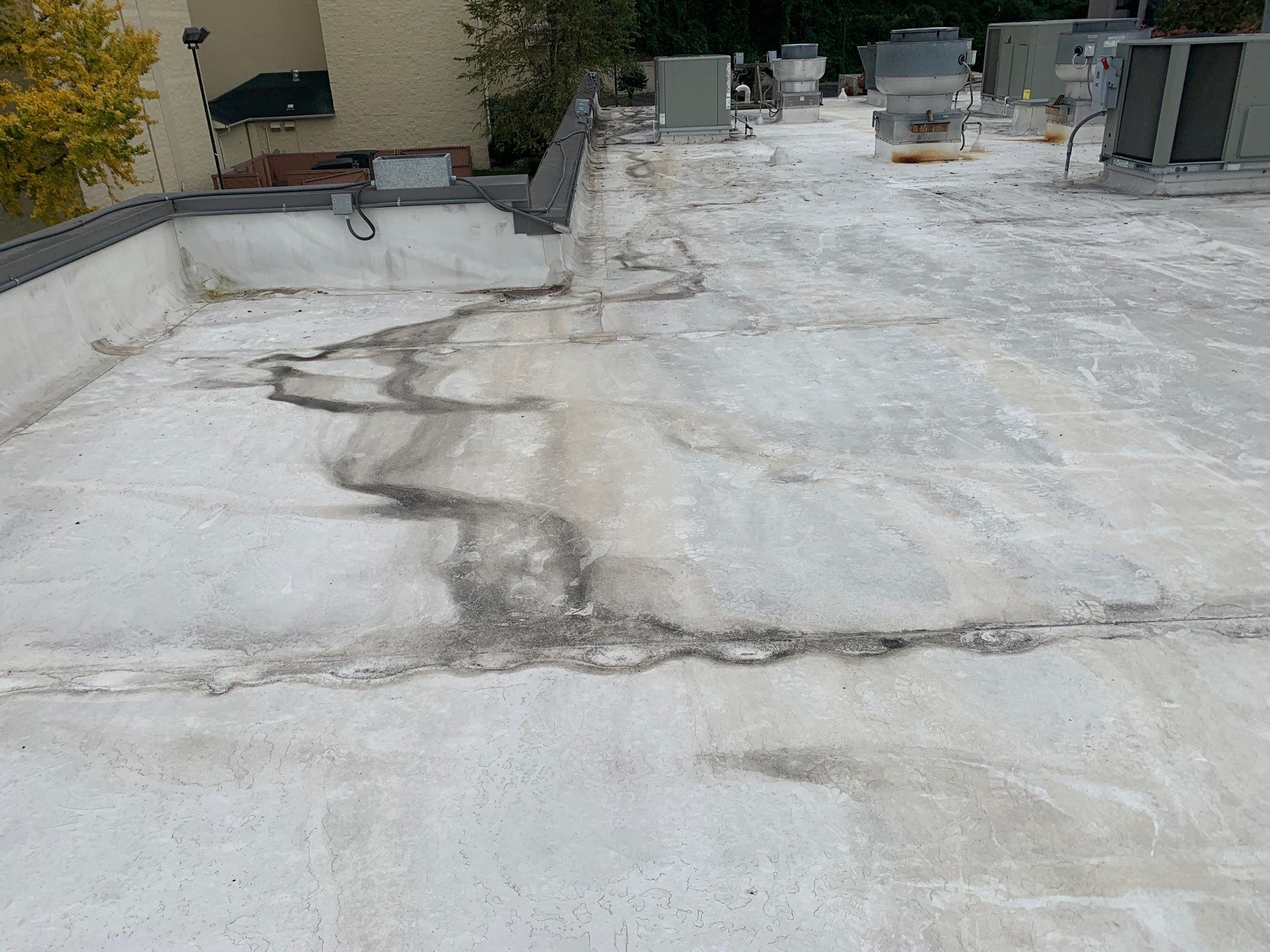
On every hurricane or tropical system inspection I conduct in Charlotte, I start by pulling the NWS storm data archive for Mecklenburg County or the relevant zip code. I record what wind speeds and rainfall totals the station nearest the building reported. I photograph every damage condition with a the project team marker in the frame - zone ID, date stamp - and write a condition description that notes whether the damage pattern is consistent with the reported wind or rainfall event. A flashing that is peeled back uniformly across a long parapet run, in the direction of the prevailing storm wind, is consistent with event-related uplift. A flashing that has been failing at isolated points for an extended period - with rust staining below, with prior repair patches evident - is pre-existing condition regardless of what the storm was doing outside.
I produce a scope document that the building owner's adjuster, public adjuster, or attorney can use directly. That document is not an estimate - it is a documented condition report with a scope of work separated into event-related damage and pre-existing condition. Event-related damage is what belongs in the claim. Pre-existing condition is deferred maintenance that the owner needs to address regardless of claim outcome.
Drain Sizing: Helene's 2024 Lesson for Charlotte Buildings
The 2024 Helene event reached Charlotte as a remnant tropical system with rainfall rates that exceeded the 3-inch-per-hour threshold at multiple Mecklenburg County stations. Buildings whose primary and secondary roof drains were sized to 1980s-era rainfall tables - which used a 2.5-inch-per-hour design event - saw water accumulate faster than the drainage system could remove it. On some buildings this produced ponding that exceeded the structural design live load. On others it backed up through secondary drain overflows and entered the building through flashing terminations and wall penetrations that were sealed against normal rain but not against six-inch-per-hour standing-water conditions.
My Charlotte building had roof damage after a hurricane or tropical storm. How fast can I get an inspection?
For commercial buildings in Mecklenburg County, within one to two business days of the event - sooner if the building has active interior water intrusion. I prioritize buildings with active leaks because delay between water entry and mitigation has direct impact on the scope of interior damage. Call 704-710-8487 or reach out through the contact form and identify it as a storm-damage inspection request.
How does Hurricane Hugo affect damage claims on Charlotte buildings today?
Hugo-era replacement roofs - installed 1989 to 1992 - are at or past end of serviceable life. If a current storm event damages a building on that generation of roofing, the adjuster will argue that the membrane was already in pre-existing failure. The documentation that distinguishes event damage from long-term wear on a 35-year-old roof system requires more detailed baseline work than a simple post-storm photo set. I document these buildings thoroughly and note every condition with an approximate timeline interpretation.
Hurricane or tropical storm damage inspection for your Charlotte building?
My project managers walk the roof, document event-related damage separately from pre-existing condition, and produce a written scope that works for adjusters - for any commercial building in Mecklenburg County or the Charlotte metro.
Request a Written Scope