

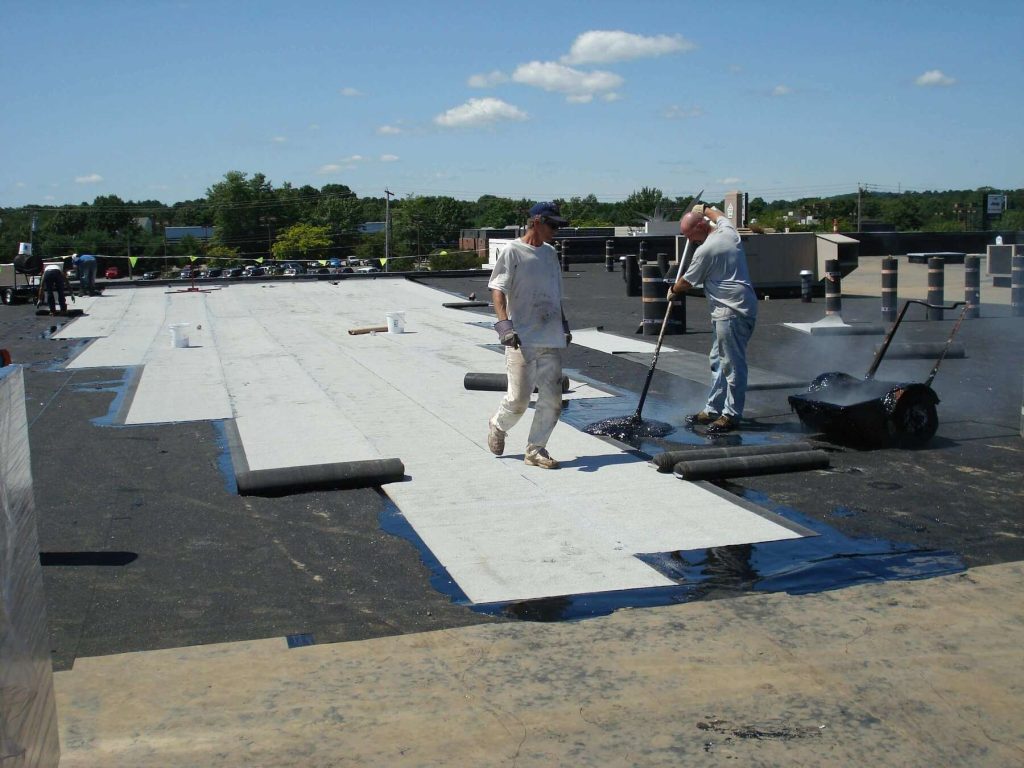
Built-Up Roof Systems (BUR)
Built-up roofing assessment, recover, and replacement for Charlotte's legacy commercial stock - the 1970s and 1980s BUR inventory across Uptown, South End, and the mid-century industrial buildings that
Commercial Roofers Charlotte
Built-up roofing assessment, recover, and replacement for Charlotte's legacy commercial stock - the 1970s and 1980s BUR inventory across Uptown, South End, and the mid-century industrial buildings that anchor the Charlotte metro's oldest commercial corridors.
Built-Up Roof Systems (BUR) decisions should account for roof traffic, drainage, substrate condition, chemical exposure, warranty goals, and ownership horizon.
Charlotte's oldest commercial buildings - the 1960s and 1970s Uptown office towers, the mid-century South End industrial buildings, and the early University Research Park structures - ran built-up roofing as their original specification. We assess, repair, and replace BUR systems on Charlotte's legacy commercial stock.
Built-up roofing - multiple plies of asphalt-saturated felts or fiberglass mats mopped together with hot asphalt and finished with a flood coat and aggregate surface - was the commercial roofing standard in Charlotte through the late 1980s. The Uptown office buildings constructed before the Uptown office towers era, the industrial buildings along South Boulevard and the former Westinghouse corridor, and the 1970s-era warehouse and light industrial buildings that occupied much of what is now Charlotte's South End and NoDa creative district all ran BUR as their original roofing specification.
Most of Charlotte's original BUR stock has been covered at least once - and in many cases twice - with modified bitumen recover layers. The buildings where we encounter original BUR today are primarily the ones where the ownership has been continuous and the asset management decisions were conservative: no recover, just periodic repair, until the building leaks badly enough to force a decision. At that point, what looks like a surface repair issue is usually a moisture-damaged insulation issue that has been progressing for years.
BUR replacement in Charlotte is a different scope conversation than single-ply replacement. Hot asphalt BUR is no longer the replacement specification - no one is mopping new four-ply BUR on Charlotte commercial buildings in 2024. The replacement paths from existing BUR are: SBS modified bitumen recover if the existing BUR is dry and the deck can support it; full tear-off and TPO or EPDM replacement if moisture is present or the deck is at or over the permitted recover limit; or silicone coating restoration if the BUR surface is intact and moisture-free. We use core samples and moisture readings to establish which path is defensible.
The closeout package keeps the next decision clear with before photos, after photos, material notes, warranty coordination, and recommended maintenance timing.
For occupied buildings, staging, access, odor control, and tenant communication are part of the roof plan before crews arrive.
For portfolio owners, the goal is consistent documentation across properties, not a one-off opinion that cannot be compared later.
The first visit produces a practical roof record: current conditions, visible failure points, drainage notes, access concerns, and the repair or replacement path that fits the building.
Owners get a written scope that separates urgent water-control work from longer-term capital planning, so the roof decision is not made from guesswork.
Assessing Charlotte BUR Systems
The diagnostic challenge with BUR systems in Charlotte is that the ply count and the condition of the intermediate plies are invisible from the surface. A BUR system that looks serviceable from a roof walk - intact aggregate, no obvious blisters - can be running partially delaminated plies and moisture-damaged insulation that has not yet produced interior water damage. The only way to document what is inside a BUR system is to pull cores: through the surface aggregate, through the flood coat, through each ply, and into the insulation below.
On every Charlotte BUR assessment, we pull a minimum of five cores in a grid pattern across the field, plus additional cores at any area showing blistering, surface alligatoring, or evidence of prior patch work. We photograph the core at every pull location - which plies are intact, which are delaminated, what the insulation looks like at the bottom of the core. That documentation becomes the scope basis and is provided to the owner regardless of whether they proceed with our company or take the scope to competitive bid.
Blister assessment on Charlotte BUR: Blisters - dome-shaped bubbles in the BUR surface - are a diagnostic indicator, not in themselves a failure mode. A blister that is intact and dry at the core is a sign of trapped construction moisture that never fully escaped, but it is not actively admitting water. A blister that is soft or wet at the core is a sign of active moisture accumulation - either the blister has failed and is admitting water, or the moisture is migrating through the insulation assembly from a perimeter or seam failure. We document blister count, size distribution, and core condition on every BUR inspection.
BUR Replacement Paths on
Full tear-off and single-ply replacement is the path we specify when moisture cores show wet insulation at more than 25% of the field, when the deck is in question, or when the building is already at the two-layer code limit for recovers. On Charlotte's older concrete-deck Uptown and South End buildings, BUR tear-off requires additional consideration - concrete decks retain moisture and require drying time before new insulation is installed. We schedule pre-install deck moisture readings and do not install insulation on a concrete deck that reads above the acceptable moisture threshold for the adhesive or fastener system being used.
Silicone coating over intact BUR: If a Charlotte BUR system passes moisture core testing and the surface is intact enough to accept coating adhesion, a silicone restoration coating can extend the system's life by 10-15 years at significantly lower cost than tear-off and replacement. The coating fills minor surface cracks, restores reflectance, and carries a manufacturer warranty. The key qualifier is the moisture core result - silicone coating over wet insulation seals in the moisture and accelerates insulation degradation.
Our Charlotte building has had the same BUR roof for 40 years. What are our options?
The first step is a core-and-moisture assessment to determine what is inside the system. A 40-year-old BUR roof can be in any condition from remarkably serviceable to deeply compromised depending on maintenance history, drain performance, and whether any recovers were applied over the original system. We cannot give you options without knowing what the cores show. Contact us and we will schedule a roof walk and core assessment - the documentation from that visit is what drives the decision.
Is hot-applied BUR still installed?
Rarely, and only on specialized applications where the multi-ply redundancy is specifically required by a building owner's standard or where a historic preservation requirement applies. The operational complexity of hot-asphalt mopping - kettle equipment, asphalt temperature management, fire watch, hot-work permits - means that modified bitumen and single-ply systems have replaced new BUR installation on virtually all standard commercial work in Charlotte. What we do is assess and replace existing BUR, not install new BUR.
What is the permitting situation for BUR tear-off?
Tear-off and replacement of a BUR roof requires a building permit from the City of Charlotte or the relevant jurisdiction - Mecklenburg County, Town of Huntersville, Town of Matthews, etc. - depending on where the building sits. We handle permitting as part of scope. Tear-off of BUR with aggregate surfacing also generates significant debris - we manage dumpster staging, debris disposal, and aggregate containment as part of the pre-construction sequencing plan.
BUR assessment or replacement scope for a Charlotte building?
We pull cores, assess moisture, document existing BUR conditions, and produce a written replacement or restoration scope for any Charlotte commercial building with legacy BUR roofing - Uptown, South End, NoDa, or anywhere in the Mecklenburg County metro. Call 704-710-8487 or visit Uptown Charlotte.
Request a Written Scope