

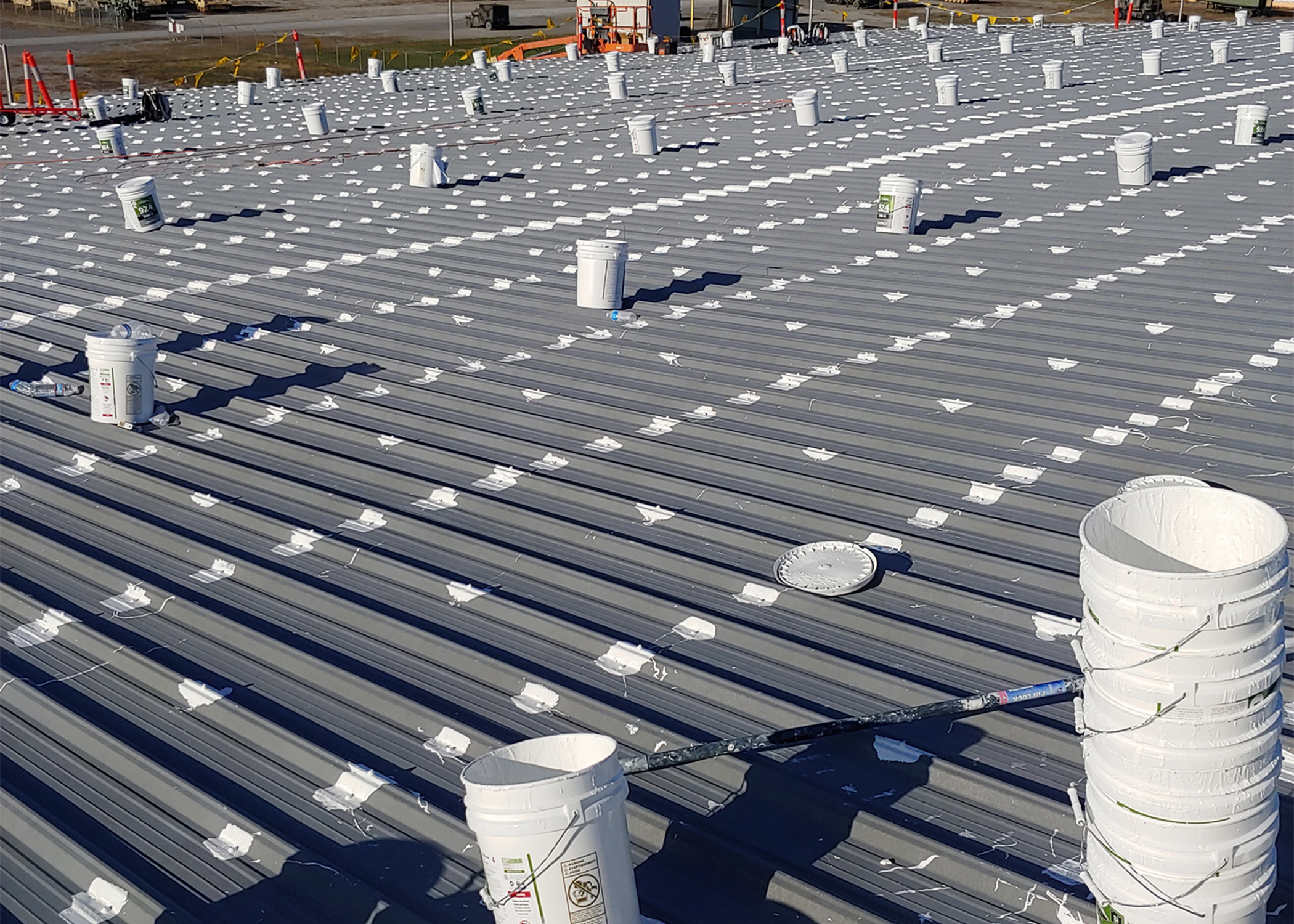
Silicone Roof Coating Systems
Silicone roof coating restoration systems for Charlotte commercial buildings - 20-mil to 40-mil applications over TPO, EPDM, modified bitumen, and metal substrates with 10-to-20-year manufacturer warranty options.
Commercial Roofers Charlotte
Silicone Roof Coating Systems decisions should account for roof traffic, drainage, substrate condition, chemical exposure, warranty goals, and ownership horizon.
Silicone coating restoration is the viable path for Charlotte commercial buildings where the existing membrane or metal system is structurally sound and moisture-free, but the surface has degraded to the point where active failure is approaching. The right application extends the existing system's life by 10-20 years at 30-50% of replacement cost.
Silicone roof coating is not a universal fix. It is a material that performs exceptionally well in specific conditions and fails to deliver its promise in others. In Charlotte's market, the sales pitch for silicone coating is not always matched by the application discipline required to make it work - which means we see coated roofs on Charlotte commercial buildings that failed within three years because the substrate moisture was not properly assessed before coating was applied, or because the surface preparation was inadequate for adhesion in Charlotte's summer humidity.
When silicone coating is appropriate, it is the most cost-effective path to extended service life on an existing Charlotte commercial roof. A 60-mil EPDM system at year 22 that has dry insulation and an intact membrane surface, but a UV-degraded cap surface, is a candidate for silicone coating that can carry the building another 10-15 years. A modified bitumen system at year 18 with intact granulated cap and clean moisture cores is a coating candidate. A TPO system at year 16 with alligatored surface but dry insulation is a coating candidate. What makes all of these candidates is the same: the structure is sound, the moisture is absent, and the surface is still adherent enough to accept a coating bond.
Charlotte's summer UV intensity is silicone's operating environment. Silicone chemistry resists UV degradation better than acrylic or urethane coatings - it does not chalk, it does not yellow significantly under Charlotte's sun angles, and it retains its flexibility through the Piedmont's thermal cycling range. The 100% solids silicone formulations we specify for Charlotte commercial applications carry manufacturer warranties at 20-mil and 30-mil application thicknesses, with 10, 15, and 20-year warranty terms depending on applied mil depth.
The first visit produces a practical roof record: current conditions, visible failure points, drainage notes, access concerns, and the repair or replacement path that fits the building.
Owners get a written scope that separates urgent water-control work from longer-term capital planning, so the roof decision is not made from guesswork.
The closeout package keeps the next decision clear with before photos, after photos, material notes, warranty coordination, and recommended maintenance timing.
For occupied buildings, staging, access, odor control, and tenant communication are part of the roof plan before crews arrive.
For portfolio owners, the goal is consistent documentation across properties, not a one-off opinion that cannot be compared later.
Silicone Coating Substrate Assessment
Every silicone coating project in Charlotte starts with a moisture assessment - no exceptions. Applying silicone over wet or moisture-compromised insulation is the most common silicone coating failure mode across the industry. The coating seals the moisture in, accelerates insulation degradation, and produces a roof that fails from the inside rather than from the surface. Charlotte's summer rainfall intensity makes moisture assessment non-optional - there is no such thing as a Charlotte commercial building that went through a summer without ponding risk that is automatically eligible for coating without a moisture survey.
We pull infrared thermography or nuclear moisture readings in a grid across the roof field before finalizing any coating specification. Infrared thermography identifies wet insulation zones by detecting temperature differential between wet and dry areas after sunset - the technique works best in Charlotte's late summer and early fall when the temperature differential is large and the sky is clear after the afternoon thunderstorm passes. Nuclear moisture readings verify suspected wet zones identified by infrared. Any area that reads wet on either instrument gets a core pull to confirm and document.
Surface preparation is the second critical variable. Silicone adheres to a clean, dry, primed surface. Charlotte's urban tree canopy deposits organic matter on commercial roofs - leaf tannins, algae colonies, and bird contamination that compromise adhesion if not removed before coating. We pressure-wash and treat with a mold/algae biocide before any coating application. We then apply the manufacturer-specified primer for the substrate type. On modified bitumen and BUR surfaces, the primer chemistry is different from what is used on single-ply membrane. We specify the correct primer for the substrate - not a generic coating primer.
Application and Warranty Specifications for Charlotte Buildings
Charlotte's summer humidity window creates application constraints for silicone coating. Most manufacturer specifications require ambient relative humidity below 85% and substrate temperature above 50F. Charlotte's summer mornings often run 80-plus percent relative humidity until mid-morning - which means early-start coating crews in summer are often waiting for conditions, not coating. We build that constraint into the project schedule and the crew mobilization plan. We do not coat in conditions outside the manufacturer's application window.
Applied mil thickness determines the warranty term. 20-mil dry-film thickness (DFT) is the minimum for most 10-year manufacturer warranties. 30-mil DFT carries 15-year warranties. 40-mil DFT - typically applied in two 20-mil passes - carries 20-year warranties. We measure wet-film thickness during application and pull dry-film thickness samples at completion to verify the specification was met. Underapplied coating is the most common reason coating warranties are denied on Charlotte commercial buildings that go through a warranty claim process.
Charlotte cool-roof incentive programs: Some Charlotte-area utility programs and the NC Energy Efficiency Revolving Loan Fund include incentives for cool-roof applications that 65 SRI or better for low-slope applications. White silicone coatings from most major manufacturers We document the pre-coating and post-coating reflectance values for any Charlotte building owner pursuing incentive program qualification.
How do I know if my Charlotte building is a candidate for silicone coating rather than replacement?
The qualifying criteria are: moisture cores showing dry insulation across at least 75% of the roof field, an existing membrane or cap surface that is still adherent (not delaminating from the substrate below), and a substrate material that accepts silicone primer - TPO, EPDM, modified bitumen, metal, and BUR with intact surface are all generally compatible. We assess those three criteria on a roof walk and moisture survey before making any recommendation. If the criteria are not met, coating is not the right answer regardless of the cost differential with replacement.
Can silicone coating stop an active leak on a Charlotte commercial building?
No - silicone coating is a restoration system, not an emergency repair product. An actively leaking Charlotte commercial building needs the leak source identified and repaired before any coating application is considered. We handle emergency temporary repair and leak investigation as a first step, then assess whether the building is a coating candidate once the active leak is resolved.
How long does silicone coating application take on a Charlotte commercial building?
For a 30,000-square-foot building with a single-plane roof and straightforward drain and flashing geometry: surface prep and drying typically runs two to three days, primer application and drying one to two days, and coating application two to four days depending on ambient conditions. Charlotte's summer afternoon thunderstorm pattern adds a weather contingency to every coating project schedule - we build weather days into the production plan rather than promising a fixed completion date.
Assessing a Charlotte building for silicone coating restoration?
We perform a moisture survey, pull cores, and produce a written coating specification or replacement recommendation - not a sales pitch for either option - for any Charlotte commercial building where the existing system may be a coating candidate. Reach us at Uptown Charlotte or call 704-710-8487.
Request a Written Scope