

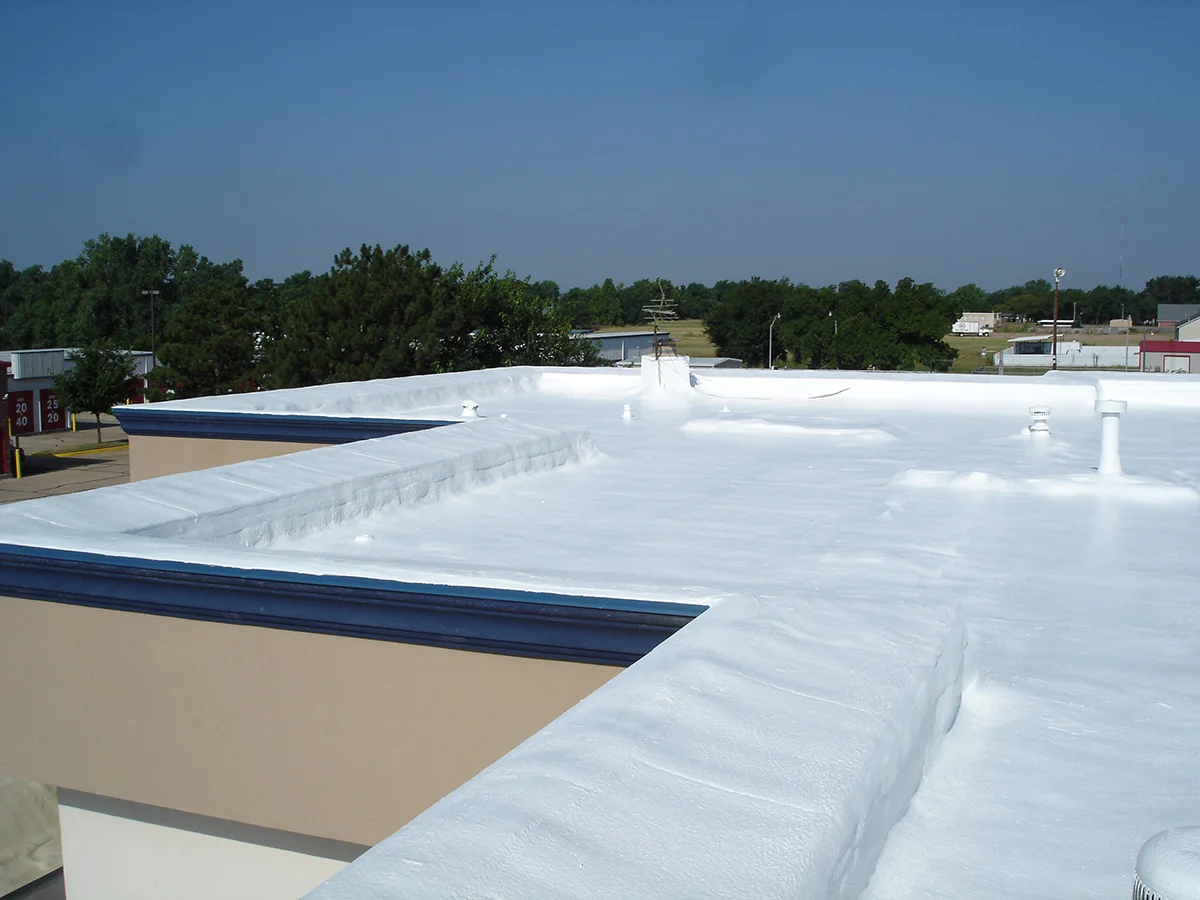
Spray Polyurethane Foam Roof Systems
Spray polyurethane foam roofing for Charlotte commercial buildings - seamless monolithic insulation and waterproofing systems with silicone topcoat, used on complex-geometry and re-slope applications in Mecklenburg County.
Commercial Roofers Charlotte
Spray Polyurethane Foam Roof Systems decisions should account for roof traffic, drainage, substrate condition, chemical exposure, warranty goals, and ownership horizon.
Spray polyurethane foam is a monolithic seamless roofing system - foam applied as a liquid that expands and cures in place, covering the entire roof surface including penetrations and complex geometry without seams. In Charlotte's commercial market it is specified for buildings where complex rooftop geometry, re-slope requirements, or penetration density makes a seamed membrane system impractical.
Spray polyurethane foam roofing is the most misunderstood commercial roofing system in the Charlotte market. Its proponents oversell it as a universal solution; its detractors dismiss it as a niche product with a short service life. The accurate picture is narrower and more specific: SPF is an excellent system for a defined set of applications, and the wrong specification for most others.
SPF is applied as a two-component liquid - isocyanate and polyol - that reacts on contact to form a closed-cell foam. The foam adheres directly to the substrate, expands to 20-30 times its liquid volume, and cures to a rigid surface within minutes. A protective silicone or polyurea topcoat is applied over the cured foam to provide UV and weather protection. The result is a seamless system with no laps, no seams, and no fastener penetrations through the waterproofing plane - which is its primary advantage over single-ply membranes in complex-geometry applications.
Charlotte commercial applications where SPF gets specified: older South End and NoDa adaptive-reuse buildings with complex rooflines, multiple level changes, and penetration densities that would make seamed membrane detailing extremely labor-intensive; warehouse buildings on the Steele Creek and Westinghouse corridors where the existing roof has drainage problems that can be corrected by spraying additional foam in strategic locations to re-establish positive slope; and institutional buildings in the UNC Charlotte corridor where the owner's energy code compliance goal requires higher continuous insulation R-values than rigid board insulation can deliver in a single recover layer.
The closeout package keeps the next decision clear with before photos, after photos, material notes, warranty coordination, and recommended maintenance timing.
For occupied buildings, staging, access, odor control, and tenant communication are part of the roof plan before crews arrive.
For portfolio owners, the goal is consistent documentation across properties, not a one-off opinion that cannot be compared later.
The first visit produces a practical roof record: current conditions, visible failure points, drainage notes, access concerns, and the repair or replacement path that fits the building.
Owners get a written scope that separates urgent water-control work from longer-term capital planning, so the roof decision is not made from guesswork.
SPF Application Requirements
SPF is highly weather-sensitive. Application requires ambient temperature above 50F, relative humidity below 85%, and wind speeds below approximately 10 mph during spray. Charlotte's summer morning humidity frequently runs at or above the application threshold until 9 or 10 AM, and Charlotte's summer afternoon thunderstorm pattern can close the application window without warning. SPF application in Charlotte is a morning-window operation in summer - we plan crew mobilization and staging to maximize the productive window before afternoon convective activity develops.
Surface preparation for SPF in Charlotte follows the same principles as silicone coating - clean, dry, primed substrate that is free of organic contamination. The Charlotte tree canopy generates the same algae, leaf, and bird contamination issues for SPF adhesion as it does for silicone. Substrate primer for SPF is specific to the existing roofing material - concrete deck, metal deck, existing membrane - and the primer must be fully cured before foam application begins. In Charlotte's summer humidity, primer cure times can extend beyond the manufacturer's published schedule if relative humidity is at the upper application limit.
Re-slope applications on Charlotte warehouses: One of the most practical SPF applications in Charlotte is targeted re-slope of existing flat roofs where drainage failures have produced chronic ponding. Foam can be sprayed at varying thickness to build positive slope toward drains without tearing off and replacing the existing system. The re-slope foam thickness ranges from a feather-edge at the high point to 2-4 inches at the drain approach - which also adds meaningful insulation R-value to the building envelope. We survey the existing roof surface elevations before specifying a re-slope application to determine the volume of foam required and the drain height adjustment needed.
SPF Topcoat and Long-Term Performance
Uncovered SPF foam degrades rapidly under UV exposure - it would be orange and chalky within a season on a Charlotte commercial roof without a protective topcoat. The silicone topcoat - applied at 20-30 mils DFT over the cured foam - provides UV protection, waterproofing at the surface, and the reflectance values required for cool-roof performance. The topcoat is the renewable component of an SPF system: when the silicone topcoat degrades after 10-15 years, it is recoated rather than the foam replaced. That renewable-topcoat model is the basis for SPF's long-term cost argument - one foam application, periodic topcoat renewal.
The practical limitation of that model in Charlotte's market is application quality control. SPF foam that was applied at insufficient thickness, over a substrate that had moisture present, or in conditions outside the application window can delaminate, develop blisters, or lose adhesion at the substrate interface. When that happens, the topcoat is not restorable without addressing the underlying foam condition. On any Charlotte building where SPF was applied more than 10 years ago and has not been professionally inspected since, we assess foam adhesion and substrate condition before recommending recoat or replacement.
Is SPF appropriate for a Charlotte flat warehouse roof with chronic ponding problems?
It is one option - re-slope with SPF is a viable solution for Charlotte warehouse roofs where positive slope can be re-established without full tear-off. The prerequisite is a moisture assessment of the existing insulation. If the existing insulation is wet from chronic ponding, the foam cannot be applied over wet substrate and the wet material must be removed before SPF can be installed. The re-slope application only makes sense economically if the existing insulation passes the moisture threshold.
How long does SPF last on a Charlotte commercial roof?
The foam substrate, if properly applied and protected, can remain structurally sound for 30 or more years. The silicone topcoat that protects the foam needs renewal every 10-15 years depending on applied thickness and UV exposure. Charlotte's intense summer sun is harder on silicone topcoat than northern climates, and the topcoat renewal cycle on Charlotte SPF roofs tends toward the shorter end of that range. We assess topcoat condition annually on any Charlotte SPF building we maintain.
What are the energy efficiency implications of SPF for a Charlotte commercial building?
SPF closed-cell foam provides approximately R-6.5 per inch of thickness at standard application density. A 2-inch SPF application adds R-13 to the building envelope - on a Charlotte building where energy code requires R-25 and the existing system only delivers R-10, SPF re-slope can close the gap without changing the drain height by more than an inch or two. The reflective white silicone topcoat also reduces solar heat gain in Charlotte's high-UV summer months. Combined insulation and reflectance benefits make SPF relevant to Charlotte buildings pursuing energy benchmarking improvement.
SPF assessment or re-slope scope for a Charlotte building?
We assess existing conditions, identify re-slope opportunities, and produce a written SPF specification with topcoat selection and warranty path for Charlotte commercial buildings where the application fits. Complex geometry, ponding problems, and energy compliance are the conversations we have most often. Call 704-710-8487 or visit Uptown Charlotte.
Request a Written Scope