

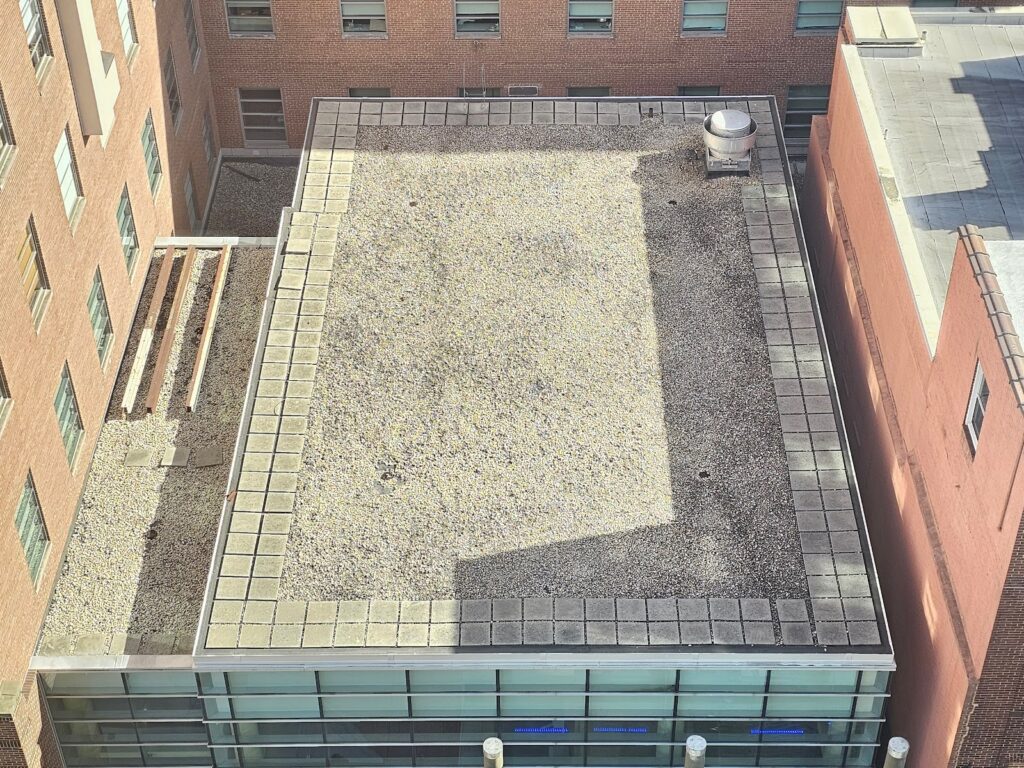
Ballasted Roof Systems
Ballasted commercial roof system assessment and replacement for Charlotte buildings - evaluating existing ballasted EPDM and TPO for structural adequacy, wind uplift compliance, and replacement path options in
Commercial Roofers Charlotte
Ballasted commercial roof system assessment and replacement for Charlotte buildings - evaluating existing ballasted EPDM and TPO for structural adequacy, wind uplift compliance, and replacement path options in Mecklenburg County.
Ballasted Roof Systems decisions should account for roof traffic, drainage, substrate condition, chemical exposure, warranty goals, and ownership horizon.
Ballasted single-ply roofing - loose-laid membrane held in place by a layer of river stone or concrete pavers - is a legacy configuration on a portion of Charlotte's 1980s and 1990s commercial stock. We assess existing ballasted systems for structural adequacy, wind-uplift compliance, and replacement path, and we specify replacement systems that address the conditions the ballasted system created.
Ballasted roofing was a common specification in the 1980s and 1990s on Charlotte commercial buildings, primarily because it offered the lowest first-cost of any single-ply installation method: no adhesive, no mechanical fasteners through the membrane, just a loose-laid membrane weighted down by stone. The roofing labor was fast, the material was simple, and the installation looked clean. What was less clear at specification time was how the system would perform over 30 years as the stone migrated, the drains packed with fines, and the building's structural dead load documentation became relevant to the next scope conversation.
We do not specify new ballasted single-ply roofing on Charlotte commercial buildings. The combination of ASCE 7-22 wind-uplift requirements for Charlotte's wind zone, the added dead load that ballast imposes on aging structural systems, and the unavailability of meaningful manufacturer warranties for ballasted systems on most Charlotte commercial buildings makes ballasted specification obsolete compared to mechanically attached and fully adhered alternatives. What we do is assess existing ballasted systems and manage their replacement.
The Charlotte commercial buildings still running ballasted roofing are concentrated in the mid-to-late 1990s warehouse and light industrial vintage in the Arrowood corridor, the Westinghouse Boulevard zone, and the older University Research Park buildings. These buildings are typically 25-35 years old, running 45-mil or 60-mil ballasted EPDM with stone ballast at 10-12 pounds per square foot. The membrane may still be intact. The drain sumps are typically impacted with stone fines that have migrated over 30 years. The structural live load capacity may have been reduced by building modifications or deferred maintenance. Those are the variables we assess.
For occupied buildings, staging, access, odor control, and tenant communication are part of the roof plan before crews arrive.
For portfolio owners, the goal is consistent documentation across properties, not a one-off opinion that cannot be compared later.
The first visit produces a practical roof record: current conditions, visible failure points, drainage notes, access concerns, and the repair or replacement path that fits the building.
Owners get a written scope that separates urgent water-control work from longer-term capital planning, so the roof decision is not made from guesswork.
The closeout package keeps the next decision clear with before photos, after photos, material notes, warranty coordination, and recommended maintenance timing.
Ballasted System Assessment Priorities
Drain condition: Stone ballast migrates toward drains over 30 years of foot traffic, equipment vibration, and wind. Drain sumps on ballasted Charlotte buildings are typically packed with stone fines that reduce the sump depth and slow drain flow. We clear and camera-inspect drains on every ballasted building assessment. Charlotte's summer thunderstorm intensity makes a partially blocked drain on a ballasted roof a significant interior flooding risk - the stone slows surface drainage relative to a membrane system, and the drain is the only path for water moving through the ballast field.
Membrane condition under ballast: The membrane on a ballasted roof cannot be assessed from the surface - it is buried under stone. We remove ballast in representative areas - at drains, at curb flashings, at the membrane perimeter, and in the field at 2-3 locations per 10,000 square feet - to inspect membrane condition directly. The EPDM membrane under 30-year-old Charlotte ballasted systems is often in better condition than expected because the stone has protected it from UV exposure. But ballast-induced stress at drain rings and perimeter flashings, where the stone concentrates, can produce localized failures that are invisible from the surface.
Replacing Ballasted Roofing on
Ballast removal is the most labor-intensive and debris-intensive part of replacing a ballasted roof on a Charlotte commercial building. Stone at 10-12 pounds per square foot across 100,000 square feet is 500-600 tons of material. Crane and conveyor staging, dumpster logistics, disposal site selection, and dust control at adjacent properties are all pre-construction planning items on ballasted roof replacements. For Charlotte buildings near commercial zones - the transition areas between the Arrowood industrial corridor and the commercial streets east of South Boulevard, or the Westinghouse corridor buildings near Steele Creek Road commercial - dust and noise management during ballast removal requires a pre-construction neighbor notification plan.
After ballast removal, we clean the deck surface, pull moisture cores in a full grid, and assess deck condition before specifying the replacement system. The deck under 30-year-old Charlotte ballasted roofing is often cleaner than the deck under torch-applied modified bitumen - the ballast installation did not introduce adhesive or asphalt chemistry onto the deck surface. Mechanically attached TPO with tapered insulation and new drain sumps is the standard replacement specification for Charlotte commercial ballasted-to-single-ply conversions.
Wind uplift engineering on replacement: The replacement system must Charlotte's tornado corridor and the periodic high-wind events from Atlantic storm remnants make this engineering non-optional. We provide a stamped fastener pattern drawing for every replacement project above 20,000 square feet, including every ballasted-to-mechanically-attached conversion.
My Charlotte warehouse has a ballasted EPDM roof that is not leaking. Do I need to replace it?
Not immediately on the basis of age alone - a ballasted EPDM roof that is not leaking may have years of service life remaining if the membrane condition under the ballast is intact and the structural loading is within capacity. What we recommend is a formal assessment: ballast removal at representative locations to inspect the membrane, drain inspection and clearing, and a structural dead-load verification if the original design documents are unavailable. That assessment produces the information needed to make a defensible replacement-timing decision rather than replacing by calendar.
Is there a wind risk for ballasted roofs?
Yes, and it is relevant. Charlotte's ASCE 7-22 wind zone - 115 mph basic wind speed for most of Mecklenburg County - puts ballasted roof systems under scrutiny. ASCE 7-22 wind-uplift calculations for ballasted systems require heavier stone at roof perimeters and corners, where wind-uplift pressure is highest. Most Charlotte ballasted systems installed in the 1980s and 1990s were designed to older ASCE 7-88 or ASCE 7-93 wind-speed maps, which used lower base wind speeds than current code. A ballasted Charlotte building with a perimeter stone layer that meets 1993 requirements but not 2022 requirements is carrying a wind-uplift deficiency that would show up as stone displacement or membrane peeling in a high-wind event.
Ballasted roof assessment or replacement scope for a Charlotte building?
We assess existing ballasted systems - membrane condition, structural loading, drain function, wind-uplift compliance - and produce a written replacement scope with full sequencing plan for any Charlotte commercial building in Mecklenburg County and the surrounding metro. Call 704-710-8487 or contact us.
Request a Written Scope