

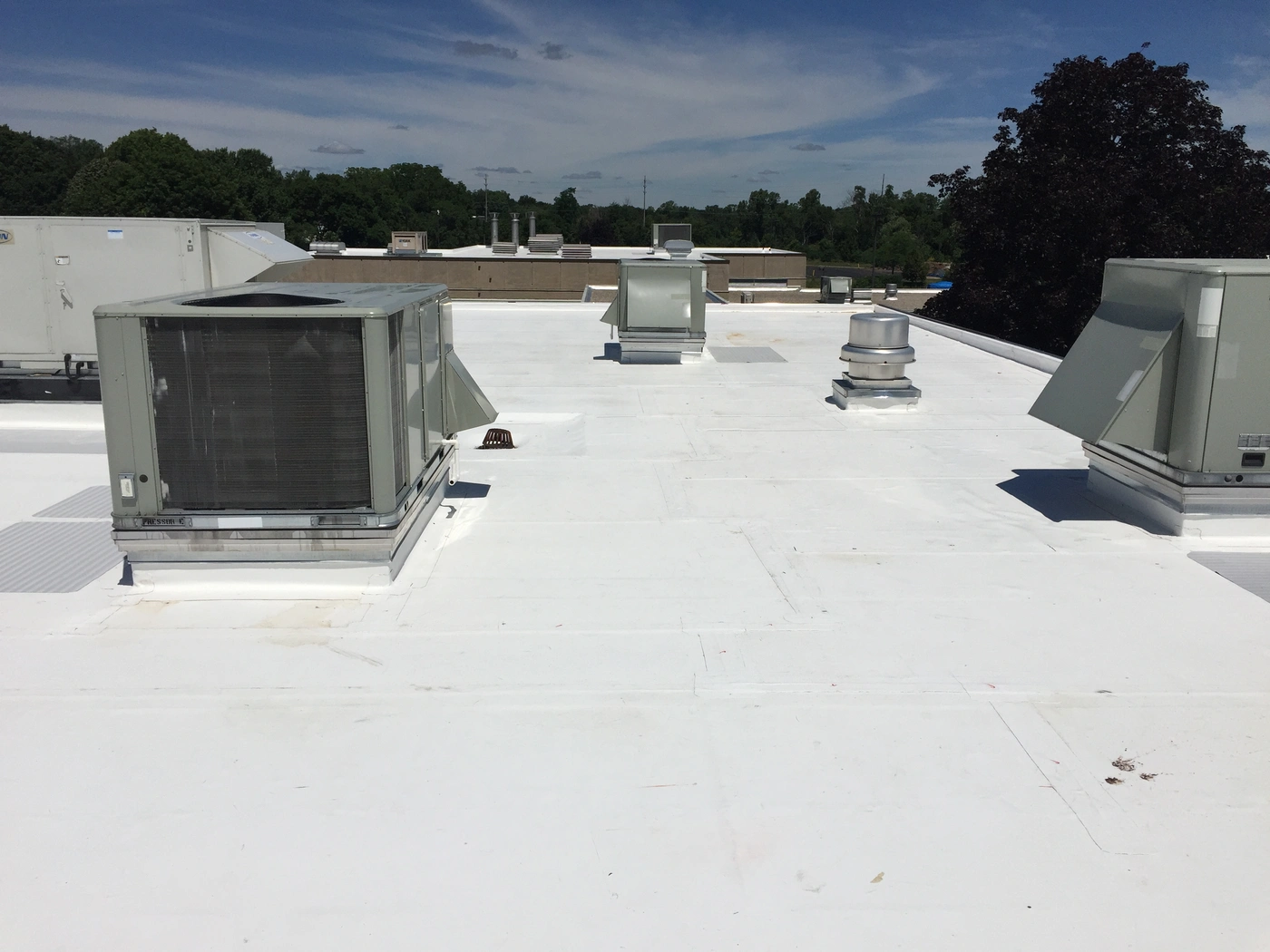
PVC Roof Systems
PVC commercial roof system installation for Charlotte restaurant, food service, chemical exposure, and high-performance applications - 50-mil and 60-mil systems with 20-to-25-year NDL manufacturer warranty paths.
Commercial Roofers Charlotte
PVC Roof Systems decisions should account for roof traffic, drainage, substrate condition, chemical exposure, warranty goals, and ownership horizon.
Polyvinyl chloride roofing is the right specification for a specific category of Charlotte commercial building: food service, restaurant, grease-exhaust environments, and buildings with chemical exposure on the roof surface where TPO and EPDM performance falls short. We install 50-mil and 60-mil PVC systems from Sika Sarnafil, Carlisle, and Versico with 20-to-25-year NDL warranty paths.
PVC is not the volume commercial specification in Charlotte - TPO is - but it is the correct specification for the applications where its chemistry matters. Animal fats and cooking oils from restaurant exhaust systems degrade TPO and EPDM membranes over time. PVC's formulation resists fat-based contaminants without surface degradation, which is why food service operations on rooftop exhaust environments consistently outlast their first TPO or EPDM install and find their way to PVC on the second reroof. Charlotte's food service density - the South End restaurant corridor, the SouthPark dining destinations, the Ballantyne mixed-use restaurants, and the NoDa food hall cluster - means PVC gets specified regularly on the restaurant and food hall roofs in those districts.
The early PVC formulations from the 1980s and early 1990s had well-documented plasticizer-migration problems - plasticizers migrated out of the membrane over time, leaving it brittle, chalky, and prone to cracking at cold temperatures. If your Charlotte building has PVC installed before 1995, that plasticizer-migration problem is relevant to its current condition. Current PVC formulations from Sika Sarnafil and Carlisle use stabilized plasticizer chemistry that does not migrate at the rates that plagued older material - but we assess manufacturer and installation vintage during inspection on any existing PVC system.
PVC's welding chemistry is different from TPO's. Both are heat-welded thermoplastics, but PVC welds at lower temperatures than TPO and the weld window is narrower in Charlotte's summer ambient conditions. We train our welding operators specifically on PVC weld temperature protocols and probe every PVC seam on every project - not a sample, every seam.
The closeout package keeps the next decision clear with before photos, after photos, material notes, warranty coordination, and recommended maintenance timing.
For occupied buildings, staging, access, odor control, and tenant communication are part of the roof plan before crews arrive.
For portfolio owners, the goal is consistent documentation across properties, not a one-off opinion that cannot be compared later.
The first visit produces a practical roof record: current conditions, visible failure points, drainage notes, access concerns, and the repair or replacement path that fits the building.
Owners get a written scope that separates urgent water-control work from longer-term capital planning, so the roof decision is not made from guesswork.
Where PVC Gets Specified
Restaurant and food service roofs: Any Charlotte building with rooftop kitchen exhaust equipment gets a PVC specification discussion when we scope the roof. Grease-laden exhaust from Type I commercial kitchen hoods deposits on the membrane surface around exhaust fans and on the prevailing-wind downwind side of the fan. Over 5-10 years, those deposits degrade TPO's surface chemistry at the seams around the fan curbs. PVC does not degrade in grease contact. The South End restaurant buildings, the NoDa food hall roofs, and the Ballantyne restaurant strip center roofs are all candidate PVC applications.
High-performance institutional applications: Some Charlotte hospital campuses and the larger medical office buildings in the healthcare campus and healthcare campus systems specify PVC for its 25-year NDL warranty path from Sika Sarnafil - longer than any standard TPO warranty. Where the owner's capital planning horizon is 25 years and the budget supports it, PVC's longer warranty path is a legitimate specifying reason.
PVC System Installation Details
PVC is installed fully adhered or mechanically attached on Charlotte commercial buildings. Fully adhered is the standard for most restaurant and chemical exposure applications - bonding the membrane directly to the insulation substrate eliminates the fastener penetrations where grease and chemical contamination can track into the insulation assembly. Mechanically attached PVC is used on large-footprint low-slope buildings where the engineering fastener pattern meets ASCE 7-22 requirements and the attachment cost difference is significant.
PVC and EPDM are chemically incompatible - PVC plasticizers migrate into EPDM rubber and destroy it. When we specify a PVC recovery over an existing EPDM building, we install a separation layer between the old EPDM and the new PVC membrane. This adds a material cost that is not present on a TPO-over-TPO or PVC-over-PVC recover, and it needs to be in the scope before the bid is finalized. Surprises at this stage cause change-order conflicts on every project where they are not addressed in the initial specification.
Warranty closeout on PVC requires a manufacturer field representative inspection - same as TPO and EPDM. Sika Sarnafil and Carlisle both have active field representative networks that cover Charlotte. We schedule and attend the manufacturer inspection as part of every PVC project's closeout sequence, and we provide the owner with the warranty registration documents before leaving the project.
Is PVC more expensive than TPO on a Charlotte commercial building?
Yes, typically by 15-25% on installed cost, depending on the building size and application. The premium reflects PVC's material cost and the more demanding weld protocols. For a restaurant or food service building where the alternative is a TPO system that will show grease degradation at the seams within 8-10 years, the PVC premium often pencils over the ownership horizon. For a standard office building with no chemical exposure, TPO is the right specification and the cost premium for PVC is not justified.
How do you handle old PVC on a Charlotte building that is showing brittleness?
Brittle PVC is a symptom of plasticizer migration - the plasticizers that give PVC its flexibility have leached out of the membrane over time. The diagnostic step is a membrane flexibility test in cool conditions - if the membrane cracks when bent at 40F ambient, the plasticizer content is at or below the failure threshold. At that point, repair is a stop-gap at best. Full replacement with current-formulation PVC is the honest scope for a building where brittle membrane is present across more than 20% of the roof field.
Can PVC be installed on a Charlotte building with an existing TPO roof?
Yes - PVC over TPO is chemically compatible, and if the existing TPO insulation is dry and the deck is sound, a PVC recover is a viable path. PVC over EPDM requires a separation layer because the two materials are chemically incompatible. We document the existing membrane type, pull moisture cores, and specify the correct recover path based on what we find.
PVC roof system scope for a Charlotte restaurant or specialty building?
We walk the roof, document existing conditions and exhaust chemistry requirements, and produce a PVC system scope with warranty path and installed cost range for any Charlotte commercial building where the application justifies the specification. Reach us at Uptown Charlotte or call 704-710-8487.
Request a Written Scope