

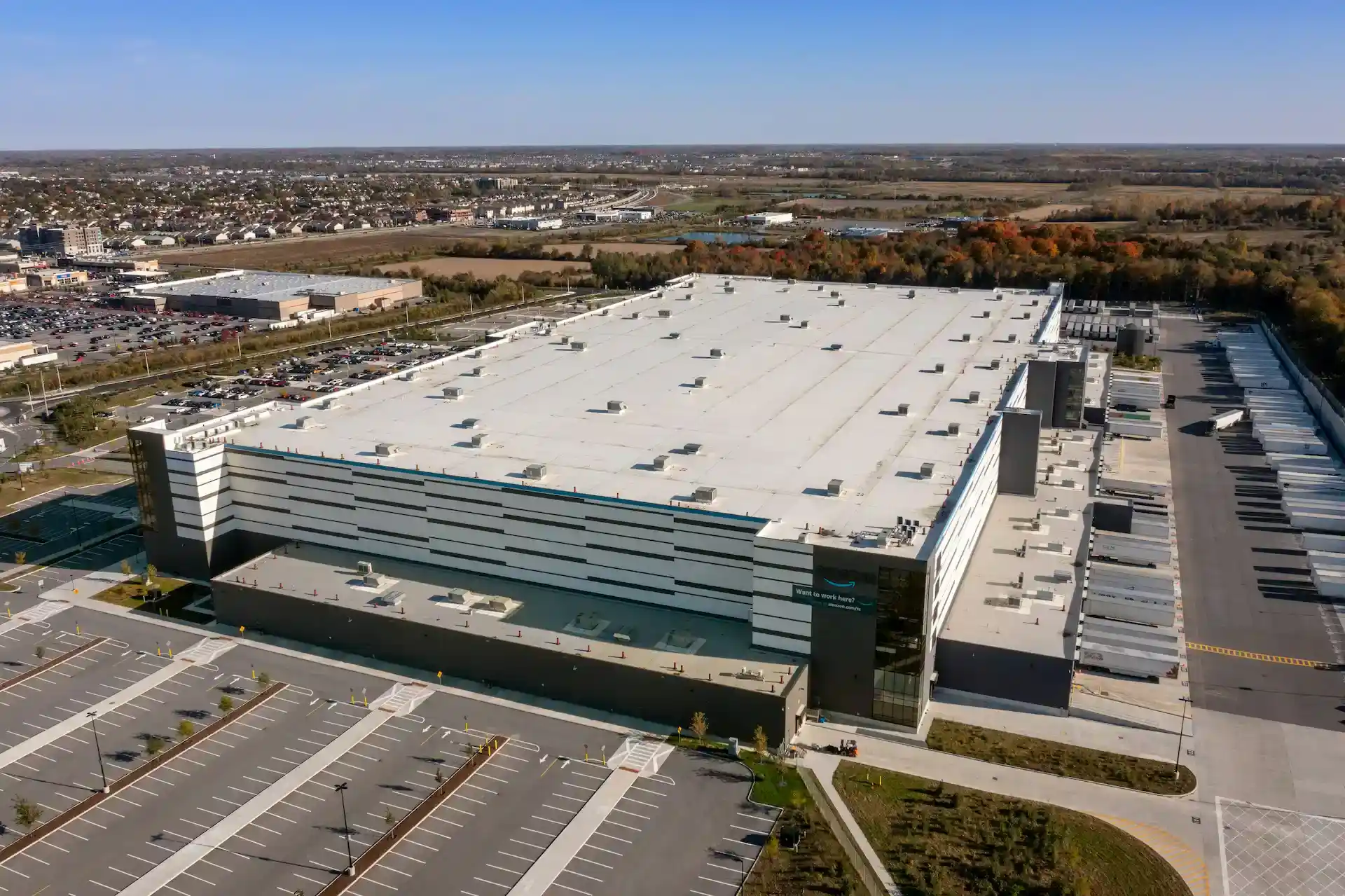
Warehouse and Distribution Center Roofing
Commercial roofing for warehouses, distribution centers, and industrial facilities throughout Charlotte, NC. TPO, EPDM, and metal roof systems.
Commercial Roofers Charlotte
Warehouse and Distribution Center Roofing work starts with a documented roof walk and ends with a scope owners can use.
The Amazon Fulfillment Center in Concord and the Walmart Distribution Center in Monroe anchor Charlotte's massive industrial logistics footprint, which has expanded dramatically along I-85, I-485, and the Cabarrus County industrial corridors as the region has become one of the Southeast's premier distribution hubs. Warehouse roofing contractors serving the Charlotte metro operate in a climate that combines hot, humid summers with occasional ice storms and modest snowfall winters, creating a roofing environment that demands all-season durability and strong wind uplift performance without the extreme cold-weather constraints found further north.
Drainage engineering for Charlotte warehouses must account for the region's intense summer thunderstorm activity, which can deliver two to three inches of rain within an hour during convective events that are common from June through September. Roof drains on large distribution buildings must be sized using Charlotte's design rainfall intensity data from the North Carolina State Building Code and ASCE 7, and the drain field must be positioned to prevent low-slope areas from retaining standing water longer than 48 hours after a rain event. Slow-draining sections of large warehouse roofs are one of the leading causes of accelerated membrane degradation in the Charlotte market because the UV-stressed membrane surface is repeatedly softened and chemically attacked by prolonged water contact.
TPO membrane is the near-universal specification for new warehouse construction in the Charlotte market because it satisfies the dual demands of heat-weldable seam integrity under summer thunderstorm conditions and reflective surface performance during Charlotte's long, hot cooling season. A mechanically attached 60-mil TPO over two layers of polyisocyanurate insulation is the standard assembly for large distribution buildings in Mecklenburg, Cabarrus, and Union counties. North Carolina's energy code requires commercial roof insulation that meets minimum continuous R-value requirements, and the two-layer iso approach with staggered joints achieves code compliance while eliminating the thermal bridging that single-layer fastened systems create.
Dock door and truck court flashing on Charlotte-area warehouses must accommodate the thermal expansion cycles driven by the region's temperature swings - summer afternoons regularly reach 95F while January nights can dip into the single digits during cold-air outflow events. Metal dock door frames and CMU wall panels expand and contract by measurable amounts across this seasonal temperature range, and any flashing system that relies on a rigid bond to both surfaces will develop gaps within two to three years. Contractors serving the Charlotte warehouse market specify EPDM or TPO flexible flashing tape at all dock wall transitions, providing the elastic elongation capacity to follow building movement without cracking or peeling.
For portfolio owners, the goal is consistent documentation across properties, not a one-off opinion that cannot be compared later.
The first visit produces a practical roof record: current conditions, visible failure points, drainage notes, access concerns, and the repair or replacement path that fits the building.
Owners get a written scope that separates urgent water-control work from longer-term capital planning, so the roof decision is not made from guesswork.
The closeout package keeps the next decision clear with before photos, after photos, material notes, warranty coordination, and recommended maintenance timing.
For occupied buildings, staging, access, odor control, and tenant communication are part of the roof plan before crews arrive.
Can a new single-ply membrane be installed over an existing BUR roof on a Charlotte building?
Yes, if the moisture survey shows the existing BUR insulation is dry and the BUR plies are structurally intact. Most major TPO and EPDM manufacturers have published recover specifications that allow their membrane to be installed over a sound BUR substrate. The recover specification typically requires a cover board - high-density polyiso or gypsum - over the existing BUR surface before the new membrane is installed. We verify the recover specification with the manufacturer before scoping and obtain manufacturer confirmation that the recover configuration qualifies for the target warranty term.
How many cores do you pull on a Charlotte BUR moisture survey?
Minimum five locations on a roof under 10,000 square feet. On larger roofs we target one core per 2,000 to 2,500 square feet, concentrated in areas showing surface deflection, prior repair work, or drainage anomalies. On BUR roofs with a history of localized leaks, we pull additional cores around the reported leak locations and at all four parapet corners - the highest-probability moisture entry points on older Charlotte BUR systems.
Does BUR work require a permit?
Replacement and recover projects above the City of Charlotte's threshold - currently $30,000 in contract value for commercial work - require a building permit filed with the relevant jurisdiction. We handle permitting as part of our scope for all BUR replacement and recover projects in Charlotte, Mecklenburg County, and the surrounding municipalities. Repair work below the permit threshold does not typically require a permit, but we document all repair work to the same standard regardless of permit status.
BUR assessment for an older Charlotte commercial building?
We will walk the roof, pull moisture cores, and produce a written assessment with recover-vs-tear-off recommendation - for any BUR system in Uptown, South End, NoDa, or anywhere else in the Charlotte metro.
Planning Warehouse and Distribution Center Roofing
Warehouse and Distribution Center Roofing should be evaluated through the roof condition, the building use, the owner's timing, and the level of documentation needed to make a decision.
The written record should make the next step clear without relying on broad claims or generic sales language.
Request a Written Scope