

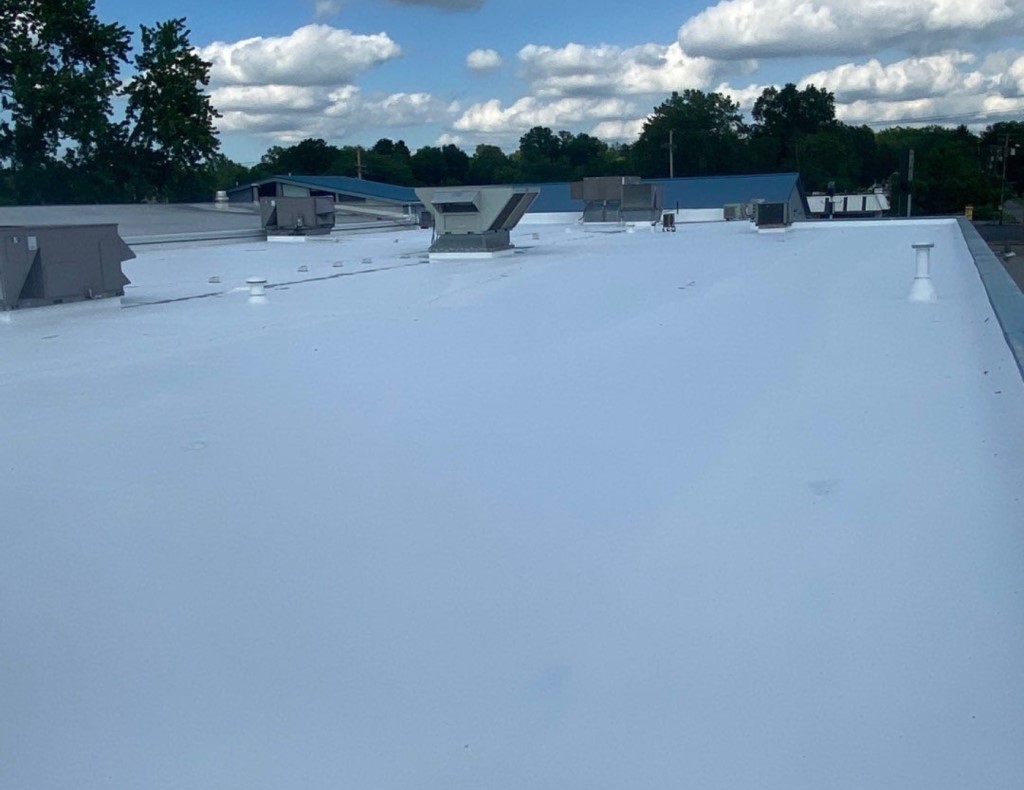
Single-Ply Roofing
Single-ply commercial roofing for Charlotte - TPO, EPDM, and PVC membrane selection, installation, and warranty programs for the full range of commercial building types across Mecklenburg County.
Commercial Roofers Charlotte
Single-Ply Roofing work starts with a documented roof walk and ends with a scope owners can use.
TPO, EPDM, and PVC single-ply systems for Charlotte commercial buildings - membrane selection scoped against the building's use, climate exposure, and capital horizon, with manufacturer warranty documentation from the industry's leading programs.
Single-ply roofing is not a membrane - it is a category of commercial roofing systems that includes three distinct membrane chemistries, each with different performance profiles, installation requirements, and warranty structures. Charlotte building owners who ask for a single-ply quote without specifying membrane type are getting bids that may be comparing fundamentally different products at different installed costs. The price spread between 45-mil EPDM and 80-mil TPO on a 50,000 square foot Charlotte commercial building can be $150,000 or more. The specifications are not equivalent.
We install all three single-ply chemistries - TPO, EPDM, and PVC - and we specify based on the building's actual requirements: use, rooftop traffic density, chemical exposure environment, existing substrate condition, wind-uplift exposure category, and owner capital horizon. Our office at Uptown Charlotte, in Uptown Charlotte between the Uptown office towers and the financial district headquarters, serves the full range of Charlotte commercial building types - from the dense high-rise office stock in Uptown to the 400,000 square foot distribution buildings on the Steele Creek corridor.
Charlotte's climate context shapes every single-ply specification we produce. The Carolina Piedmont's summer thunderstorm pattern means any single-ply installation must account for same-day dry-in sequencing during tear-off and installation. The Helene remnant rainfall in 2024 demonstrated that drain sizing is as important as membrane selection - a correctly specified 60-mil TPO membrane over an undersized drain system still results in a flooded building. We design drain capacity alongside membrane specification on every project.
For portfolio owners, the goal is consistent documentation across properties, not a one-off opinion that cannot be compared later.
The first visit produces a practical roof record: current conditions, visible failure points, drainage notes, access concerns, and the repair or replacement path that fits the building.
Owners get a written scope that separates urgent water-control work from longer-term capital planning, so the roof decision is not made from guesswork.
The closeout package keeps the next decision clear with before photos, after photos, material notes, warranty coordination, and recommended maintenance timing.
For occupied buildings, staging, access, odor control, and tenant communication are part of the roof plan before crews arrive.
TPO vs. EPDM vs. PVC: How We Match System to Building
TPO for volume commercial work: The default specification for most Charlotte commercial buildings - strip centers in Matthews and Mint Hill, warehouse buildings in the Steele Creek corridor, office buildings in University Research Park, and the speculative industrial product in the Westinghouse Boulevard zone. TPO's reflective white surface satisfies the North Carolina 2021 NCBC cool-roof requirement without an additional coating, and its heat-welded seams produce reliable factory-testable joints. 60-mil TPO on tapered polyiso over mechanically fastened base is the highest-frequency specification we install across the Charlotte market.
EPDM for high-traffic and industrial applications: The specification for Charlotte buildings with heavy rooftop equipment access, chemical inertness requirements, or existing ballasted-EPDM substrate conditions where a recover extends service life. The Steele Creek warehouse buildings with dense rooftop HVAC arrays, the CLT airport cargo facilities with heavy mechanical maintenance traffic, and the NoDa adaptive-reuse buildings with masonry parapets where membrane movement accommodation is critical are all EPDM applications in the Charlotte market.
PVC for chemical exposure environments: The specification where TPO or EPDM would degrade prematurely. Restaurant corridor buildings in South End and NoDa, medical office buildings in the SouthPark Mall cluster, and industrial facilities in the Westinghouse Boulevard zone where petroleum or solvent exposure is realistic. PVC costs more per square foot but avoids the premature failure costs that result from specifying the wrong membrane in a chemical-exposure environment.
Single-Ply System Components Beyond the Membrane
Insulation assembly: The insulation system beneath the single-ply membrane determines the system's thermal performance, wind-uplift resistance, and compatibility with the manufacturer's warranty program. North Carolina's 2021 NCBC requires minimum R-25 insulation for low-slope commercial applications in Climate Zone 3. The standard Charlotte stack is polyiso primary with a high-density cover board - HD polyiso or gypsum-based - because standard-density polyiso compresses under foot traffic and creates ponding low spots that accelerate membrane degradation at the compressed locations. Tapered insulation packages are designed against the actual drain layout documented during the pre-installation inspection.
Fastener pattern and attachment: Mechanically attached single-ply systems are secured with factory-specified fastener rows and patterns designed against ASCE 7-22 wind-uplift requirements for the building's exposure category. Charlotte ASCE Wind Zone II - 115 mph basic wind speed - is the baseline. Buildings near CLT airport open exposure, Lake Norman lakefront, and the open-field industrial zone along the Steele Creek corridor get higher fastener density. We provide stamped engineering fastener patterns for every project above 20,000 square feet.
Flashing and detail work: Single-ply flashing details at parapets, penetrations, curbs, and drains are where most commercial roof failures originate. The Charlotte market's predominant flashing failure mode - parapet flashing separation on masonry walls in South End, NoDa, and older Uptown commercial buildings - is a detail problem, not a membrane problem. We specify flashing details that accommodate the seasonal movement of Charlotte's masonry parapet walls rather than details that rely on caulk as the primary seal.
Single-Ply Manufacturer Warranty Programs on Charlotte Projects
NDL warranty options by membrane type: 20-year NDL warranties are available from every major manufacturer on 60-mil TPO and EPDM systems. 25-year NDL warranties are available from Sika Sarnafil and Carlisle on 60-mil PVC. 80-mil TPO systems can carry 25-year NDL warranties from select manufacturers. Every warranty requires documented annual maintenance by a credentialed contractor - a requirement that is written into the warranty document and enforced by the warranty desk when claims are submitted.
Manufacturer field inspections at closeout: Every single-ply project we close out requires a manufacturer's field representative inspection before the NDL warranty is issued. We schedule and attend that inspection. The inspection verifies that the installed system matches the submitted shop drawings, that seam quality meets manufacturer standards, and that all penetration and flashing details are correctly installed. A system that passes field inspection is one the manufacturer will honor when a warranty claim is submitted - which is the point of the warranty.
Can single-ply roofing be installed during Charlotte's winter?
Mechanically attached TPO and EPDM can be installed in Charlotte's mild winters - ambient temperature thresholds for these systems are typically above 25-30F, and Charlotte winters rarely sustain temperatures below those thresholds for extended periods. Adhesive-set fully adhered systems and self-adhered modified bitumen have higher temperature minimums and require morning temperature readings before application. We schedule temperature-sensitive installations with mid-morning start times based on actual ambient reading, not forecast alone.
How do I know which single-ply membrane my Charlotte building needs?
We make that call from the inspection - not from a phone conversation. Building use, rooftop traffic density, chemical exposure environment, existing substrate type, and the building's location within Charlotte's exposure zones all factor into the specification. Charlotte buildings near the CLT airport and in the Steele Creek open-field corridor get different fastener patterns than sheltered campus buildings. NoDa and South End buildings with masonry parapets get different flashing details than poured-concrete Uptown high-rise sections. The specification is building-specific, and it starts with a documented walk.
Single-ply roofing assessment for your Charlotte commercial building?
We will walk the roof, assess substrate and drainage conditions, and produce a single-ply specification - TPO, EPDM, or PVC - matched to your building's use and capital horizon, for any commercial building in Mecklenburg County or the surrounding Charlotte metro.
Request a Written Scope