

Solar-Ready Commercial Roofing & PV Integration
Solar-ready commercial roofing in Charlotte, NC. We handle PV racking penetrations, membrane compatibility, structural and uplift loads, and the warranty handoff between roofer and solar installer.
Commercial Roofers Charlotte
Solar-Ready Commercial Roofing & PV Integration work starts with a documented roof walk and ends with a scope owners can use.
The roof is the part of a solar project nobody budgeted for A photovoltaic array is a 25-year piece of equipment, and somebody is about to bolt it to your roof.
That single sentence is the whole reason owners call us before they sign a solar contract.
Out along the Steele Creek distribution corridor near Charlotte Douglas International, and across the manufacturing and flex space toward the University Research Park on US-29, we keep finding arrays that were dropped onto membranes with only a handful of years left in them.
When that membrane gives out, the array does not move itself.
A crew has to de-energize the system, lift the panels and racking off, stage them somewhere, replace the roof, and reset everything.
On a mid-size Charlotte warehouse that surprise can run well into five figures, and it is completely avoidable if the roof is dealt with first.
We sit on the roofing side of this, and we do not earn anything on the solar contract.
That is exactly why owners trust our read: we tell you whether the deck and membrane are actually ready to host an array, or whether you are about to spend solar money on a roof that is going to fail underneath it.
What has to be true before panels go up Three questions decide whether a roof is solar-ready, and a solar proforma almost never asks any of them because it treats the roof as a free, permanent platform.
Does the membrane have the life to carry a 25-year array?
We core-cut the roof and run an infrared moisture survey to see whether the field is dry and how many years it really has left.
A roof with fifteen-plus dry years is a candidate to build on.
The roof is the part of a solar project nobody budgeted for
A photovoltaic array is a 25-year piece of equipment, and somebody is about to bolt it to your roof. That single sentence is the whole reason owners call us before they sign a solar contract. Out along the Steele Creek distribution corridor near Charlotte Douglas International, and across the manufacturing and flex space toward the University Research Park on US-29, we keep finding arrays that were dropped onto membranes with only a handful of years left in them. When that membrane gives out, the array does not move itself. A crew has to de-energize the system, lift the panels and racking off, stage them somewhere, replace the roof, and reset everything. On a mid-size Charlotte warehouse that surprise can run well into five figures, and it is completely avoidable if the roof is dealt with first.
We sit on the roofing side of this, and we do not earn anything on the solar contract. That is exactly why owners trust our read: we tell you whether the deck and membrane are actually ready to host an array, or whether you are about to spend solar money on a roof that is going to fail underneath it.
What has to be true before panels go up
Three questions decide whether a roof is solar-ready, and a solar proforma almost never asks any of them because it treats the roof as a free, permanent platform. It is neither.
Does the membrane have the life to carry a 25-year array?
We core-cut the roof and run an infrared moisture survey to see whether the field is dry and how many years it really has left. A roof with fifteen-plus dry years is a candidate to build on. A roof in the single digits is not, and we will tell you plainly that reroofing first is cheaper than paying to remove and reset an array later.
Can the structure take the weight and the uplift?
Racking, panels, and any ballast all add real dead load per square foot, and wind adds uplift pulling the other direction. A lot of Charlotte's older industrial stock was framed to lighter load tables than today's code. Before anything is ordered, the deck and framing have to be confirmed against the proposed system. A structural engineer's sign-off here is not optional.
Ballast or anchored attachment?
Ballasted racking holds the array down with weighted pads and leaves the membrane unbroken, which suits a flat Charlotte roof with spare load capacity. Mechanically anchored racking penetrates the membrane and is the answer on slopes or where weight is the constraint. The choice trades structural load against penetration count, and it depends on your deck, your wind exposure, and your membrane.
Every penetration is a future leak unless it is detailed right
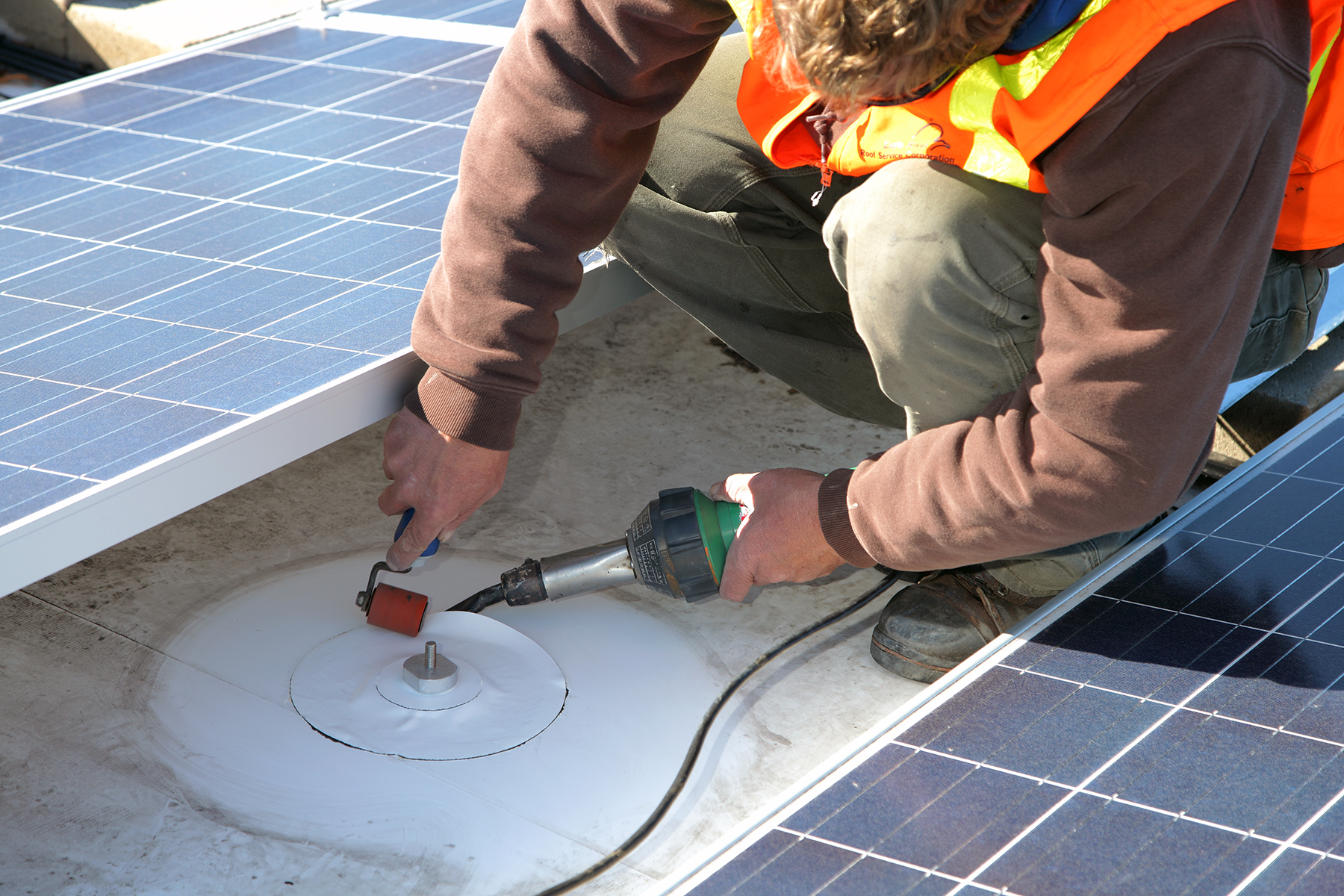
The integration leaks we get called back to repair almost never come from the panels. They come from the wiring. A solar electrician clamps conduit straight to the membrane with no standoff, and as it heats and shifts through Charlotte's temperature swings it chafes a hole through the sheet. Or a conduit penetration gets boot-flashed with a generic part that was never made for that detail, and it weeps for a year into the insulation before anyone notices the wet spot on the moisture scan.
Our rule eliminates most of it: the roofer flashes the roof penetrations, not the electrician. On any anchored array we treat each racking foot and conduit run like any other roof penetration, with a manufacturer-approved base and properly welded or adhered flashing tied into the field membrane. And we map the entire conduit route and every penetration with the solar EPC during preconstruction, before the electrician ever shows up, so nothing gets fastened to the membrane on the fly.
Picking a membrane that works under an array
The membrane spec changes once an array is sitting on it. For most solar-ready commercial roofs in Charlotte we specify a 60-mil reflective white TPO or PVC system. The reflective surface keeps the deck under the panels cooler, which helps module output through our long, hot summers, and a mechanically attached sheet gives ballasted racking a stable, uniform field to sit on. Where the structure rules out ballast weight, we shift to a fully adhered system paired with anchored racking. What we will not do is let a solar layout push us into a membrane that is wrong for your building.
Should we reroof before installing solar, or can we mount on what we have?
It comes down to remaining membrane life. With fifteen or more dry years left, mounting on the existing roof is reasonable. With seven years or less, reroofing first almost always beats paying to remove and reset the array during a future replacement. We core-cut and scan the roof and hand you a service-life estimate before you decide.
Do the mounts have to penetrate my roof?
Not necessarily. Ballasted racking holds the array with weighted pads and leaves the membrane intact, which is common on flat Charlotte roofs with spare structural capacity. Anchored racking penetrates the membrane and is used on slopes or where load limits rule out ballast. When we do penetrate, every foot is flashed to the manufacturer's detail and pulled into the warranty.
What membrane works best under an array?
For most solar-ready commercial roofs here we specify 60-mil white TPO or PVC, mechanically attached. The reflective surface helps module performance through Charlotte's heat, and the attached sheet is a stable base for ballasted racking. Fully adhered systems pair with anchored racking where ballast weight is a problem.
Request a Written Scope