

Silicone Roof Coating
Silicone roof coating for Charlotte commercial flat roofs - fluid-applied seamless restoration at 20-50 mils dry-film thickness with 10, 15, or 20-year manufacturer warranty options for Mecklenburg County
Commercial Roofers Charlotte
Silicone roof coating for Charlotte commercial flat roofs - fluid-applied seamless restoration at 20-50 mils dry-film thickness with 10, 15, or 20-year manufacturer warranty options for Mecklenburg County buildings with sound existing membranes.
Silicone Roof Coating work starts with a documented roof walk and ends with a scope owners can use.
Fluid-applied silicone restoration for Charlotte commercial flat roofs - a seamless coating system installed over sound existing single-ply or modified bitumen membranes that carries 10, 15, or 20-year manufacturer warranties and avoids the disruption and waste of a full tear-off.
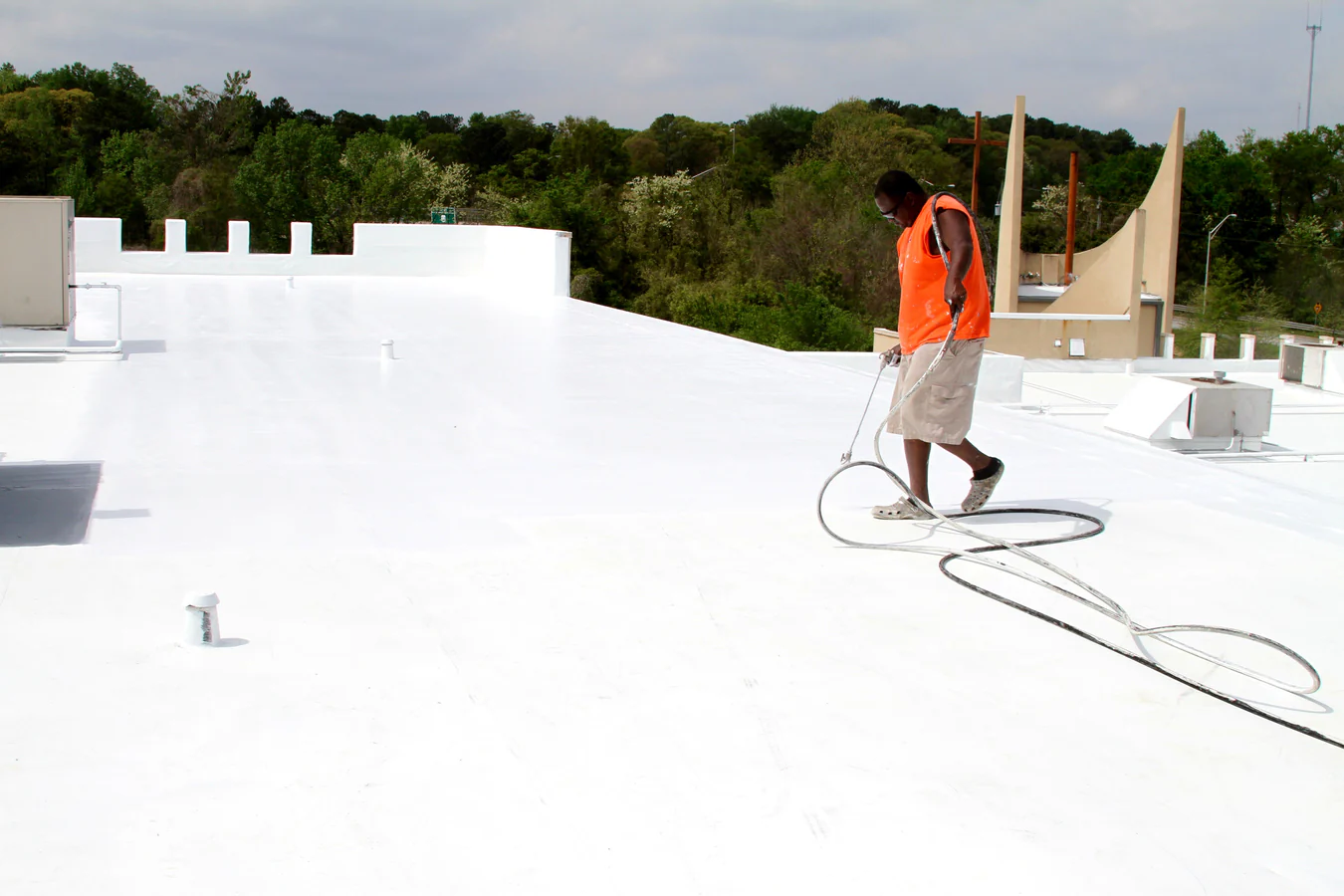
Silicone roof coating is a fluid-applied membrane applied over an existing commercial roof surface in one or two passes to build to a target dry-film thickness - typically 20 mils for a 10-year warranty and 30 to 40 mils for 15- and 20-year warranty systems. The finished coating is seamless, UV-stable, and highly ponding-water resistant - a critical attribute for Charlotte commercial buildings where drain systems are often undersized for the current ASCE 7-22 rainfall intensity standard and temporary ponding after heavy storms is common.
We specify silicone coating for Charlotte commercial buildings when three conditions are met: the existing membrane has no active leaks or the leaks are isolated and repairable before coating, the moisture survey shows the existing insulation is dry, and the building owner's capital horizon is 10 to 20 years rather than 30 to 40. A silicone coating system at the right mil thickness costs roughly 40 to 60 percent of a full replacement on the same roof area, avoids landfill disposal of the existing membrane, and produces a warranted system that a future owner, lender, or insurer can evaluate. If the existing insulation is wet or the membrane has failed in more than isolated areas, coating is not the right scope - tear-off and replacement is.
Charlotte's summer afternoon thunderstorm pattern makes silicone coating particularly relevant for the large-footprint warehouse and distribution buildings in the Steele Creek corridor and the University Research Park logistics zone north of UNC Charlotte. These buildings often have slow-draining internal drain systems that pond water for 24 to 48 hours after significant rain events. Silicone's ponding-water resistance is the attribute that distinguishes it from acrylic and polyurethane coatings - silicone does not re-emulsify, blister, or delaminate under standing water. On a Charlotte warehouse with chronic slow drainage, acrylic coating will fail within three to five years. Silicone holds.
The closeout package keeps the next decision clear with before photos, after photos, material notes, warranty coordination, and recommended maintenance timing.
For occupied buildings, staging, access, odor control, and tenant communication are part of the roof plan before crews arrive.
For portfolio owners, the goal is consistent documentation across properties, not a one-off opinion that cannot be compared later.
The first visit produces a practical roof record: current conditions, visible failure points, drainage notes, access concerns, and the repair or replacement path that fits the building.
Owners get a written scope that separates urgent water-control work from longer-term capital planning, so the roof decision is not made from guesswork.
Surface Preparation - Where Silicone Coating Projects Fail
The most common silicone coating failure mode we see on Charlotte commercial buildings is adhesion failure - the coating peels from the existing membrane surface within two to three years. The cause is almost always surface preparation: the substrate was not clean, dry, and mechanically prepared before coating was applied. Silicone bonds to TPO, EPDM, modified bitumen, and BUR surfaces at adequate adhesion levels only when those surfaces are clean of organic contamination, chalk, and loose material, and when a primer appropriate to the substrate has been applied at the manufacturer's specified rate.
Our surface preparation protocol for Charlotte silicone coating projects starts with pressure washing - 3,000 PSI minimum - to remove organic growth, dirt, and chalk. Charlotte's humidity drives biological growth on commercial flat roofs faster than in drier markets. A TPO membrane that has been on a Charlotte warehouse roof for 12 years without maintenance is typically carrying a film of algae and biofilm that, if not removed, will prevent silicone adhesion regardless of primer type. After washing, we allow the surface to dry completely - typically 24 to 48 hours of dry weather in Charlotte's humid climate - before primer application.
Seam repair before coating is non-negotiable. Every open or lifting seam on the existing membrane is repaired with a heat-welded patch (for TPO and PVC) or a compatible seam tape system (for EPDM and modified bitumen) before any coating is applied. Coating over an open seam does not seal the seam - the coating bridges the gap but the underlying seam failure will telegraph through the coating within one to two years. We document every seam repair on a zone-keyed photograph log and provide that log to the building owner at project closeout.
Warranty Options and Application Thickness
Silicone coating manufacturer warranties are directly tied to applied dry-film thickness. The standard warranty tiers from the major coating manufacturers - GE Advanced Materials, Dow Corning, Henry Company, Tremco, and others - map approximately as follows: 20 mils DFT for a 10-year warranty, 25 to 30 mils DFT for a 15-year warranty, and 35 to 40 mils DFT for a 20-year warranty. Wet-film application rates must account for the spread rate loss over textured surfaces - TPO textured membranes and granule-surface modified bitumen require higher wet-film rates to achieve the target dry-film thickness.
We measure wet film at application using a wet-film gauge, and we verify dry-film at completion with a mil gauge at a minimum of one reading per 1,000 square feet of coated area. These measurements are logged by zone and submitted to the manufacturer as part of the warranty registration package. Without documented thickness verification, most silicone coating manufacturers will not issue the warranty - or will issue a warranty they can void if the building ever makes a claim and the thickness cannot be proven.
For Charlotte commercial buildings pursuing a 20-year warranty system, we typically apply silicone in two passes rather than one. A single 40-mil wet-film application over a textured TPO surface is difficult to achieve uniformly - the coating tends to bridge low spots and pool in textured valleys, producing uneven dry-film thickness. Two passes of 20 mils wet each produce more consistent coverage and give the applicator a secondary opportunity to catch and fill any areas that read low on the wet-film gauge after the first pass.
When Silicone Coating Is Not the Right Scope
Silicone coating is not appropriate for Charlotte commercial buildings where the moisture survey shows wet insulation. Coating over wet insulation traps moisture - vapor pressure from the trapped moisture works against the coating adhesion layer and produces blistering and delamination within three to five years. If we pull cores on a Charlotte building and find saturated or damp insulation in more than isolated areas, we tell the building owner that coating is not the right scope and explain why. A coating project that fails in three years is more expensive than a replacement done correctly today.
Silicone coating is also not appropriate over severely degraded membrane surfaces - membranes that are cracking, shrinking (a common late-life EPDM failure mode), or showing widespread seam failure across more than 15 to 20 percent of the field. The coating application will not stabilize a membrane that is in structural failure. In those cases, tear-off and replacement is the scope. We make this determination from the condition assessment - not from which scope generates more revenue.
Finally, silicone coating is not appropriate for Charlotte buildings where the owner's capital horizon requires the longest possible system life. A 20-year warranted silicone system provides 20 years. A new 60-mil TPO or EPDM system provides 20 to 25 years of warranted life, typically at a higher first cost but with a longer runway before the next capital event. For building owners whose asset plan extends 25 to 30 years, we recommend full replacement over coating and provide a comparison of total cost of ownership across both paths.
Can silicone coating be applied over an existing silicone coating on a Charlotte building?
Yes - silicone bonds to silicone without a primer for most manufacturer systems, which makes it one of the few coating types that can be recoated at warranty end without tear-off. At 10 or 20-year warranty expiration on a Charlotte commercial building with a silicone coating system, the building owner can recoat to the target mil thickness and renew the warranty - provided the existing coating is still adhered and the membrane below remains intact. We assess the existing coating adhesion and mil thickness before recommending a recoat and provide a written scope with the thickness verification plan.
How long does a silicone coating project take on a Charlotte commercial building?
A 50,000 square foot TPO roof with required seam repairs, surface prep, and two-coat silicone application typically runs 5 to 7 working days of production, depending on weather. Charlotte's summer thunderstorm season is the primary scheduling variable - silicone cannot be applied to a wet surface, and a storm that wets the prepared surface requires a full drying period before coating can resume. We build weather days into every coating schedule and provide a realistic production timeline with weather-day assumptions before contract signing.
Does silicone coating reduce energy costs?
A white silicone coating with a solar reflectance index above 100 reduces rooftop surface temperatures significantly compared to a dark or chalked-surface membrane. For Charlotte commercial buildings without adequate insulation below the membrane, that surface temperature reduction can translate to reduced HVAC load during summer. The ENERGY STAR cool-roof reflectance and emittance requirements are met by most white silicone coating systems we install. We provide the manufacturer's ENERGY STAR certification documentation at closeout for any building owner pursuing utility rebates or LEED credit.
Silicone coating assessment for a Charlotte commercial roof?
We will walk the roof, pull moisture cores to confirm the coating path is appropriate, and produce a written scope with warranty options and installed cost range for any commercial building in Mecklenburg County or the surrounding Charlotte metro.
Request a Written Scope