

Infrared Moisture Scanning
Infrared thermography and capacitance-based moisture scanning for Charlotte commercial flat roofs - locate wet insulation, map moisture migration paths, and document recover-vs-replace decisions before a single dollar is
Commercial Roofers Charlotte
Infrared thermography and capacitance-based moisture scanning for Charlotte commercial flat roofs - locate wet insulation, map moisture migration paths, and document recover-vs-replace decisions before a single dollar is committed.
Infrared Moisture Scanning work starts with a documented roof walk and ends with a scope owners can use.
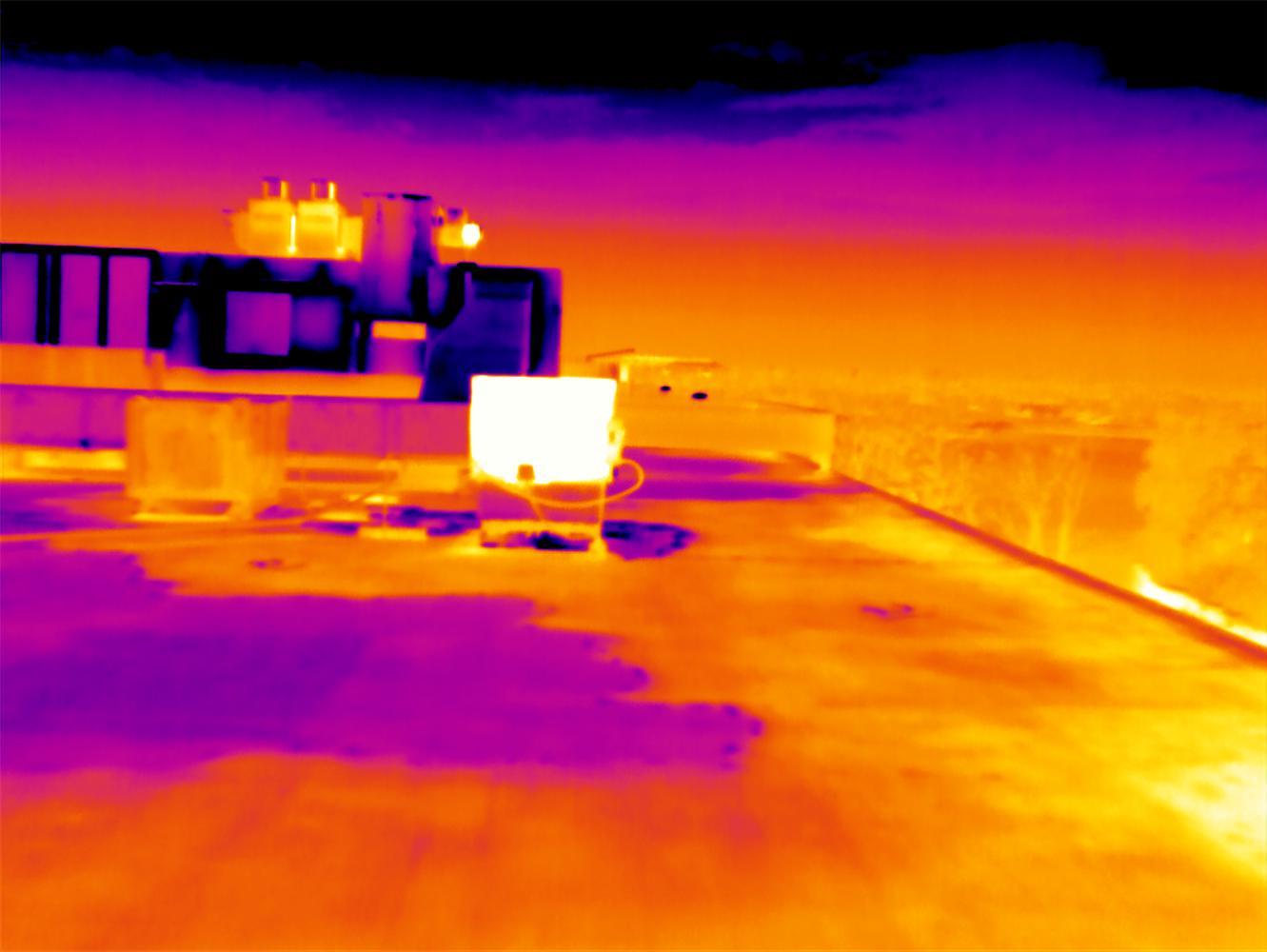
Wet insulation in a commercial flat roof is invisible from the surface and undetectable in a standard visual inspection. Infrared thermography locates it without cutting - and changes what a Charlotte building owner knows about their roof before they commit capital.
A visual inspection of a commercial flat roof in Charlotte tells you what you can see: surface condition, flashing integrity, drain rings, evidence of prior repairs. It does not tell you what is under the membrane. A TPO roof that looks clean from the surface can be sitting on insulation that is 40 percent saturated - wet from a drain failure three years ago, from a flashing lap that lifted and sealed itself back down after the damage was done, or from a membrane blister that cycled open and closed with Charlotte's thermal fluctuations. That wet insulation is doing two things: degrading continuously, and concealing the full cost of whatever scope decision comes next.
Infrared thermography uses the differential thermal mass of wet versus dry insulation to make saturated insulation visible in a thermal image. After sundown on a warm day, a commercial roof radiates stored heat into the night sky. Dry insulation releases heat at one rate; wet insulation - with its higher thermal mass - holds heat longer and appears warmer in a calibrated IR camera. A trained technician walking a Charlotte flat roof after sunset with a calibrated thermal camera produces a thermal map of the entire field that distinguishes wet and dry zones with high accuracy.
Owners get a written scope that separates urgent water-control work from longer-term capital planning, so the roof decision is not made from guesswork.
The closeout package keeps the next decision clear with before photos, after photos, material notes, warranty coordination, and recommended maintenance timing.
For occupied buildings, staging, access, odor control, and tenant communication are part of the roof plan before crews arrive.
For portfolio owners, the goal is consistent documentation across properties, not a one-off opinion that cannot be compared later.
The first visit produces a practical roof record: current conditions, visible failure points, drainage notes, access concerns, and the repair or replacement path that fits the building.
Why Moisture Scanning Matters for Charlotte Building Owners
Insurance claim support after Charlotte weather events: Hail events, wind events, and the residual rainfall from Atlantic tropical systems that reach the Piedmont - including the Helene remnant in September 2024 - produce insurance claims that require documented proof of storm-related moisture intrusion distinct from pre-existing saturation. An infrared survey conducted within 30 days of the event produces exactly that documentation. The survey map shows new moisture migration paths from storm-related entry points and distinguishes them from older, stable wet zones that predate the event. Insurance carriers - and their adjusters - use this data when evaluating claims.
Pre-purchase due diligence on Charlotte commercial acquisitions: Buyers acquiring Ballantyne corporate campus buildings, Steele Creek warehouse blocks, or South End adaptive reuse properties need to know the moisture condition of the roof before closing. A moisture survey conducted during the inspection period quantifies the insulation remediation cost with precision and changes the capital reserve calculation in the purchase model. A wet insulation condition that would cost $180,000 to address in full tearout and replacement is a very different underwriting item than a localized wet zone that costs $30,000 to cut out and patch.
Our Infrared Survey Process for Charlotte Buildings
Pre-scan conditions assessment: Infrared thermography requires a minimum of four hours of direct solar loading on the day of the scan to create the thermal differential that makes wet zones visible. For Charlotte scans, we check the solar irradiance forecast, the cloud cover timeline, and the overnight cooling rate forecast before scheduling. Scans scheduled for partly cloudy days in Charlotte's variable spring weather require a weather contingency window. We do not charge a mobilization fee for weather postponements when the conditions were outside the forecast range at the time of scheduling.
Roof walk with marked grid: The technician walks the roof in parallel passes spaced to keep the entire field within the camera's thermal resolution range. Every 200-square-foot zone is photographed and recorded. Suspect zones - areas where the thermal image suggests elevated moisture - are marked with chalk and core-pulled in the field for physical confirmation. The core pull is the ground truth that confirms the thermal anomaly represents actual wet insulation rather than a thermal artifact from a seam, fastener pattern, or membrane color change.
Moisture map delivery: The survey deliverable is a scaled moisture map of the roof showing wet zones, borderline zones, and dry zones by color coding. The map is overlaid on the building's roof plan and quantifies the approximate square footage of each moisture category. The written report includes the core-pull confirmation data for any zones physically sampled, the methodology and conditions of the scan, and a recover-vs-replace recommendation with the technical basis explained.
Follow-up scope integration: We use the moisture map data to scope the appropriate remediation. In a partial wet case - say, 15 percent of an Arrowood industrial building's insulation field is wet, concentrated around two drain locations - the scope is targeted wet-area replacement of the insulation in those zones, re-cover of the full field, and drain reconstruction. In a high-saturation case - over 25 percent of the field is wet with migration from multiple entry points - the scope is full replacement. The moisture map is the first document in the project file, and every scope decision traces back to it.
Conditions Where Infrared Scanning Is Essential
Post-hail event assessment: Hail impacts on TPO and EPDM membranes can cause immediate perforation or sub-surface damage that becomes an entry point in subsequent rainfall. Charlotte's secondary hail corridor - storm tracks that move off the Appalachian front in spring and up from the Gulf in late summer and fall - produces multiple hail events per season that affect the commercial building stock. After any hail event above 1-inch diameter, a moisture survey documents whether insulation saturation has begun from hail-related perforation. That documentation is essential for insurance claims on buildings where the adjuster argues the damage is cosmetic rather than functional.
End-of-warranty assessment for Ballantyne and University Research Park buildings: Buildings in Ballantyne's first-wave corporate campus cluster - the 2001-2012 buildings on 15-year and 20-year manufacturer warranties - should receive a moisture survey before the warranty expires. If wet insulation is documented while the warranty is active, the manufacturer is on notice and any remediation costs may be recoverable under the warranty terms. Waiting until after expiration forfeits that recovery path.
Post-Helene remediation prioritization: The September 2024 Helene remnant event produced multi-inch rainfall over a compressed timeframe across the Charlotte metro. Buildings with undersized primary drains and no secondary overflow protection - common in the pre-2000 Mecklenburg County commercial stock - experienced drain surcharge and ponding conditions that saturated insulation that had previously been dry. A moisture survey conducted in the months following Helene would identify which buildings in that category absorbed storm-related insulation damage and how much.
When is the best time of year to do infrared scanning on a Charlotte commercial roof?
Late summer through early fall - August through October - produces the best conditions for infrared thermography in Charlotte. Solar loading is high enough to create the required thermal differential, and the overnight cooling rate is sufficient for clear thermal imaging. Early spring scans work when skies are clear and solar loading is adequate, but cloudy spring days in Charlotte often require switching to capacitance scanning. We assess conditions at scheduling and select the method appropriate to the forecast.
How accurate is infrared moisture scanning?
Under ideal conditions - four or more hours of direct solar loading, dry membrane surface, clear overnight sky - infrared thermography has a detection accuracy above 90 percent for wet insulation zones larger than approximately 10 square feet. We ground-truth every thermal anomaly with a physical core pull during the survey walk. The core pull is the confirmation; the thermal image is the locating tool. The combination produces a reliable moisture map that we are willing to use as the basis for scope decisions.
Can moisture scanning be done on a roof that is actively leaking?
Yes, with a caveat. If the roof surface is wet from recent rain, the thermal signal is compromised - the wet surface creates its own thermal signature that interferes with the insulation moisture signature. We schedule infrared surveys a minimum of 24 hours after the last rainfall event. If a building is actively leaking during an ongoing rain event, we can provide emergency temporary containment and schedule the survey for the first dry window.
Do you perform infrared scanning as a standalone service, or only as part of a larger project?
Both. We perform standalone moisture surveys for building owners who need independent documentation - for due diligence, for insurance claims, or for capital planning - with no expectation of a subsequent repair or replacement contract with us. The survey fee is fixed per building based on square footage. If you subsequently contract us for the repair or replacement, the survey fee is credited against the project cost.
Find out what is under your Charlotte commercial roof.
Our technicians will conduct a full infrared moisture survey, ground-truth every anomaly with core pulls, and deliver a moisture map and written report that changes what you know before you commit to any repair or replacement scope.
Request a Written Scope