

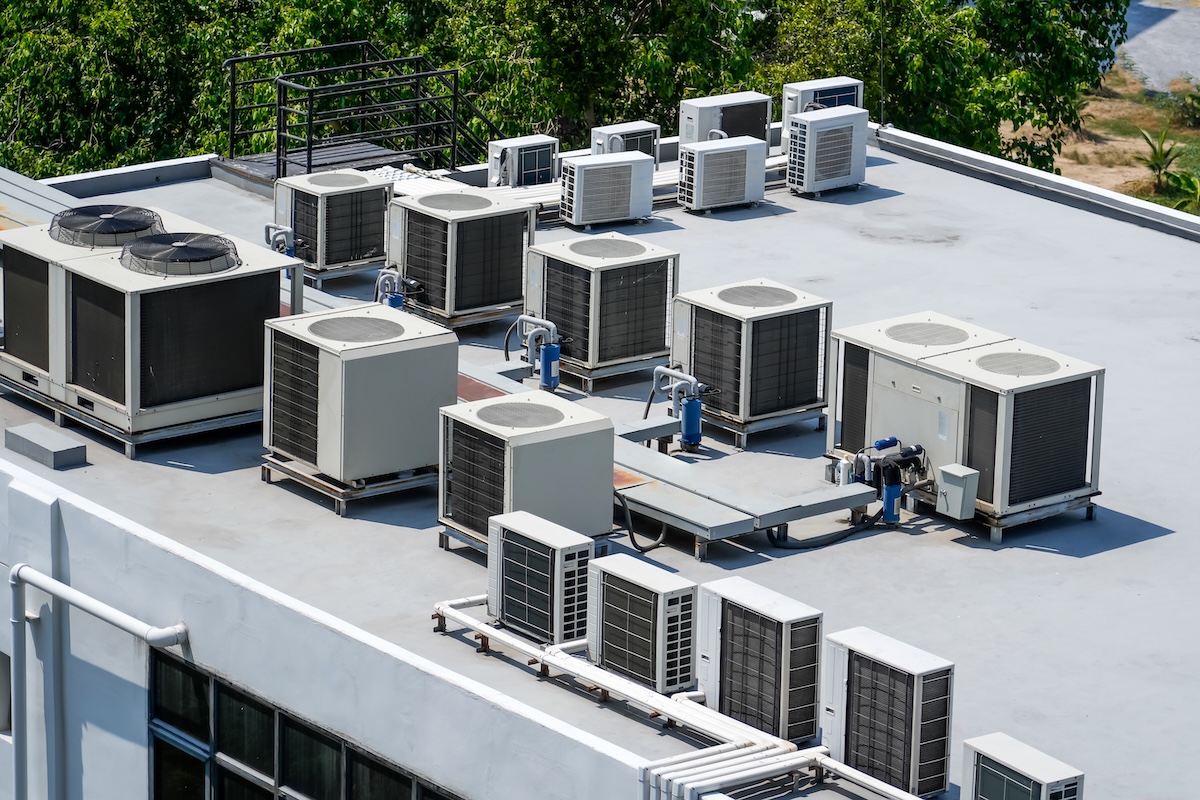
Office Building Roofing
Commercial roofing for Class A, B, and C office buildings, suburban office parks, and downtown towers throughout Charlotte, NC.
Commercial Roofers Charlotte
Office Building Roofing work starts with a documented roof walk and ends with a scope owners can use.
The Uptown office towers on Tryon Street in uptown Charlotte and the Ballantyne Corporate Park campus in south Charlotte represent the twin poles of the city's Class A office market - the dense urban core and the suburban campus format that has grown dramatically alongside Charlotte's financial services and technology sector expansion. Charlotte is one of the Southeast's fastest-growing office markets, and the building owners who manage its Class A and B inventory along the South End corridor, in the University City research district, and on the SouthPark mixed-use campus face roofing decisions that must balance occupied-building operational complexity, North Carolina energy code compliance, and the aesthetic and sustainability standards that nationally competitive tenants increasingly require.
Occupied-building protocols in Charlotte's Class A office market are shaped by the presence of major financial institutions, healthcare organizations, and technology firms whose operational continuity requirements go beyond simple noise restrictions. Reroofing projects on occupied Charlotte office towers require pre-construction planning that identifies the location of all sensitive air intakes, server room ventilation points, and emergency power systems before any membrane-prep or adhesive work is scheduled near those locations. Large trading floors, data centers, and financial operations centers within Charlotte's Class A buildings have zero tolerance for air quality events or power interruptions, and roofing project managers who have not worked in this type of building environment before often underestimate the coordination complexity.
North Carolina energy code compliance for office building reroofing is governed by the state's adoption of the IECC commercial provisions and ASHRAE 90.1, which assign Charlotte to Climate Zone 3A. The continuous insulation requirements for Charlotte office buildings under this framework position polyisocyanurate board at R-15 to R-20 as the code baseline, with additional insulation increasingly specified on premium buildings where the energy model demonstrates meaningful operating cost reduction. utility corridor's commercial demand response programs and energy efficiency incentives have historically provided partial rebates for commercial insulation upgrades that improve the building's thermal performance beyond code requirements.
Reflective cool membrane specification for Charlotte office buildings is strongly supported by the city's Climate Zone 3A classification, where summer cooling loads are the dominant energy cost driver. White TPO or PVC membrane on a Charlotte office building reduces peak cooling demand meaningfully, and the ENERGY STAR roof certification available for qualifying membranes is a straightforward sustainability credential. Charlotte's mild winters mean that the heating-season penalty of a highly reflective membrane is small relative to the cooling benefit, unlike the more nuanced trade-off in Boston or Buffalo, making white membrane the practical choice for most Charlotte office building reroofing projects without the need for detailed energy modeling.
The first visit produces a practical roof record: current conditions, visible failure points, drainage notes, access concerns, and the repair or replacement path that fits the building.
Owners get a written scope that separates urgent water-control work from longer-term capital planning, so the roof decision is not made from guesswork.
The closeout package keeps the next decision clear with before photos, after photos, material notes, warranty coordination, and recommended maintenance timing.
For occupied buildings, staging, access, odor control, and tenant communication are part of the roof plan before crews arrive.
For portfolio owners, the goal is consistent documentation across properties, not a one-off opinion that cannot be compared later.
Can a new single-ply membrane be installed over an existing BUR roof on a Charlotte building?
Yes, if the moisture survey shows the existing BUR insulation is dry and the BUR plies are structurally intact. Most major TPO and EPDM manufacturers have published recover specifications that allow their membrane to be installed over a sound BUR substrate. The recover specification typically requires a cover board - high-density polyiso or gypsum - over the existing BUR surface before the new membrane is installed. We verify the recover specification with the manufacturer before scoping and obtain manufacturer confirmation that the recover configuration qualifies for the target warranty term.
How many cores do you pull on a Charlotte BUR moisture survey?
Minimum five locations on a roof under 10,000 square feet. On larger roofs we target one core per 2,000 to 2,500 square feet, concentrated in areas showing surface deflection, prior repair work, or drainage anomalies. On BUR roofs with a history of localized leaks, we pull additional cores around the reported leak locations and at all four parapet corners - the highest-probability moisture entry points on older Charlotte BUR systems.
Does BUR work require a permit?
Replacement and recover projects above the City of Charlotte's threshold - currently $30,000 in contract value for commercial work - require a building permit filed with the relevant jurisdiction. We handle permitting as part of our scope for all BUR replacement and recover projects in Charlotte, Mecklenburg County, and the surrounding municipalities. Repair work below the permit threshold does not typically require a permit, but we document all repair work to the same standard regardless of permit status.
BUR assessment for an older Charlotte commercial building?
We will walk the roof, pull moisture cores, and produce a written assessment with recover-vs-tear-off recommendation - for any BUR system in Uptown, South End, NoDa, or anywhere else in the Charlotte metro.
Planning Office Building Roofing
Office Building Roofing should be evaluated through the roof condition, the building use, the owner's timing, and the level of documentation needed to make a decision.
The written record should make the next step clear without relying on broad claims or generic sales language.
Request a Written Scope