

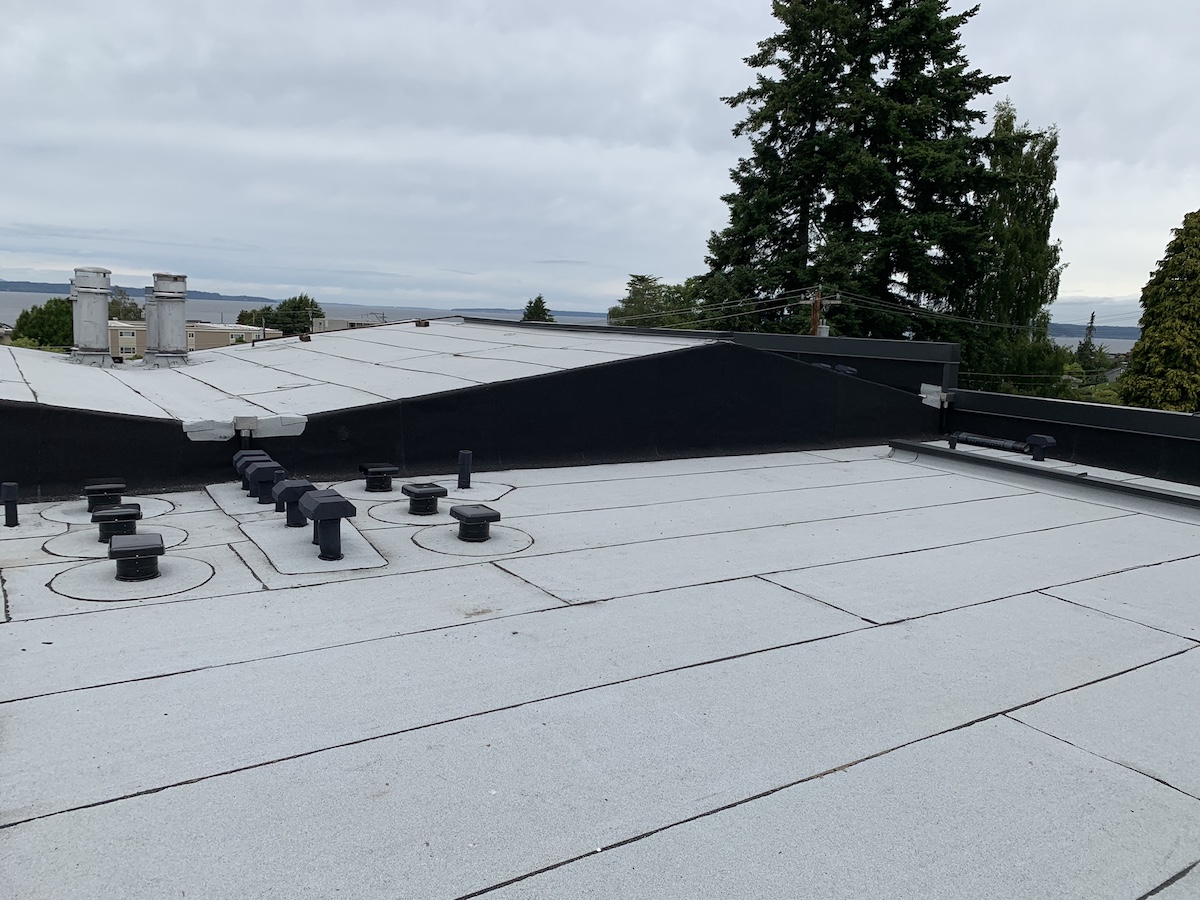
Modified Bitumen Roofing
Modified bitumen roofing installation and recovery for Charlotte commercial buildings - SBS and APP systems over existing BUR substrates, with manufacturer warranty programs.
Commercial Roofers Charlotte
Modified Bitumen Roofing work starts with a documented roof walk and ends with a scope owners can use.
Styrene-butadiene-styrene and APP modified bitumen systems for Charlotte commercial buildings - torch-applied, cold-adhesive, and self-adhered installation over new and existing substrates, with the flexibility and impact resistance that Charlotte's hail corridor demands.
Modified bitumen is Charlotte's oldest surviving low-slope commercial roofing category, and it is still the specification for specific building types and existing-substrate recover situations. The wave of modified bitumen installations that followed Hurricane Hugo's 1989 track over Charlotte - which put hundreds of 1970s-era BUR roofs into emergency replacement - represents the bulk of Charlotte's mid-vintage modified bitumen inventory. That generation of SBS-modified bitumen is now 30-35 years old and actively entering replacement and recover evaluation.
SBS modified bitumen - rubber-modified asphalt - is the specification for Charlotte buildings where cold-temperature flexibility, impact resistance, and the ability to be field-repaired with a torch are the prioritized characteristics. APP modified bitumen - plastic-modified asphalt - is harder and more UV-resistant but less flexible in cold, which limits its application in Charlotte's occasional winter freeze-thaw cycles. We install SBS on the vast majority of Charlotte modified bitumen projects.
From our Uptown Charlotte office at Uptown Charlotte, our modified bitumen installation crews are licensed for torch application - which generates the most durable seams - and for cold-adhesive and self-adhered systems where the building's occupancy or local ordinance constrains open-flame application. The utility corridor Center and several of the Uptown high-rise buildings with occupied terraces adjacent to the work zone require cold-adhesive application.
The first visit produces a practical roof record: current conditions, visible failure points, drainage notes, access concerns, and the repair or replacement path that fits the building.
Owners get a written scope that separates urgent water-control work from longer-term capital planning, so the roof decision is not made from guesswork.
The closeout package keeps the next decision clear with before photos, after photos, material notes, warranty coordination, and recommended maintenance timing.
For occupied buildings, staging, access, odor control, and tenant communication are part of the roof plan before crews arrive.
For portfolio owners, the goal is consistent documentation across properties, not a one-off opinion that cannot be compared later.
Modified Bitumen Systems We Install
Torch-applied SBS cap sheet over a base sheet: The standard modified bitumen specification for Charlotte commercial buildings where open-flame application is permitted. The cap sheet is a granule-surfaced SBS-modified asphalt sheet applied with a propane torch, fused to a mechanically fastened or fully adhered base sheet. Torch application produces the most reliable seam - the bitumen flows to fill micro-voids at the lap and creates a fully fused joint. Charlotte's humid summers require care in torch application - seaming in high-humidity conditions can produce surface blistering if the torch temperature is not calibrated correctly.
Cold-adhesive SBS two-ply: The specification for Charlotte buildings where torch application is not permitted - occupied terraces, buildings adjacent to fuel storage or combustible material, and Uptown properties where the City of Charlotte's fire marshal has restricted open-flame roofing. Cold-adhesive seams are more sensitive to temperature and substrate cleanliness than torch seams, but properly applied cold-adhesive modified bitumen systems carry the same manufacturer warranty terms.
Self-adhered modified bitumen: The fastest-installation option for small-area repairs and recover projects on Charlotte buildings where crew scheduling and production speed are constraints. Self-adhered sheets have pressure-sensitive adhesive factory-applied to the underside - no torch, no adhesive. Seam quality depends entirely on substrate cleanliness and temperature at time of application. We restrict self-adhered application to ambient temperatures above 50F, which limits winter application in Charlotte but covers the full spring-to-fall window.
Charlotte-Specific Modified Bitumen Conditions
Hugo-era BUR recover substrates: The most common substrate situation we encounter on Charlotte modified bitumen projects is a 1990s-era modified bitumen recover over 1970s or 1980s built-up roofing. This two-layer existing system is often 4 to 6 inches thick, and the moisture survey must penetrate to the original BUR surface to accurately assess insulation saturation in the lower layer. We core to the deck on every Hugo-era building where the recover-vs-replace decision is not already resolved by visible condition.
Impact resistance in Charlotte's hail corridor: Charlotte sits in a secondary hail corridor that catches systems moving off the Appalachian front in spring and Gulf-origin systems in fall. Modified bitumen's granule surfacing provides better inherent hail resistance than bare TPO or EPDM - the granules absorb impact energy and protect the bitumen matrix. For Charlotte buildings where the property insurance carrier requires Impact Resistance Class 4 documentation, we specify SBS cap sheets from manufacturers whose granule-surfaced products have earned FM 4473 Class 4 ratings.
Thermal cycling on Charlotte rooftops: Modified bitumen's temperature flexibility range is the characteristic that makes SBS the correct choice over APP for Charlotte's climate. APP systems can become brittle during the occasional winter cold snap - temperatures below 20F occur a few times per decade in Charlotte, and the 2022 and 2023 winter events brought sub-zero wind chills. An APP system that brittled during a hard freeze is susceptible to cracking at fastener locations and seam edges during the subsequent thermal expansion cycle.
Modified Bitumen Recover Over Existing BUR
When moisture cores read dry insulation on a Charlotte building with an existing BUR or modified bitumen substrate, a recover with a new SBS two-ply system is a legitimate scope that can extend service life 15-20 years at roughly half the cost of a full tear-off and replacement. The existing substrate must be evaluated against two additional criteria beyond moisture: fastener pullout resistance adequate to support the recover system's mechanical attachment, and deck capacity to handle the added weight of a new insulation layer plus membrane.
Is modified bitumen still competitive with TPO?
On specific building types - yes. Modified bitumen's granule surface provides inherent impact resistance, its torch-applied seams are field-repairable without specialized tools, and it performs well in roof-access traffic environments. For a Charlotte building in the hail corridor where impact resistance documentation is required by the insurance carrier, SBS modified bitumen over a proper insulation assembly is a technically superior choice to bare TPO. For most large-footprint warehouse and office buildings where cost per square foot is the primary constraint, TPO at current pricing is competitive. The right specification depends on the building.
Can you torch-apply modified bitumen on any Charlotte commercial building?
Not on every building. Occupied terraces adjacent to the work zone, buildings with combustible material at the roof perimeter, and certain Uptown Charlotte buildings where the fire marshal has restricted open-flame application require cold-adhesive or self-adhered systems. We verify fire marshal requirements and building fire code compliance before specifying torch application on any project.
How long does modified bitumen last's climate?
A properly installed SBS two-ply modified bitumen system carries 15-year manufacturer warranties from most manufacturers, with 20-year warranties available from select manufacturers on heavier-gauge SBS formulations. Field performance data from the Hugo-era Charlotte installations suggests that 25-30 year service life is achievable on systems that were installed correctly and maintained with documented annual inspections. The Hugo-era systems that were installed correctly are outlasting the systems that were rushed through during the insurance-replacement wave with inadequate detail work.
Modified bitumen assessment or installation for your Charlotte commercial building?
We will evaluate existing substrate conditions, pull moisture cores, and produce a written scope - new installation or recover - with manufacturer warranty options for any commercial building in Mecklenburg County or the surrounding metro.
Request a Written Scope