

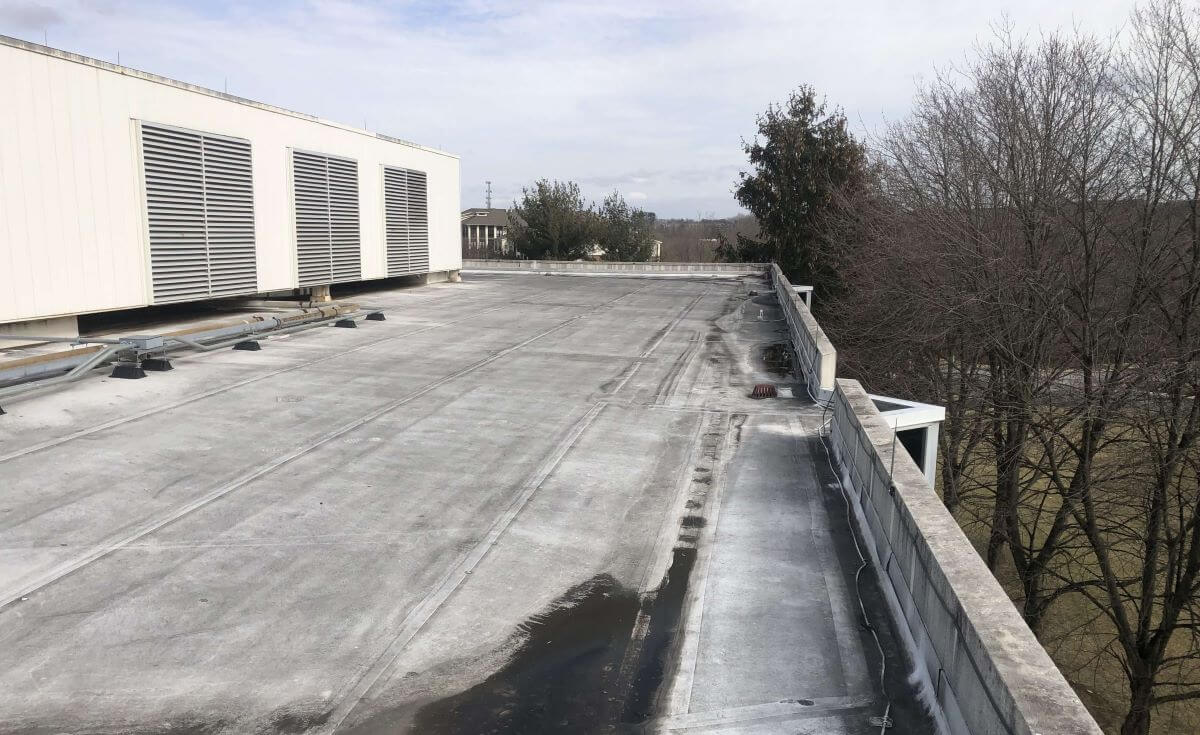
Roof Recover and Overlay
Roof recover and overlay options for Charlotte commercial buildings, with moisture and substrate checks to decide if a new membrane can go over the old roof.
Commercial Roofers Charlotte
Roof Recover and Overlay work starts with a documented roof walk and ends with a scope owners can use.
Thermoplastic polyolefin - TPO - is the volume specification for Charlotte commercial flat roofs because it balances UV reflectance, heat-weld seam reliability, and 20-year manufacturer warranty paths at an installed cost that pencils for everything from a 10,000 square foot strip center in Matthews to a 400,000 square foot warehouse in the Steele Creek corridor. Every major manufacturer offers it: Carlisle SynTec, GAF EverGuard, Johns Manville, Sika Sarnafil, Versico, Firestone.
We install TPO mechanically attached, fully adhered, or ballasted depending on building use, wind-uplift requirements, and the manufacturer's published design package. In the Charlotte metro, most commercial TPO is mechanically attached on tapered polyiso over steel deck - the configuration that handles the Piedmont's wind loading, thermal cycling, and seasonal humidity at the best installed cost per square. Fully adhered systems are specified for buildings where fastener pattern would compromise the deck or where wind-uplift calculations require a stronger attachment than mechanical can deliver.
The first visit produces a practical roof record: current conditions, visible failure points, drainage notes, access concerns, and the repair or replacement path that fits the building.
Owners get a written scope that separates urgent water-control work from longer-term capital planning, so the roof decision is not made from guesswork.
The closeout package keeps the next decision clear with before photos, after photos, material notes, warranty coordination, and recommended maintenance timing.
For occupied buildings, staging, access, odor control, and tenant communication are part of the roof plan before crews arrive.
For portfolio owners, the goal is consistent documentation across properties, not a one-off opinion that cannot be compared later.
TPO Thickness - 60-mil vs 80-mil Conditions
60-mil TPO is the standard specification for most Charlotte commercial buildings - warehouses, office buildings, strip centers, and light industrial. It carries a 20-year NDL warranty from every major manufacturer and handles Charlotte's UV load, summer heat, and humidity without degradation issues when installed correctly. The failure modes we see on 60-mil TPO in Charlotte are not membrane-related - they are seam and flashing failures from incorrect installation, not from membrane material degradation.
80-mil TPO costs more per square but extends warranty life (up to 25 years from some manufacturers), resists puncture better under heavy rooftop mechanical traffic, and handles the thermal cycling that Charlotte buildings in shade-to-sun transition zones experience. We specify 80-mil for buildings with dense rooftop HVAC equipment requiring frequent maintenance access, for roofs with existing puncture histories, and for owners whose capital planning horizon favors a longer warranty term over lower first cost.
Charlotte-Specific TPO Considerations
Seam quality in Charlotte humidity: TPO seams are heat-welded with a robotic or hand-held hot-air welder. Charlotte's ambient humidity affects the weld window - high dew point conditions narrow the temperature range at which a clean weld forms. Our welding operators track dew point alongside ambient temperature during installation and test every seam with a 5-pound pull-probe before the day's work is closed. Every seam on every project gets a probe test - not a sample.
Drainage sizing for Piedmont rainfall intensity: Charlotte's summer thunderstorm pattern regularly produces rainfall rates above the 3-inch-per-hour threshold used in older drain sizing tables. We size primary and secondary drains to ASCE 7-22 rainfall intensity for Charlotte (100-year 1-hour event: approximately 3.8 inches per hour for Mecklenburg County) on every TPO project. Buildings that came out of the 2024 Helene rainfall event with interior flooding often had drains sized to 1980s-era tables that were half the current standard.
Hail impact cover board: Charlotte sits in a secondary hail corridor that catches storm systems moving off the Appalachian front in spring and systems tracking up from the Gulf in fall. We install a high-density cover board under every TPO membrane - not standard-density foam - because HD cover board is what earns the impact-resistance rating that most commercial property insurance carriers now require for premium-discount qualification.
Common TPO Failure Modes We See
Field seam failure at prior repair patches: The most common single TPO failure mode we document across Charlotte's existing commercial stock is patch-on-patch failure - where a prior contractor applied a heat-welded patch over an existing seam failure without addressing the underlying cause. Charlotte's temperature cycling causes the patch to peel at the leading edge, reopening the original seam failure. Our repair protocol removes the underlying membrane to clean deck in a zone around every field seam failure before applying a new membrane section.
Parapet flashing failure at masonry walls: Charlotte's older commercial districts - South End, NoDa, and the older industrial buildings north of Uptown - have unreinforced masonry parapet walls that move seasonally. Standard TPO termination bar and counter-flashing detail does not accommodate this movement. We specify flexible coping cap details and elongated TPO boot flashings on any masonry parapet above 30 years old. The alternative is annual flashing repair on a detail that will never hold.
Missing walkway pads at rooftop mechanical access: Ballantyne, University Research Park, and the Uptown office corridor all have dense rooftop HVAC equipment requiring frequent access by building mechanical contractors. TPO is not designed for foot traffic without protection. We install manufacturer-specified walkway pads on every traffic path from the roof access door to every mechanical unit - sized and routed so a technician cannot reach any unit without crossing a pad.
Which TPO manufacturer do you install?
We are manufacturer-agnostic. We install systems from Carlisle, GAF, Johns Manville, Sika Sarnafil, Versico, and Firestone. The right manufacturer for a given Charlotte building depends on warranty terms, available formulation options, lead time, and what the owner's roof asset standard specifies. We recommend based on those criteria, not on distributor relationships.
Can TPO be installed over Charlotte's existing roofs?
Yes, if the existing insulation is dry and the deck is sound. We pull moisture cores to verify the recover path before specifying it. If the existing insulation is wet, recovering over it traps the moisture, accelerates degradation of the new insulation, and voids the new manufacturer warranty. In that case, replacement is the honest scope - not a recover.
Does TPO handle Charlotte's summer heat and humidity?
Modern 60-mil TPO formulations handle Charlotte's climate well - the 95F ambient temperatures and high humidity that the Piedmont produces are within the operating envelope these membranes are designed for. Older TPO formulations from the early 2000s had UV-degradation and plasticizer-migration issues that current formulations corrected. If your Charlotte building has a TPO roof installed before 2008, it may be running an older formulation. We assess manufacturer and installation date during inspection and document where each building sits on the membrane lifecycle curve.
Scoping a TPO project for a Charlotte commercial building?
We will walk the roof, document existing conditions, and produce a TPO scope - replacement or recover - with manufacturer warranty path and installed cost range, for any commercial building in the Charlotte metro.
Request a Written Scope