

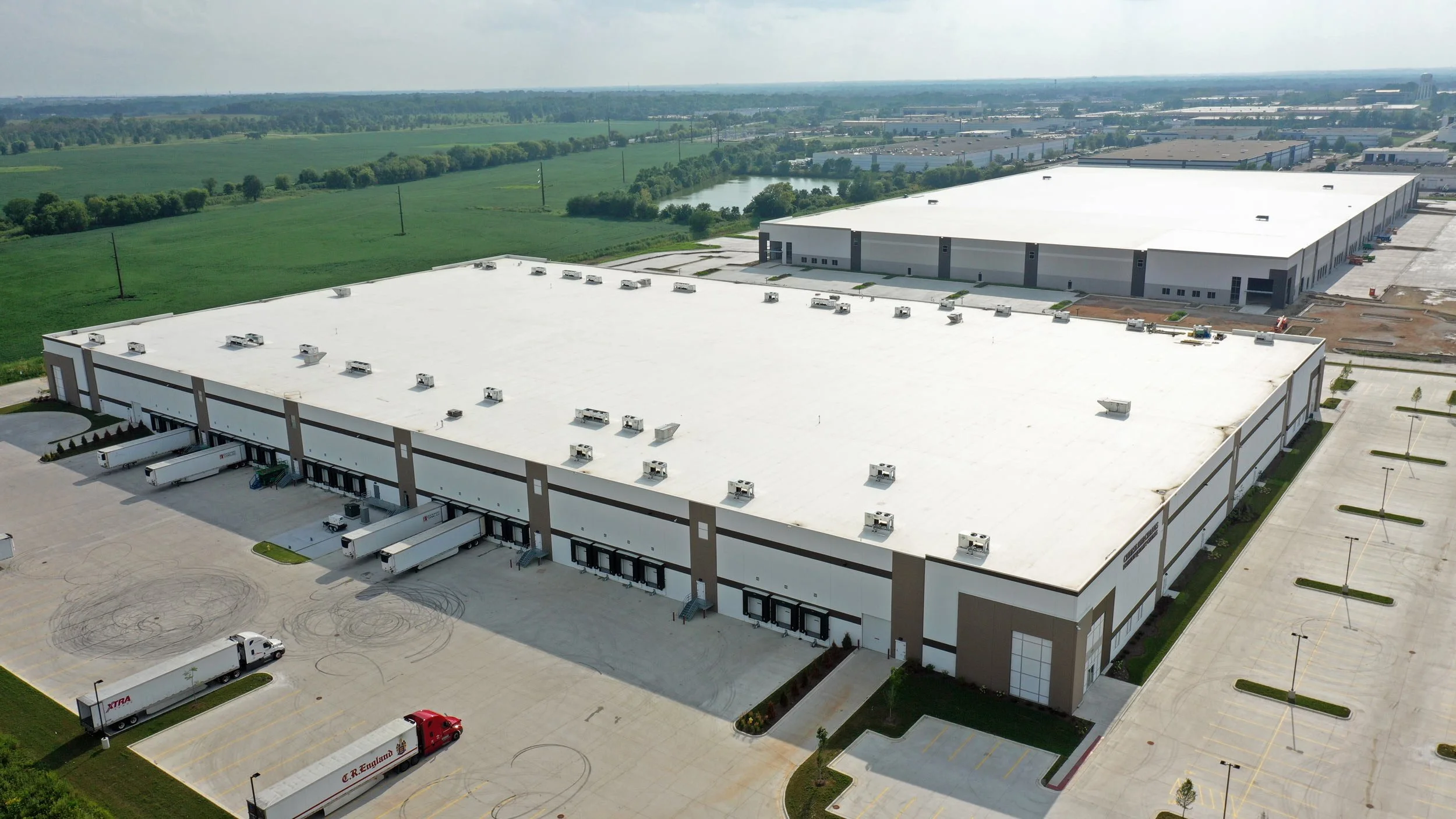
Distribution Center Roofing
Commercial roofing for Charlotte distribution centers - Westinghouse Blvd corridor, US-321 logistics zone, CLT airport-adjacent facilities - large-footprint membrane replacement, drain sizing, and operational sequencing.
Commercial Roofers Charlotte
Distribution Center Roofing roof work is shaped by occupancy, access, drainage, tenant protection, and the warranty path that fits the building.
Charlotte's Westinghouse Boulevard distribution spine, the US-321 logistics corridor north toward Gastonia, and the CLT airport-adjacent cargo facilities are the three major distribution center zones in the metro - each with distinct access, staging, and operational coordination requirements.
Distribution center roofing is, by volume, the largest single category of commercial roofing I manage in the Charlotte metro. The square footage per building is larger than any other property type - 300,000 to 800,000 square feet on a single roof plane is not unusual in the Westinghouse Boulevard zone or the I-85 logistics corridor east of the airport. The roof system is typically mechanically attached 60-mil TPO over metal deck with internal drain systems. The failure patterns are predictable and the stakes are high: a 600,000-square-foot distribution center with an active leak is a business continuity event for the tenant, not just a property management problem.
Charlotte has been one of the southeastern United States' fastest-growing logistics markets for the past decade, and the distribution center construction that followed that growth has created a tiered inventory. The first wave - buildings from 2000 to 2012 on the Westinghouse and US-321 corridors - is in active replacement or late-maintenance phase. The second wave - 2012 to 2020 construction across the I-485 rim and the CLT airport periphery - is approaching first major maintenance milestones. The current wave - 2020 to present - is under construction or in early warranty years.
The distribution center operators who occupy these buildings - national e-commerce fulfillment tenants, regional grocery distribution networks, automotive parts logistics operators, and industrial supply distributors - have operational requirements that determine how reroofing is sequenced. A building running a 24/7 fulfillment operation cannot tolerate a reroofing approach that leaves sections open overnight. I have designed and executed reroofing scopes on active distribution centers that maintained continuous operations throughout the production period.
For occupied buildings, staging, access, odor control, and tenant communication are part of the roof plan before crews arrive.
For portfolio owners, the goal is consistent documentation across properties, not a one-off opinion that cannot be compared later.
The first visit produces a practical roof record: current conditions, visible failure points, drainage notes, access concerns, and the repair or replacement path that fits the building.
Owners get a written scope that separates urgent water-control work from longer-term capital planning, so the roof decision is not made from guesswork.
The closeout package keeps the next decision clear with before photos, after photos, material notes, warranty coordination, and recommended maintenance timing.
Westinghouse Boulevard Corridor - The Core Charlotte Distribution Zone
Westinghouse Boulevard between South Tryon Street and the South Carolina state line is the spine of Charlotte's distribution real estate market. The buildings along this corridor range from 150,000-square-foot multi-tenant light industrial buildings to 600,000-plus-square-foot single-tenant fulfillment centers. The roof profile across the corridor is predominantly mechanically attached 60-mil TPO over metal deck, with the oldest inventory now running 15-20 years and in replacement cycle.
Drain sizing on Westinghouse corridor buildings is the most consistent technical deficiency I document in this zone. Buildings designed in the early 2000s were sized to drain criteria that predate the ASCE 7-22 rainfall intensity updates. On a building of 400,000 square feet or more, even modestly undersized drains produce standing water conditions during Charlotte's peak summer storm events - water that lingers on the field long enough to create ponding warranty exclusion conditions and to stress seams at low-field locations. Drain replacement or supplemental secondary drain installation is part of virtually every replacement scope I produce for this corridor.
The logistics operations in Westinghouse corridor buildings require coordinated sequencing for any reroofing project. The receiving and shipping docks that are the functional heart of a distribution center cannot be staged over or blocked by roofing material without operational approval from the tenant's facility manager. I produce a site logistics plan that maps material delivery and staging around the dock schedule before any contract is signed.
US-321 Corridor and Gaston County - Western Charlotte Logistics
The US-321 corridor between Charlotte and Gastonia, along with the Gaston County industrial parks in Belmont and Bessemer City, represents the western extension of Charlotte's distribution real estate market. Buildings in this zone tend to be older than the Westinghouse corridor inventory - many were original manufacturing or light industrial facilities converted to distribution use in the 1980s and 1990s - with more complex existing roof conditions.
The conversion buildings in the US-321 zone frequently have multi-slope metal roofing or older BUR systems rather than the low-slope TPO that dominates the purpose-built distribution centers. Metal panel roofing on older manufacturing buildings converted to distribution use has the failure pattern I described for the Lake Norman zone: fastener back-out, seam separation, and end-lap sealant failure. The assessment question on these buildings is whether a silicone restoration system can extend the roof another decade at reasonable cost, or whether the panel condition requires replacement to a new system.
Gaston County's permitting jurisdiction - the City of Gastonia, the City of Belmont, and the various Gaston County municipal jurisdictions - has different permit processing timelines than the City of Charlotte. I factor permitting lead time into the project schedule for US-321 corridor buildings and handle all permit applications as part of scope.
CLT Airport-Adjacent Distribution and Cargo Facilities
The cargo and logistics facilities immediately adjacent to Charlotte Douglas International Airport - along Josh Birmingham Parkway, Nations Ford Road, and the airport perimeter - operate under access and safety constraints that no other Charlotte commercial zone imposes. Buildings within the airport's Operations Area boundary require TSA-compliant access control. Buildings outside the boundary but within the airport's influence zone have crane height restrictions and equipment staging requirements that must be coordinated with CLT's facilities office.
I carry current CLT airport contractor credentials and have managed roofing projects on cargo handling facilities and airline support buildings within the airport complex. The credential process involves TSA background check enrollment, SIDA badge application through CLT's badging office, and airfield safety training for any crew member who may access the airfield-adjacent staging areas. This is a lead-time item - the credentialing process takes 3 to 6 weeks, and I initiate it as soon as a project on an airport-adjacent facility is under contract.
The refrigerated distribution facilities near CLT - the cold chain logistics buildings that handle perishable cargo and temperature-sensitive freight - have additional constraints on reroofing. Any work above refrigerated storage space requires coordination with the refrigeration mechanical contractor to ensure that the refrigeration system is protected from construction debris and thermal intrusion during production. I treat refrigerated distribution reroofing as a coordinated mechanical and roofing project, not a roofing-only scope.
How do you sequence a reroofing project on an active Charlotte distribution center without shutting down operations?
Section-by-section sequencing with same-shift dry-in. We tear off and dry-in each section before end of shift - we do not leave open roof above an active distribution floor overnight. The section size is calibrated to what the crew can complete in a single shift given the weather forecast. We map the production sequence around the tenant's dock and operational schedule before contract signing.
My Westinghouse Blvd distribution center has internal roof drains that back up during heavy rain. Is that a roofing problem?
Possibly both a drainage and a roofing problem. Internal drain backup during heavy rain can mean the drain bodies or leaders are undersized for current rainfall intensity, or the drain bodies are partially blocked, or both. We inspect the drain bodies, clear them, and check the drain leader sizing against ASCE 7-22 primary and secondary drain requirements for the building's square footage and Mecklenburg County rainfall intensity. If the leaders are undersized, we scope supplemental secondary drains as part of any reroofing project.
Do you carry CLT airport contractor credentials for work on airport-adjacent buildings?
Yes. We maintain current TSA enrollment and CLT SIDA badge credentials for work on facilities within the airport's access-controlled areas. For buildings in the CLT influence zone that require crane coordination, we handle the airport coordination as part of project planning.
Charlotte distribution center roof inspection or replacement scope?
Our project managers will walk the roof, assess drain sizing, and produce an operationally sequenced replacement or recovery scope - for any distribution center in the Westinghouse, US-321, or CLT airport corridor.
Request a Written Scope