

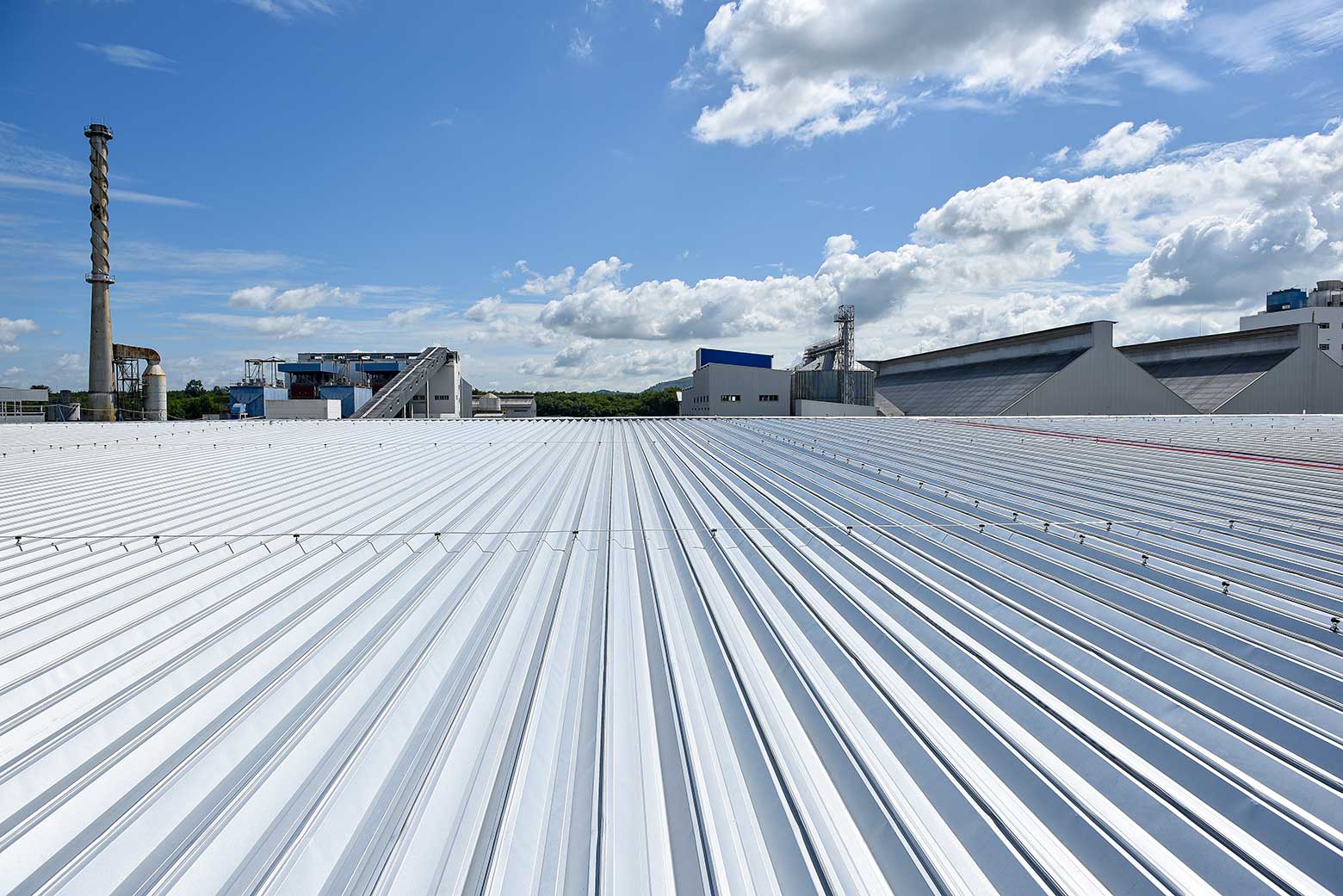
Standing Seam Metal Roofing
Standing seam metal roofing for Charlotte commercial buildings - concealed-fastener panels in steel and aluminum with 40-year expected service life, ASCE 7-22 wind-uplift compliance, and full closeout documentation
Commercial Roofers Charlotte
Standing seam metal roofing for Charlotte commercial buildings - concealed-fastener panels in steel and aluminum with 40-year expected service life, ASCE 7-22 wind-uplift compliance, and full closeout documentation for Mecklenburg County properties.
Standing Seam Metal Roofing work starts with a documented roof walk and ends with a scope owners can use.
Concealed-fastener standing seam panels for Charlotte commercial buildings - steel and aluminum systems that outlast single-ply membranes, meet ASCE 7-22 wind-uplift requirements for the Piedmont, and close out with manufacturer warranty documentation that transfers with the building.
Standing seam metal roofing is not a common specification for Charlotte's flat commercial stock, but it is the right system for a specific building profile: sloped commercial roofs, canopies, architectural sections of office and institutional buildings, and the low-slope metal buildings along Charlotte's industrial corridors where the slope is sufficient to drain but not steep enough for shingles. We install and service standing seam systems for commercial buildings across Mecklenburg County where the geometry and budget justify the system's longer service life.
A standing seam roof consists of factory-roll-formed panels - typically 24-gauge Galvalume steel or 0.032-inch aluminum - with vertical seams that rise 1.5 to 2 inches above the panel field and lock together with a mechanically seamed or snap-lock profile. The fastener is concealed beneath the seam - it never penetrates the panel face, which eliminates the primary failure mode of exposed-fastener metal roofing: fastener back-out and the resulting penetration leak. On a correctly installed standing seam system in Charlotte's Piedmont climate, with annual documented inspections, a 40-year service life is achievable. The trade-off is installation cost - standing seam runs two to three times the installed cost of a 60-mil TPO system on the same roof area.
The closeout package keeps the next decision clear with before photos, after photos, material notes, warranty coordination, and recommended maintenance timing.
For occupied buildings, staging, access, odor control, and tenant communication are part of the roof plan before crews arrive.
For portfolio owners, the goal is consistent documentation across properties, not a one-off opinion that cannot be compared later.
The first visit produces a practical roof record: current conditions, visible failure points, drainage notes, access concerns, and the repair or replacement path that fits the building.
Owners get a written scope that separates urgent water-control work from longer-term capital planning, so the roof decision is not made from guesswork.
Steel vs. Aluminum for Charlotte Conditions
24-gauge Galvalume steel with a PVDF (Kynar 500) painted finish is the standard commercial standing seam specification for most Charlotte commercial buildings. Galvalume's zinc-aluminum alloy coating provides corrosion resistance superior to galvanized steel, and the PVDF paint system retains color and gloss through 40-year warranty periods. In Charlotte's Piedmont climate - humid summers, moderate winters with occasional ice events, and the UV load from 220-plus sunny days per year - the PVDF finish holds without the chalking and fading that polyester paint systems show within 10 to 15 years.
Aluminum panels - 0.032-inch or 0.040-inch - are specified for coastal-adjacent applications or any Charlotte building in a high-humidity microclimate near Lake Norman or the Catawba River system where galvanic corrosion is a concern. Aluminum is roughly 40 percent lighter than steel at equivalent thickness, which reduces structural load on older buildings with marginal framing capacity. The trade-off is that aluminum is softer - more susceptible to hail damage - and thermal expansion is higher than steel, which means panel run lengths must be shorter or expansion joints must be more frequent.
For the commercial buildings along the Steele Creek warehouse corridor near the South Carolina line, where large roof areas on metal-frame structures are common, we specify steel standing seam with 1.5-inch snap-lock profiles - easier to install over large areas and fully compatible with the 20-year and 40-year paint warranty programs from Sherwin-Williams and AkzoNobel. The snap-lock profile is not as wind-resistant as a mechanically seamed profile, so for the open-exposure buildings near I-485 and CLT airport, we specify mechanically seamed panels and a seam density that meets the ASCE 7-22 uplift requirement for the building's specific exposure category.
Wind Uplift and Charlotte Exposure Categories
Charlotte sits in ASCE Wind Zone II at 115 mph basic wind speed for most Mecklenburg County locations. The buildings that need careful attention are those in open exposure - Exposure Category C in ASCE 7-22 notation - meaning buildings with few surrounding structures to reduce wind load. The CLT airport perimeter, the Steele Creek corridor's open-lot warehouses, and buildings on elevated sites along the I-485 ring fall into this category. A standing seam panel system at those locations must be engineered to higher clip density and narrower panel widths to
We pull the ASCE 7-22 uplift calculation for every standing seam project above 5,000 square feet. The calculation considers wind zone, exposure category, building height, roof slope, and panel attachment method. For projects above 20,000 square feet or buildings with complex geometry, we engage a North Carolina licensed structural engineer for a stamped calculation - the same document a commercial lender or insurer will require if they request a roofing system compliance certificate.
Carolina Piedmont thunderstorm downbursts are a specific wind hazard for standing seam in Charlotte. Downbursts produce intense short-duration wind loads that differ from the sustained wind model ASCE 7-22 is tailored to. We have inspected standing seam installations post-storm across the Charlotte metro where panel uplift occurred at the eave - the first three to four feet of the panel run, where uplift force is highest - because the original clip pattern was designed to the sustained-wind model without an additional eave reinforcement. We add eave clips at double density on every new standing seam installation regardless of the base specification.
Thermal Movement Management
Charlotte's climate swings between 20F winter lows and 100F summer rooftop surface temperatures - a differential that drives significant panel expansion and contraction. A 100-foot run of 24-gauge steel panel will expand approximately 0.8 inches across that temperature range. Without proper provision for that movement, the panel field buckles or the seams distort. We size panel run lengths to the manufacturer's maximum thermal movement specification - typically 40 to 50 feet for steel - and install manufacturer-specified thermal blocks at the fixed clips to manage movement direction.
Pipe penetrations and curb flashings are the thermal-movement failure point most often missed on Charlotte commercial standing seam installations we are called to repair. When a penetration boot is rigidly attached to the panel and the panel moves 0.8 inches seasonally, the boot either tears or it breaks the panel seam at the nearest clip. Our penetration details use flexible lead or EPDM collars on spring-mounted curbs that absorb panel movement without transmitting it to the flashing joint. On older installations we inherit, this detail is often the source of active leaks.
Gutters and eave trim are a related thermal management issue. Factory-formed aluminum gutters attached to steel panel eaves will expand at different rates. On commercial buildings in Ballantyne and along the Rea Road corporate corridor where gutter systems are part of the building's architectural expression, we install slip-joint sections at prescribed intervals and use floating hangers that allow longitudinal movement. A gutter system installed without these provisions will pull free from the fascia within five to ten years in Charlotte's climate.
Can standing seam metal roofing be installed on a flat Charlotte commercial building?
Only on sections with sufficient slope - typically a minimum of 1:12 (one inch of rise per foot of run) for a standard snap-lock system, and 0.5:12 for some low-slope mechanically seamed profiles. Flat-roof commercial buildings in Charlotte are better served by single-ply membranes (TPO, EPDM, PVC) or modified bitumen. Where a Charlotte commercial building has a sloped section - canopy, entry, or shed roof over a loading dock - standing seam is often the right specification for that section even if the main roof field is flat.
Do you offer standing seam with a manufacturer warranty?
Yes. The paint warranty - 40 years from AkzoNobel or Sherwin-Williams on PVDF systems - covers chalk, fade, and film integrity. Separate substrate warranties from the steel manufacturer cover perforation from corrosion. The installation warranty is our own - we provide a 10-year labor and material warranty on every standing seam installation, covering seam integrity, flashing details, and penetration performance. All three warranties require documented annual maintenance to remain active.
Standing seam assessment for a Charlotte commercial building?
We will walk the roof, verify slope and substrate conditions, and produce a written scope with panel specification, wind-uplift compliance path, and installed cost range for any commercial building in Mecklenburg County or the surrounding Charlotte metro.
Request a Written Scope