

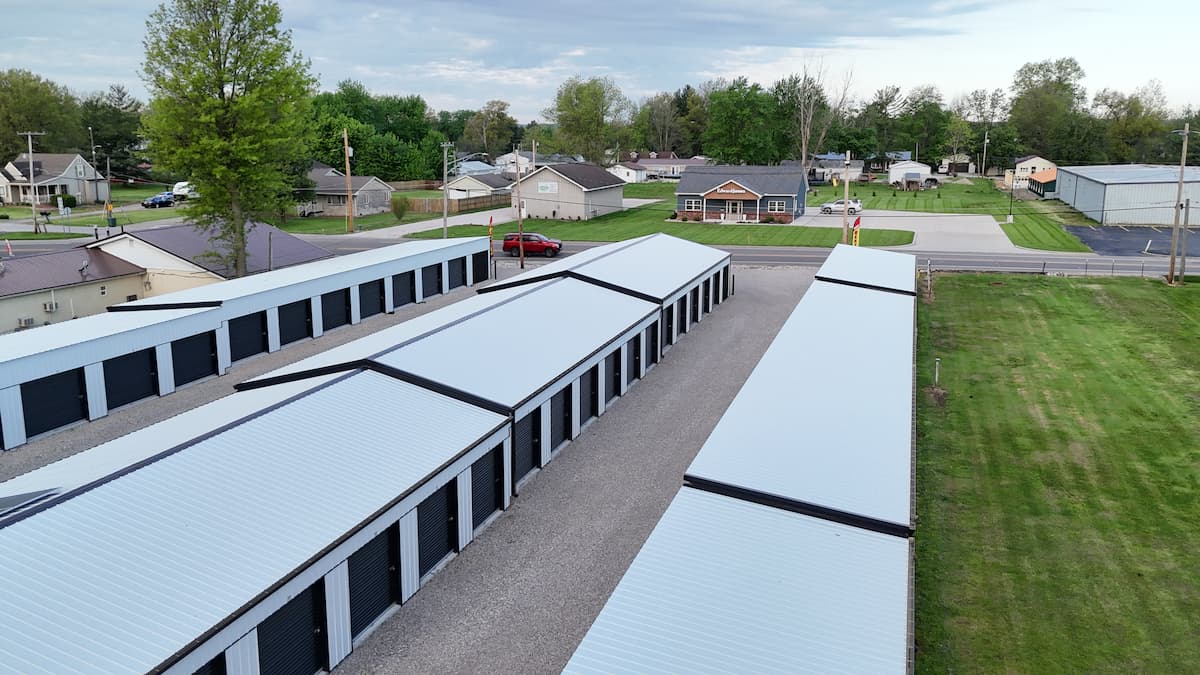
Self-Storage Facility Roofing
Commercial roofing for self-storage facilities, mini-storage buildings, and climate-controlled storage properties throughout Charlotte, NC.
Commercial Roofers Charlotte
Self-Storage Facility Roofing work starts with a documented roof walk and ends with a scope owners can use.
Charlotte's rapid growth has made it one of the fastest-expanding self-storage markets in the Southeast, with operators like Public Storage maintaining a large footprint across neighborhoods from Ballantyne to University City and facilities totaling hundreds of thousands of square feet of low-slope roofing that must perform through hot, humid summers and occasional winter ice storms. Commercial roofing contractors who serve this market understand that Charlotte sits at a climate crossroads - warm enough for significant cooling loads but cold enough for occasional freeze events that test flashings and drain details every winter.
The large flat footprints of Charlotte-area self-storage facilities demand single-ply membrane systems selected for long-term performance in a mixed-humid climate. TPO has become the dominant choice for new construction and re-roofing in the Charlotte market because of its heat-reflective white surface - reducing cooling loads during North Carolina's long hot season - and its weldable seams that provide superior water resistance compared to lap adhesive systems. Fully adhered TPO over polyisocyanurate insulation has become the standard specification for quality storage operators in the region.
Tenant belongings protection in Charlotte requires particular attention to moisture management. The city's humid subtropical climate means that unconditioned storage units can reach dewpoint conditions on cool mornings, leading to condensation on stored goods even without a roof leak. Climate-controlled facilities are growing rapidly in the market as tenants recognize this risk. For climate-controlled buildings, the roofing insulation assembly must maintain continuous thermal separation between the conditioned interior and the hot exterior, with particular attention to thermal bridging at structural members and equipment curbs.
Charlotte's occasional winter ice storms - the region averages two to three significant ice events per decade - create a specific flashing challenge. Unlike snow load, which is distributed broadly, ice accumulates at low points and creates weight concentrations and hydrostatic pressure at drain collars and parapet walls. Roofing systems in Charlotte should include high-quality through-wall flashing at all parapet transitions, sealed to prevent ice-laden meltwater from being driven under flashings by wind pressure. Spring inspections after ice events should specifically check these transition points.
The closeout package keeps the next decision clear with before photos, after photos, material notes, warranty coordination, and recommended maintenance timing.
For occupied buildings, staging, access, odor control, and tenant communication are part of the roof plan before crews arrive.
For portfolio owners, the goal is consistent documentation across properties, not a one-off opinion that cannot be compared later.
The first visit produces a practical roof record: current conditions, visible failure points, drainage notes, access concerns, and the repair or replacement path that fits the building.
Owners get a written scope that separates urgent water-control work from longer-term capital planning, so the roof decision is not made from guesswork.
Can a new single-ply membrane be installed over an existing BUR roof on a Charlotte building?
Yes, if the moisture survey shows the existing BUR insulation is dry and the BUR plies are structurally intact. Most major TPO and EPDM manufacturers have published recover specifications that allow their membrane to be installed over a sound BUR substrate. The recover specification typically requires a cover board - high-density polyiso or gypsum - over the existing BUR surface before the new membrane is installed. We verify the recover specification with the manufacturer before scoping and obtain manufacturer confirmation that the recover configuration qualifies for the target warranty term.
How many cores do you pull on a Charlotte BUR moisture survey?
Minimum five locations on a roof under 10,000 square feet. On larger roofs we target one core per 2,000 to 2,500 square feet, concentrated in areas showing surface deflection, prior repair work, or drainage anomalies. On BUR roofs with a history of localized leaks, we pull additional cores around the reported leak locations and at all four parapet corners - the highest-probability moisture entry points on older Charlotte BUR systems.
Does BUR work require a permit?
Replacement and recover projects above the City of Charlotte's threshold - currently $30,000 in contract value for commercial work - require a building permit filed with the relevant jurisdiction. We handle permitting as part of our scope for all BUR replacement and recover projects in Charlotte, Mecklenburg County, and the surrounding municipalities. Repair work below the permit threshold does not typically require a permit, but we document all repair work to the same standard regardless of permit status.
BUR assessment for an older Charlotte commercial building?
We will walk the roof, pull moisture cores, and produce a written assessment with recover-vs-tear-off recommendation - for any BUR system in Uptown, South End, NoDa, or anywhere else in the Charlotte metro.
Planning Self-Storage Facility Roofing
Self-Storage Facility Roofing should be evaluated through the roof condition, the building use, the owner's timing, and the level of documentation needed to make a decision.
The written record should make the next step clear without relying on broad claims or generic sales language.
Request a Written Scope