

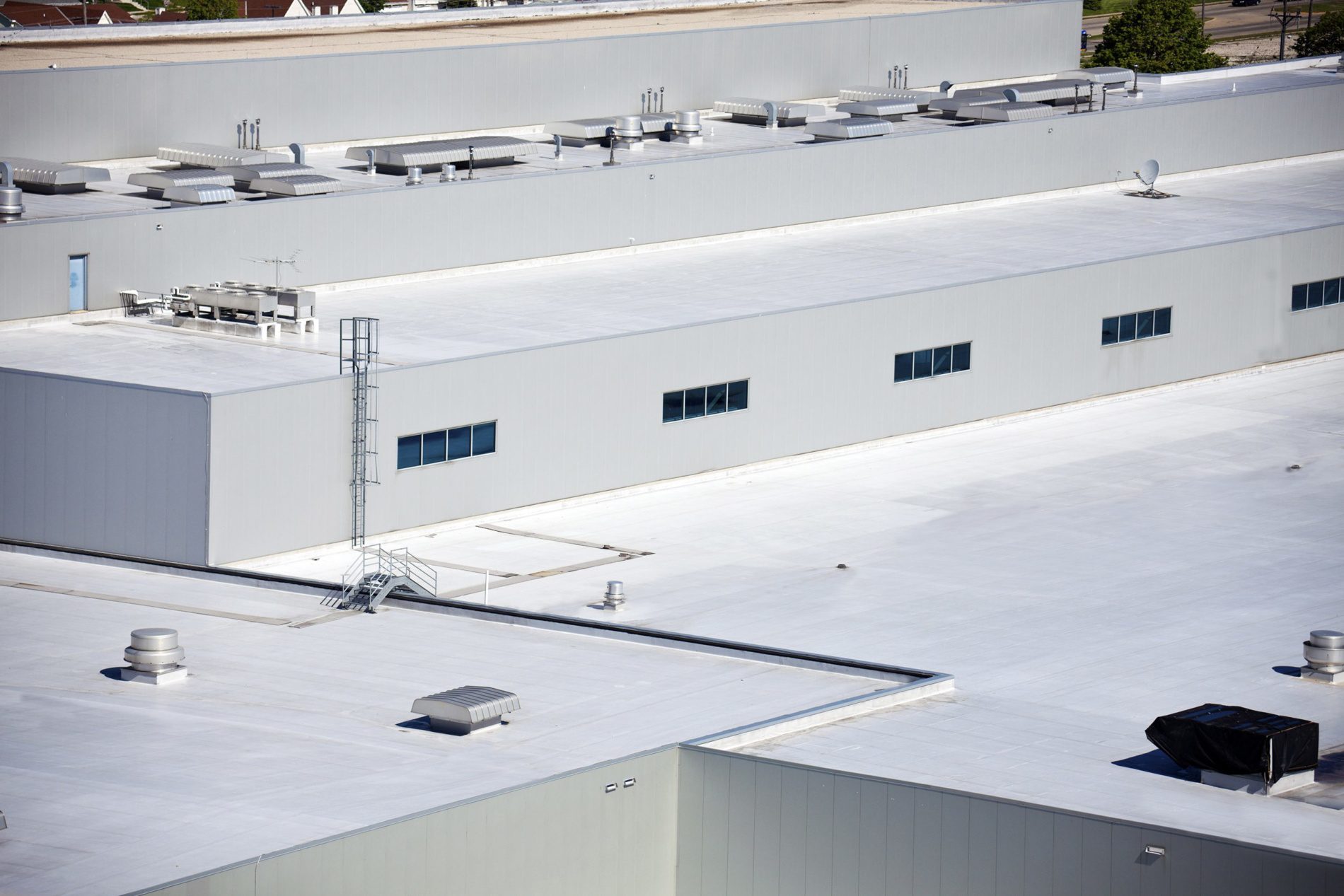
Manufacturing Facility Roofing
Commercial roofing for manufacturing plants, assembly facilities, and industrial buildings throughout Charlotte, NC.
Commercial Roofers Charlotte
Manufacturing Facility Roofing work starts with a documented roof walk and ends with a scope owners can use.
Husqvarna's manufacturing facility in McDonough - and the company's growing Charlotte-area distribution and manufacturing footprint along the I-85 corridor - illustrates how the Piedmont region has evolved from a textile and furniture economy into a diversified industrial base that places new demands on commercial roofing specialists. Charlotte's manufacturing sector now encompasses food processing, automotive components, printing and packaging, and advanced materials production, each with its own specific roof system requirements. Contractors who succeed in this market are those who have moved beyond one-size-fits-all TPO specifications and developed the diagnostic discipline to match membrane systems and maintenance programs to individual facility profiles.
Charlotte's climate occupies a transition zone between the humid subtropical South and the more temperate Piedmont, which creates roofing challenges that are distinct from both coastal and mountain environments. Summer heat drives high roof surface temperatures that stress membrane seams and accelerate insulation compression under equipment pads. Winter freeze-thaw events, while less frequent than in the Rust Belt, do occur and can be severe enough to open seams that are already under thermal stress. A properly specified Charlotte manufacturing roof must perform across this full temperature range without relying on the more moderate assumptions that some Southern contractors carry forward from warmer coastal markets.
Vibration from heavy manufacturing equipment in Charlotte's industrial corridors along Westinghouse Boulevard and Brookshire Freeway is a significant driver of premature membrane failure. Charlotte's printing and packaging sector runs large web offset and rotary die-cut equipment whose vibration signatures differ from metalworking machinery but are no less damaging to roof components over time. A vibration assessment that maps equipment below the deck to wear patterns at the membrane surface is as relevant for a Charlotte printing plant as it is for a Buffalo forging shop, even though the two buildings look nothing alike from the street.
Chemical exposure at Charlotte's food processing facilities - which include large baking, beverage, and snack food operations - generates steam, cooking oil aerosols, and refrigerant discharge that all affect roof surfaces differently. Steam infiltration into insulation layers accelerates thermal resistance degradation. Cooking oil aerosols soften standard TPO membranes and can compromise seam welds. Refrigerant discharge from relief valves can cause rapid thermal shock to membrane surfaces at the discharge point. Food processing plants in Charlotte should receive a specific chemical exposure analysis as part of every roof assessment, not a generic industrial specification.
The closeout package keeps the next decision clear with before photos, after photos, material notes, warranty coordination, and recommended maintenance timing.
For occupied buildings, staging, access, odor control, and tenant communication are part of the roof plan before crews arrive.
For portfolio owners, the goal is consistent documentation across properties, not a one-off opinion that cannot be compared later.
The first visit produces a practical roof record: current conditions, visible failure points, drainage notes, access concerns, and the repair or replacement path that fits the building.
Owners get a written scope that separates urgent water-control work from longer-term capital planning, so the roof decision is not made from guesswork.
Can a new single-ply membrane be installed over an existing BUR roof on a Charlotte building?
Yes, if the moisture survey shows the existing BUR insulation is dry and the BUR plies are structurally intact. Most major TPO and EPDM manufacturers have published recover specifications that allow their membrane to be installed over a sound BUR substrate. The recover specification typically requires a cover board - high-density polyiso or gypsum - over the existing BUR surface before the new membrane is installed. We verify the recover specification with the manufacturer before scoping and obtain manufacturer confirmation that the recover configuration qualifies for the target warranty term.
How many cores do you pull on a Charlotte BUR moisture survey?
Minimum five locations on a roof under 10,000 square feet. On larger roofs we target one core per 2,000 to 2,500 square feet, concentrated in areas showing surface deflection, prior repair work, or drainage anomalies. On BUR roofs with a history of localized leaks, we pull additional cores around the reported leak locations and at all four parapet corners - the highest-probability moisture entry points on older Charlotte BUR systems.
Does BUR work require a permit?
Replacement and recover projects above the City of Charlotte's threshold - currently $30,000 in contract value for commercial work - require a building permit filed with the relevant jurisdiction. We handle permitting as part of our scope for all BUR replacement and recover projects in Charlotte, Mecklenburg County, and the surrounding municipalities. Repair work below the permit threshold does not typically require a permit, but we document all repair work to the same standard regardless of permit status.
BUR assessment for an older Charlotte commercial building?
We will walk the roof, pull moisture cores, and produce a written assessment with recover-vs-tear-off recommendation - for any BUR system in Uptown, South End, NoDa, or anywhere else in the Charlotte metro.
Planning Manufacturing Facility Roofing
Manufacturing Facility Roofing should be evaluated through the roof condition, the building use, the owner's timing, and the level of documentation needed to make a decision.
The written record should make the next step clear without relying on broad claims or generic sales language.
Request a Written Scope