

Industrial Roofing
Industrial Roofing for manufacturing facilities, warehouses, and industrial buildings throughout Charlotte area.
Commercial Roofers Charlotte
Industrial Roofing work starts with a documented roof walk and ends with a scope owners can use.
Charlotte's industrial roofing market has been transformed by the city's emergence as a major Southeast logistics hub over the past two decades. Charlotte Douglas International Airport - one of the largest cargo handling operations in the Southeast - anchors an industrial corridor that extends along I-85 and I-77 with some of the largest distribution centers in the region. Amazon, Target, and a roster of major national retailers and third-party logistics operators have built large-scale fulfillment and distribution facilities here that make up some of the most demanding modern industrial roofing work in the Carolinas. The Steele Creek industrial area and the Westinghouse Boulevard corridor add manufacturing and logistics density to the Charlotte industrial base. We work across all of it, and the pace of new construction and re-roofing demand in Charlotte's industrial market is as high as anywhere in the Southeast.
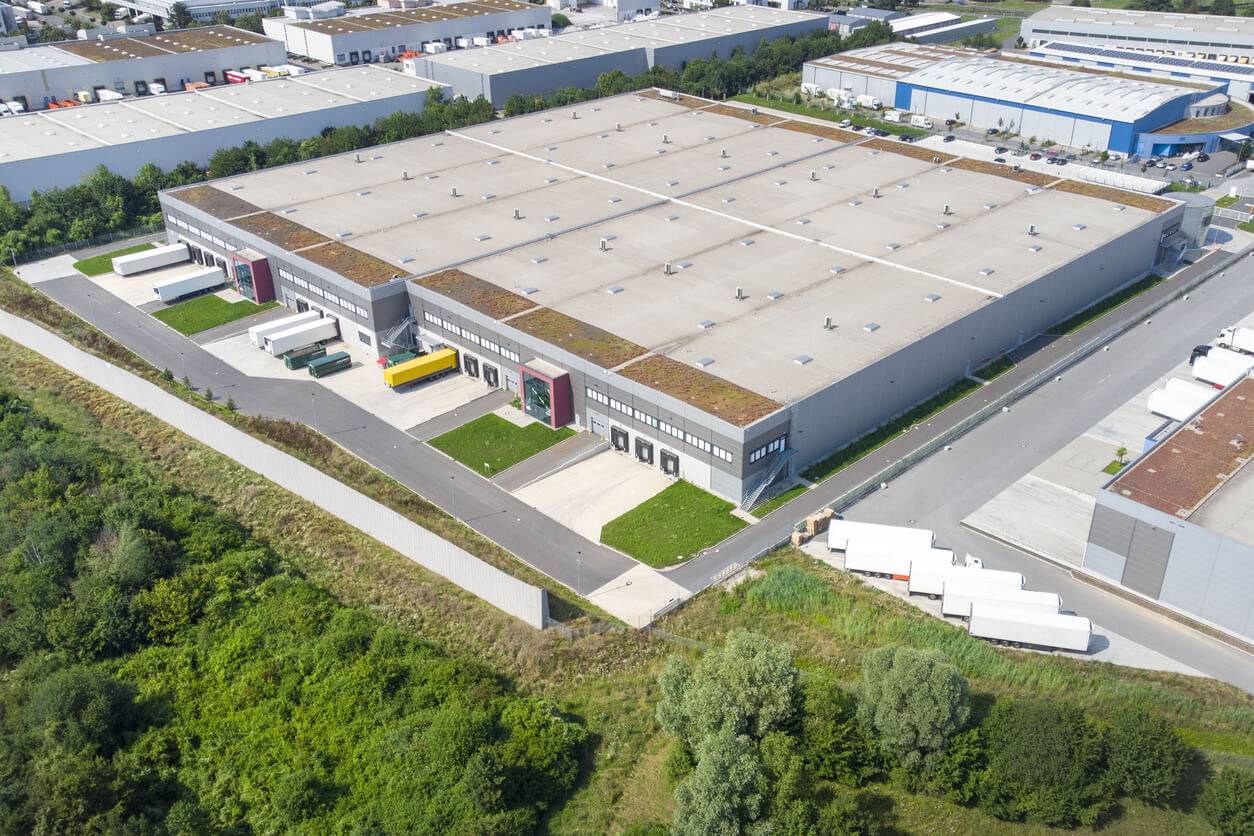
Large-scale distribution and fulfillment centers are the defining building type in Charlotte's industrial roofing market. These buildings - typically 500,000 to 1,200,000 square feet under one roof, steel-framed with insulated metal panel or tilt-up concrete walls, and low-slope roofs with dense rooftop mechanical equipment - require roofing expertise at industrial scale. The sheer size of these roofs means that drainage design, wind-uplift engineering, and insulation assembly performance have enormous consequence. A drainage problem on a 20,000-square-foot building is an inconvenience; a drainage problem on an 800,000-square-foot fulfillment center is a major operational event. We size our crews, equipment, and project management capacity to work at the scale Charlotte's industrial market demands.
For Charlotte's industrial flat and low-slope roofs, we primarily install TPO and EPDM single-ply membranes over polyiso insulation, with metal R-panel and standing seam for new construction and re-roofing over metal framing. TPO is the dominant system on modern large distribution facilities - the heat-welded seam construction provides exceptional seam durability, the reflective white surface delivers meaningful energy savings in Charlotte's warm climate, and the system's compatibility with modern rooftop equipment attachment hardware suits the dense mechanical equipment loads on large fulfillment centers. For buildings with existing complex substrate conditions or legacy BUR systems, modified bitumen provides the field fabrication flexibility that large single-ply systems can't always match. Metal standing seam is increasingly the premium choice on new industrial construction in the I-85 corridor where owners want maximum durability and 40-year warranty coverage.
Charlotte's climate is mild compared to northern industrial markets, but it's not without significant weather demands on industrial roofs. We average 43 inches of annual rainfall, distributed across the full year, and summer thunderstorms can deliver intense rainfall in short periods that tests drainage capacity. The more unusual weather challenge is the occasional winter ice storm - Charlotte doesn't have predictable annual snowfall, but it sits in the zone where warm Gulf air and cold Arctic air collide to produce ice events every few years that have significant industrial impact. The 2002, 2014, and 2016 ice events each caused substantial industrial roofing damage across the Charlotte metro, primarily through ice loading on structures, ice dam infiltration at perimeter edges, and the wind events that often accompany winter precipitation in this region.
The first visit produces a practical roof record: current conditions, visible failure points, drainage notes, access concerns, and the repair or replacement path that fits the building.
Owners get a written scope that separates urgent water-control work from longer-term capital planning, so the roof decision is not made from guesswork.
The closeout package keeps the next decision clear with before photos, after photos, material notes, warranty coordination, and recommended maintenance timing.
For occupied buildings, staging, access, odor control, and tenant communication are part of the roof plan before crews arrive.
For portfolio owners, the goal is consistent documentation across properties, not a one-off opinion that cannot be compared later.
Questions Owners Ask
24/7 active fulfillment operations are the standard in Charlotte's distribution market, and our project management approach is geared to production-neutral scheduling. We work with facility operations management to identify roof sections that can be taken sequentially, plan work to keep the active leak risk away from areas of the building with the highest operational sensitivity (pick-and-pack areas, conveyor systems, charging stations), and use temporary waterproofing coverage during tear-off phases to prevent interior exposure. All torch-applied or hot work requires coordination with the facility's fire safety team and hot work permit process. Noise-intensive activities can be scheduled around peak operational periods. On very large buildings, phased re-roofing over multiple budget years is often the right approach - we can develop a multi-year plan that prioritizes sections by condition and operational risk rather than requiring a single large capital event.
Ponding is not normal - it's a drainage deficiency that needs to be corrected. In Charlotte's summer thunderstorm climate, where high-intensity rainfall events are common, a roof that holds standing water after those events is experiencing drainage system performance that's inadequate for the actual precipitation pattern. The consequences extend beyond membrane life: ponding water adds sustained structural load, accelerates UV degradation at the pond margins, creates conditions for organic growth that clogs drains further, and creates a freeze risk on the rare Charlotte winter ice events. We diagnose ponding drainage problems by evaluating drain size and spacing, drain elevation relative to the actual deck low points, and whether there's structural deck deflection creating ponding that wasn't in the original design. The solution is almost always some combination of drain relocation, drain addition, or tapered insulation installation to create positive slope where none exists.
Charlotte is in ASCE 7 Wind Exposure Category B or C depending on location, with a basic wind speed of approximately 110 mph for Risk Category II buildings (standard occupancy). Large industrial buildings near CLT - particularly those in open terrain near the airfield - are typically designed as Exposure Category C, which requires higher uplift resistance than buildings in more sheltered locations. FM Global standards, commonly required by industrial property insurers, add additional uplift requirements beyond building code minimums and typically require pressure testing or verified installation documentation for large industrial roofing projects. We design and install to FM Global standards on all large industrial facilities and can provide the installation documentation that FM requires for wind coverage continuity.
Ice damage at industrial roof edges in Charlotte is typically caused by one of two mechanisms: wind-driven rain or ice infiltrating behind perimeter edge metal during freezing rain events, or localized ice dam formation at heated areas where snow or ice melts and refreezes at the cold roof edge. The fix depends on which mechanism is causing your problem. For wind-driven infiltration, the solution is improving the edge metal attachment and lapping system - ensuring the membrane and edge metal create a positive-stop against moisture infiltration. For ice dam formation at heated perimeter areas, the solution involves improving insulation continuity at the roof-to-wall transition to eliminate the thermal differential that drives the melt-and-refreeze cycle. We can assess your specific edge condition and identify which mechanism is at work before recommending a repair approach.
Can a new single-ply membrane be installed over an existing BUR roof on a Charlotte building?
Yes, if the moisture survey shows the existing BUR insulation is dry and the BUR plies are structurally intact. Most major TPO and EPDM manufacturers have published recover specifications that allow their membrane to be installed over a sound BUR substrate. The recover specification typically requires a cover board - high-density polyiso or gypsum - over the existing BUR surface before the new membrane is installed. We verify the recover specification with the manufacturer before scoping and obtain manufacturer confirmation that the recover configuration qualifies for the target warranty term.
How many cores do you pull on a Charlotte BUR moisture survey?
Minimum five locations on a roof under 10,000 square feet. On larger roofs we target one core per 2,000 to 2,500 square feet, concentrated in areas showing surface deflection, prior repair work, or drainage anomalies. On BUR roofs with a history of localized leaks, we pull additional cores around the reported leak locations and at all four parapet corners - the highest-probability moisture entry points on older Charlotte BUR systems.
Does BUR work require a permit?
Replacement and recover projects above the City of Charlotte's threshold - currently $30,000 in contract value for commercial work - require a building permit filed with the relevant jurisdiction. We handle permitting as part of our scope for all BUR replacement and recover projects in Charlotte, Mecklenburg County, and the surrounding municipalities. Repair work below the permit threshold does not typically require a permit, but we document all repair work to the same standard regardless of permit status.
BUR assessment for an older Charlotte commercial building?
We will walk the roof, pull moisture cores, and produce a written assessment with recover-vs-tear-off recommendation - for any BUR system in Uptown, South End, NoDa, or anywhere else in the Charlotte metro.
Request a Written Scope