

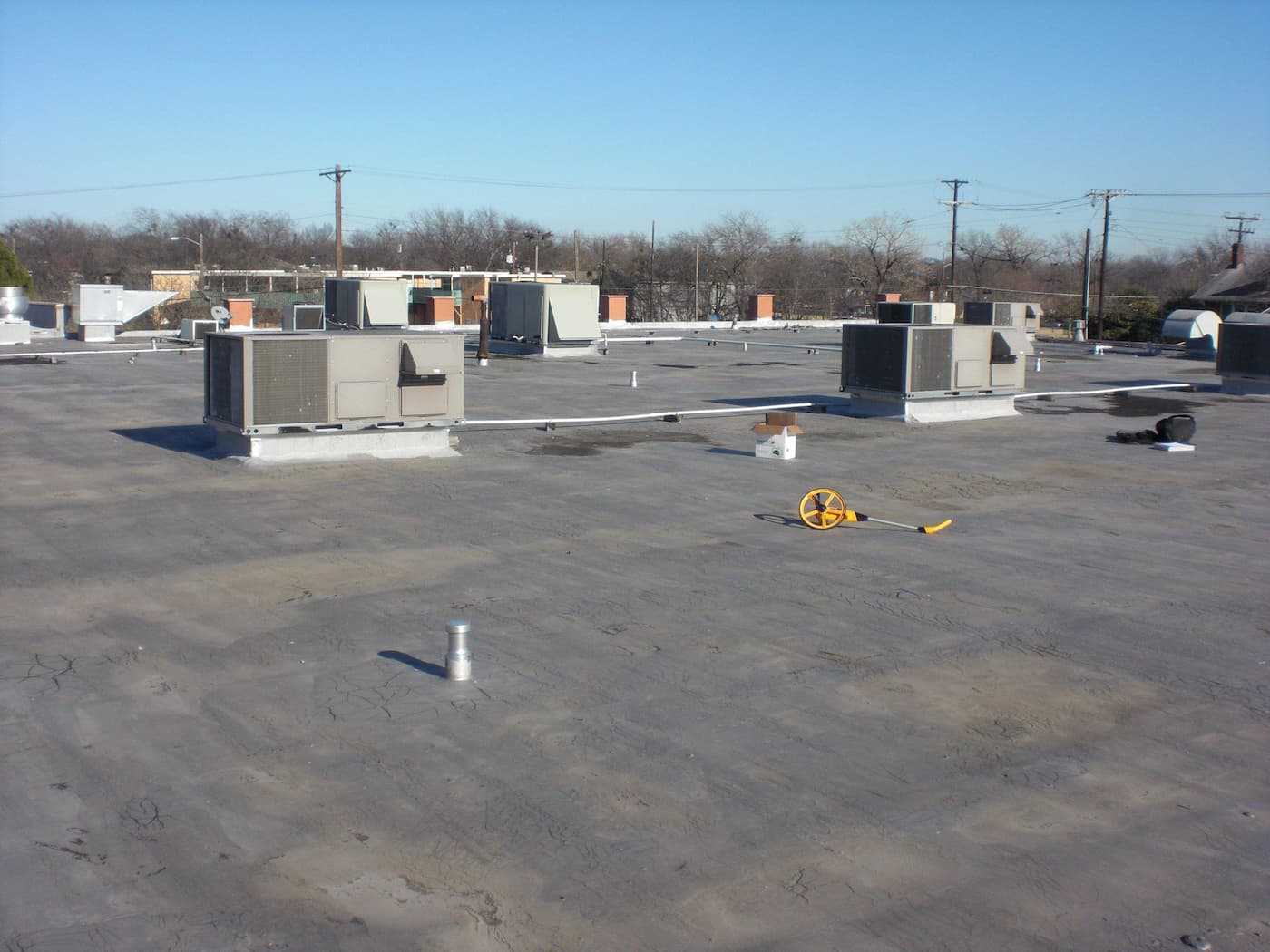
Hail Damage Roof Repair
Documented hail damage assessment and repair for Charlotte commercial flat roofs - insurance-grade photo documentation, moisture survey, and written scope for Mecklenburg County buildings after hail events.
Commercial Roofers Charlotte
Hail Damage Roof Repair work starts with a documented roof walk and ends with a scope owners can use.
Hail damage on a commercial flat roof is not always visible from the ground, and it is rarely what a general adjuster expects to find. Getting the documentation right before the claim is submitted is the difference between a paid claim and a disputed one.
Charlotte sits in what storm climatologists call the secondary Southeast hail corridor - a band of elevated hail frequency that runs from the western Carolinas through the Piedmont when spring cold fronts interact with Gulf moisture and Appalachian orographic lift. The Charlotte metro averages three to five hail events per year that produce stones at or above 1-inch diameter. Events above 1.5 inches are less frequent but they occur - the March 2020 event that tracked from Gaston County through South Charlotte produced stones above 1.5 inches in diameter over a swath that included the Arrowood and Tyvola Road industrial corridors. Events of that size cause functional damage to TPO and EPDM membranes: dents that become stress points, perforations that become entry points, and cover board compression damage that compromises the membrane's puncture resistance rating.
Commercial flat roofing hail damage looks different from commercial shingle damage. A commercial adjuster looking for bruising, granule loss, or cracked tabs will not find the right markers on a commercial TPO or EPDM roof. Hail damage on commercial membrane roofing shows up as perforation on thin membranes, as denting on felts and modified bitumen, as cracking at seam edges where the impact stress concentrates, and as insulation compression under the membrane that creates visible deflection points after storm load passes. Documenting those conditions requires a roofing contractor with commercial membrane experience - not a general adjuster applying commercial inspection criteria.
We document hail damage to Charlotte commercial roofs in a format designed to support insurance claims. That means systematic photo coverage by zone, impact measurement documentation where physical evidence of stone size is present, core pull data where insulation compression is suspected, and a written scope that distinguishes storm-caused damage from pre-existing conditions. The pre-existing condition documentation matters as much as the storm damage documentation - without it, the carrier argues that what looks like storm damage is actually chronic deferred maintenance, and the claim gets reduced or denied.
The closeout package keeps the next decision clear with before photos, after photos, material notes, warranty coordination, and recommended maintenance timing.
For occupied buildings, staging, access, odor control, and tenant communication are part of the roof plan before crews arrive.
For portfolio owners, the goal is consistent documentation across properties, not a one-off opinion that cannot be compared later.
The first visit produces a practical roof record: current conditions, visible failure points, drainage notes, access concerns, and the repair or replacement path that fits the building.
Owners get a written scope that separates urgent water-control work from longer-term capital planning, so the roof decision is not made from guesswork.
How Hail Damages Charlotte Commercial Flat Roofs
60-mil and 80-mil TPO: Modern TPO is more impact-resistant than older single-ply formulations, but it is not hail-proof. Stones above 1.25 inches can perforate 60-mil TPO on direct impact. Stones above 1.5 inches can perforate 80-mil TPO. More commonly, the impact does not produce immediate perforation but compresses the cover board beneath the membrane, reducing its puncture resistance rating and creating a stress concentration that splits under thermal cycling over the following months. Buildings on University Research Park's campus cluster and the Ballantyne corporate corridor - where high HVAC density means regular roof maintenance foot traffic - are particularly vulnerable to this secondary failure mode because technician foot traffic concentrates at compressed cover board zones.
EPDM: EPDM is softer than TPO and absorbs impact differently. Hail stone impacts on EPDM produce spiderweb cracking at the impact point rather than perforation. These cracks are small - often not visible without 10x magnification - but they provide an entry path for water infiltration that enlarges under UV and thermal cycling. The EPDM inventory in Charlotte's older industrial buildings in the Westinghouse Boulevard and Airport Road corridors was installed in the 1990s and is now near end of life. Hail impacts on aged EPDM produce more extensive cracking than impacts on new EPDM, and the insurance documentation needs to reflect the membrane age and condition at the time of the event.
Modified bitumen and built-up roofing: The remaining stock of modified bitumen and BUR in Charlotte's older Uptown and South End buildings shows hail damage as surface granule displacement and bitumen fracture at impact points. Surface granule displacement looks like cosmetic damage but removes the UV protection the granules provide - which accelerates membrane aging in Charlotte's high-UV summer environment. Bitumen fracture at impact points creates true perforation risk and is documentable with standard inspection photography. Both findings belong in the insurance claim documentation.
Insulation and cover board compression: Below the membrane, hail energy compresses the cover board and upper insulation layer. Compressed insulation at impact points loses R-value at those locations and loses the puncture resistance rating that qualifies the assembly for manufacturer hail impact certification. Some insurance policies for Charlotte commercial buildings now include a premium discount for roofing systems with certified hail impact ratings - a compression event can void that rating and affect future premium eligibility. We document cover board condition with core pulls at impact zones.
Insurance Claim Documentation We Provide
Pre-existing condition baseline: The most important document in a hail damage claim is the one that establishes what the roof looked like before the event. If we conducted a prior inspection, that report is the baseline. If we did not, we reconstruct as much as possible from available records - prior repair invoices, warranty documentation, aerial imagery - and document the current pre-storm-damage conditions in the areas not impacted by the event. The goal is to give the insurance carrier a clear distinction between chronic deferred maintenance and event-specific damage.
Impact density mapping: We photograph and log impact locations across the roof in a systematic zone-by-zone survey. The density of documented impacts per 100 square feet correlates with stone size and storm intensity at that location. Dense impact patterns in a tight zone are consistent with a localized high-intensity cell; sparse patterns across the full field are consistent with a longer-track event. Both patterns are documentable, and both support the claim that the roof was exposed to a hail event at the estimated stone size.
Damage scope with cost segregation: The written repair scope we provide separates storm-attributable damage from pre-existing conditions by line item. The storm damage items support the insurance claim. The pre-existing conditions are documented separately and are the building owner's responsibility under the policy. This clean separation is what allows an adjuster to approve the storm damage claim without the carrier disputing the pre-existing conditions in the same document.
Post-repair documentation for claim closeout: After the repair is complete, we provide a written completion report with before-and-after photos, materials used, and the repair scope executed. That document closes the insurance file and confirms that the approved work was performed. For Charlotte buildings on commercial property policies with high-value endorsements, the carrier's adjuster typically requires a completion report before releasing the final payment.
Charlotte Hail Events That Have Affected Commercial Roofs
March 2020 event: A spring cold front interaction produced a hail swath from Gaston County through South Charlotte that tracked across the Arrowood and Tyvola Road commercial corridors and into the Providence Road and Myers Park corridors. Stone sizes above 1.5 inches were documented by the National Weather Service at ground level in Mecklenburg County. That event produced significant claim activity on the commercial buildings in those corridors - a number of which had 15-year-old TPO or EPDM that was near end of life and particularly vulnerable to impact damage.
Spring 2021 and 2022 events: Smaller events with 0.75-inch to 1-inch stone sizes affected the University City corridor and portions of the Ballantyne cluster in separate events during those years. These events did not produce immediate perforation on modern 60-mil TPO but did produce the cover board compression and seam stress patterns that show up as active leaks 18 to 24 months later. Buildings in those corridors that began leaking in 2023 and 2024 sometimes traced the entry point back to a seam stress fracture at a prior impact point.
Post-storm inspection timing: North Carolina insurance policies typically require claims to be reported within a reasonable timeframe after the event - what 'reasonable' means varies by policy. For commercial property claims in Charlotte, getting a documented inspection on the books within 30 to 60 days of a significant hail event is standard practice for buildings where storm damage is suspected. Waiting 12 months to inspect reduces the quality of the documentation and gives a carrier grounds to question whether the claimed damage is event-related or subsequent.
How quickly can you inspect a Charlotte building after a hail event?
Within 48 to 72 hours for most Mecklenburg County buildings after a significant hail event. After major events that produce widespread commercial damage across the metro, our inspection schedule backs up - we prioritize active leak emergencies first, then damage assessment inspections in the order they are received. Contact us immediately after the event to get on the schedule. The sooner the inspection happens, the better the evidentiary quality of the documentation.
My insurance adjuster says my Charlotte commercial roof only has cosmetic hail damage. What should I do?
Request a reinspection with your contractor present. An adjuster applying commercial inspection criteria to a commercial membrane roof will sometimes classify functional damage as cosmetic because the markers are different from what they typically document on shingle roofs. We accompany building owners during insurance reinspections, identify the specific technical findings that constitute functional damage under commercial membrane standards, and provide supplemental documentation to support reconsideration of a denied or reduced claim.
Can hail damage void my commercial roofing warranty?
Hail damage does not automatically void a manufacturer warranty, but it may reduce the manufacturer's obligation to cover subsequent failure if the damage was not repaired. Most NDL warranties from Carlisle, GAF, and Johns Manville require that hail damage be reported to the manufacturer within 30 days and that approved repairs be completed promptly. Failure to repair documented hail damage is grounds for the manufacturer to deny warranty claims on the affected membrane sections. We handle manufacturer notification as part of our post-hail inspection and repair scope.
Document hail damage before you submit the claim.
Our project managers inspect the full roof, document impact evidence zone by zone, and produce a written scope that separates storm damage from pre-existing conditions - the format your insurance carrier needs for a complete and defensible claim.
Request a Written Scope