

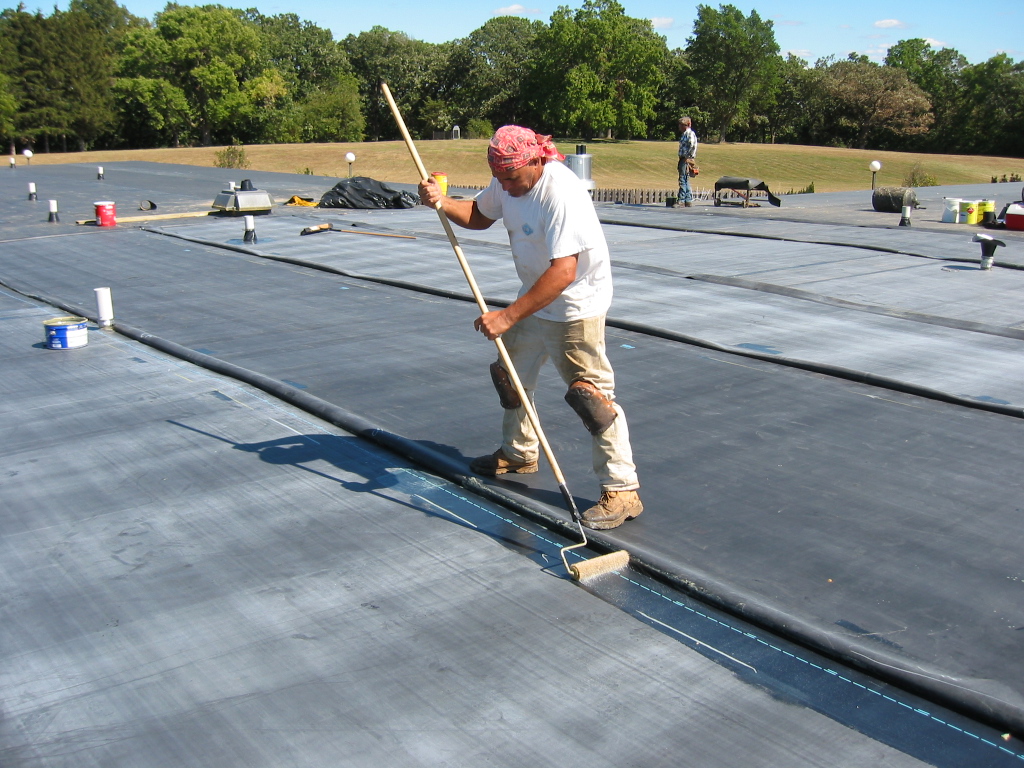
EPDM Roofing
EPDM commercial roof installation, repair, and recovery for Charlotte commercial buildings - fully adhered, mechanically attached, and ballasted 60-mil systems with manufacturer warranty programs.
Commercial Roofers Charlotte
EPDM Roofing work starts with a documented roof walk and ends with a scope owners can use.
Ethylene propylene diene monomer - EPDM - is Charlotte's workhorse commercial flat roof membrane for industrial, warehouse, and high-rooftop-traffic applications. We install fully adhered, mechanically attached, and ballasted systems with manufacturer warranty programs.
EPDM is the membrane that Charlotte's commercial market ran on for three decades before TPO pricing came down to competitive levels. The post-Hugo 1989 replacement wave - when the hurricane's inland track over Charlotte put hundreds of commercial roofs into emergency replacement - installed most of its volume in 60-mil EPDM, and that generation of buildings is now running 35-year-old systems approaching second reroof cycle. We know EPDM from both ends: the installation of new systems and the honest assessment of when an aging EPDM system has remaining life vs. when it is past the point where repair economics make sense.
EPDM performs well in Charlotte's climate. The rubber membrane handles UV exposure and thermal cycling - the shift from a Charlotte winter cold snap to a July surface temperature above 160F - without the brittleness that afflicts older PVC systems in extended heat. High humidity does not degrade EPDM the way it affects adhesive systems that rely on organic-chemistry solvents. For Steele Creek warehouse buildings with high rooftop mechanical density and heavy foot traffic, fully adhered EPDM on a robust cover board is still the specification that handles daily maintenance traffic without the walk-pad dependency that TPO requires.
We install EPDM from Carlisle SynTec, Firestone Building Products, and Johns Manville - three manufacturer programs with established warranty documentation processes and Charlotte-area technical representatives who conduct the field inspections required for NDL warranty issuance.
For occupied buildings, staging, access, odor control, and tenant communication are part of the roof plan before crews arrive.
For portfolio owners, the goal is consistent documentation across properties, not a one-off opinion that cannot be compared later.
The first visit produces a practical roof record: current conditions, visible failure points, drainage notes, access concerns, and the repair or replacement path that fits the building.
Owners get a written scope that separates urgent water-control work from longer-term capital planning, so the roof decision is not made from guesswork.
The closeout package keeps the next decision clear with before photos, after photos, material notes, warranty coordination, and recommended maintenance timing.
EPDM Attachment Methods for Charlotte Buildings
Fully adhered EPDM: The specification for buildings with high rooftop equipment density and heavy foot traffic. Adhesive bonded to the substrate across the full membrane field - no fasteners in the field, no membrane flutter under wind uplift. Charlotte's ASCE Wind Zone II loading (115 mph basic wind speed, higher near CLT airport open exposure) requires either a fully adhered attachment or a fastener pattern engineered to that load. Fully adhered systems are also the specification for rooftop terrace applications on the mixed-use South End and NoDa buildings, where the membrane is a walking surface.
Mechanically attached EPDM: The cost-effective specification for large-footprint warehouse and distribution buildings on the Steele Creek corridor and the Westinghouse Boulevard industrial zone. Fastener pattern is engineered against ASCE 7-22 wind-uplift requirements for the building's exposure category. Charlotte buildings near open exposure - the CLT airport cargo zone, lakefront buildings on Lake Norman's northern shore - get higher fastener density than the sheltered interior campus buildings. We provide stamped engineering fastener patterns for every project above 20,000 square feet.
Ballasted EPDM: The lowest cost installed system per square foot, appropriate for buildings with adequate structural capacity to carry the ballast load. Charlotte's structural requirements for ballasted systems are sized against ASCE 7-22 wind uplift for the exposure zone. We calculate ballast requirements before specifying this system and verify structural capacity with the building's engineer of record before any ballast spec is committed.
EPDM Failure Modes Specific to Charlotte Conditions
Seam delamination on factory-seamed EPDM: Older EPDM systems installed before modern butyl tape technology rely on contact cement seams. Charlotte's humidity and thermal cycling causes contact cement seams to delaminate at the leading edge over time. Systems installed in the early post-Hugo window - 1990 to 1995 - are now 30-plus years old and frequently show contact cement seam delamination across the field. Repair of isolated seam failures is straightforward with modern seam tape. When seam failures cover more than 25% of the field, replacement economics are typically better than a widespread seam repair program.
Membrane shrinkage at parapet walls: EPDM shrinks as it ages. On Charlotte buildings with tall masonry parapets - common in the older South End and NoDa industrial-to-office conversion buildings - membrane shrinkage pulls the base flashing up the parapet wall and eventually away from it. The gap at the base of the flashing is the leading cause of interior water intrusion in these buildings. We install elongated boot flashings and slip-sheet details on every EPDM installation at masonry parapets to account for anticipated shrinkage over the system's service life.
Puncture damage at rooftop HVAC service paths: The Ballantyne corporate campuses and the University Research Park office buildings have dense HVAC equipment clusters requiring frequent access by building mechanical contractors who are not trained in membrane protection. EPDM is more puncture-resistant than TPO but is not immune to damage from dropped tools, sharp HVAC component edges, or dragged equipment. We install manufacturer-specified walkway protection at every equipment access path on every new EPDM installation.
EPDM Recover and Replacement Decisions
Charlotte's aging EPDM stock - particularly the Hugo-era and early 1990s installations - presents a consistent recover-vs-replace decision. Fully adhered 60-mil EPDM installed over sound, dry polyiso insulation may still support a recover with a new single-ply sheet if the insulation cores read dry and the existing membrane is sound under the surface. We pull 5 to 10 moisture cores and photograph the insulation cross-section before recommending a recover path. If more than 25% of cores read saturated, replacement is the call.
Deck condition is the second filter. Charlotte's high-humidity environment means steel deck beneath aging EPDM accumulates corrosion on the underside that is not visible from the roof surface. We open deck at deflection points and at suspected saturation locations before finalizing the scope on any aging EPDM system. Corroded flutes require deck replacement, which materially changes the project cost and timeline. Building owners need this information before contract signing.
How long does EPDM last on?
Modern 60-mil fully adhered EPDM carries 20-year NDL warranties from Carlisle and Firestone, and field performance data supports 25-30 year service life when properly maintained. The Hugo-era 60-mil EPDM installations are approaching 35 years - some are still serviceable with active seam repair programs; others are past economical repair. We assess each building individually. Mil thickness, adhesive technology, insulation condition, and maintenance history all affect where a specific system sits on the lifecycle curve.
Can EPDM be installed's summer heat?
Yes, with scheduling adjustments. Adhesive-set fully adhered EPDM requires ambient temperatures above 40F and below the flash point of the adhesive - typically practical in Charlotte from April through October with morning start times before afternoon thunderstorm windows close the site. Mechanically attached EPDM has a wider installation temperature range and is less sensitive to Charlotte's summer heat and humidity conditions.
Does EPDM handle standing water better than TPO?
Modern EPDM handles ponding water better than TPO in certain respects - it does not suffer the seam delamination from standing water that older TPO formulations produced. However, standing water on any commercial membrane system is a maintenance and warranty issue, regardless of membrane type. Manufacturer warranties on EPDM systems require adequate drainage - most NDL warranties specifically exclude damage from ponding water beyond 48 hours. We size drains to ASCE 7-22 current standards on every EPDM installation.
EPDM installation or assessment for your Charlotte commercial building?
We will assess existing conditions, pull moisture cores on any aging EPDM system, and produce a written scope - installation, recover, or replacement - with manufacturer warranty options for any commercial building in Mecklenburg County or the surrounding metro.
Request a Written Scope