

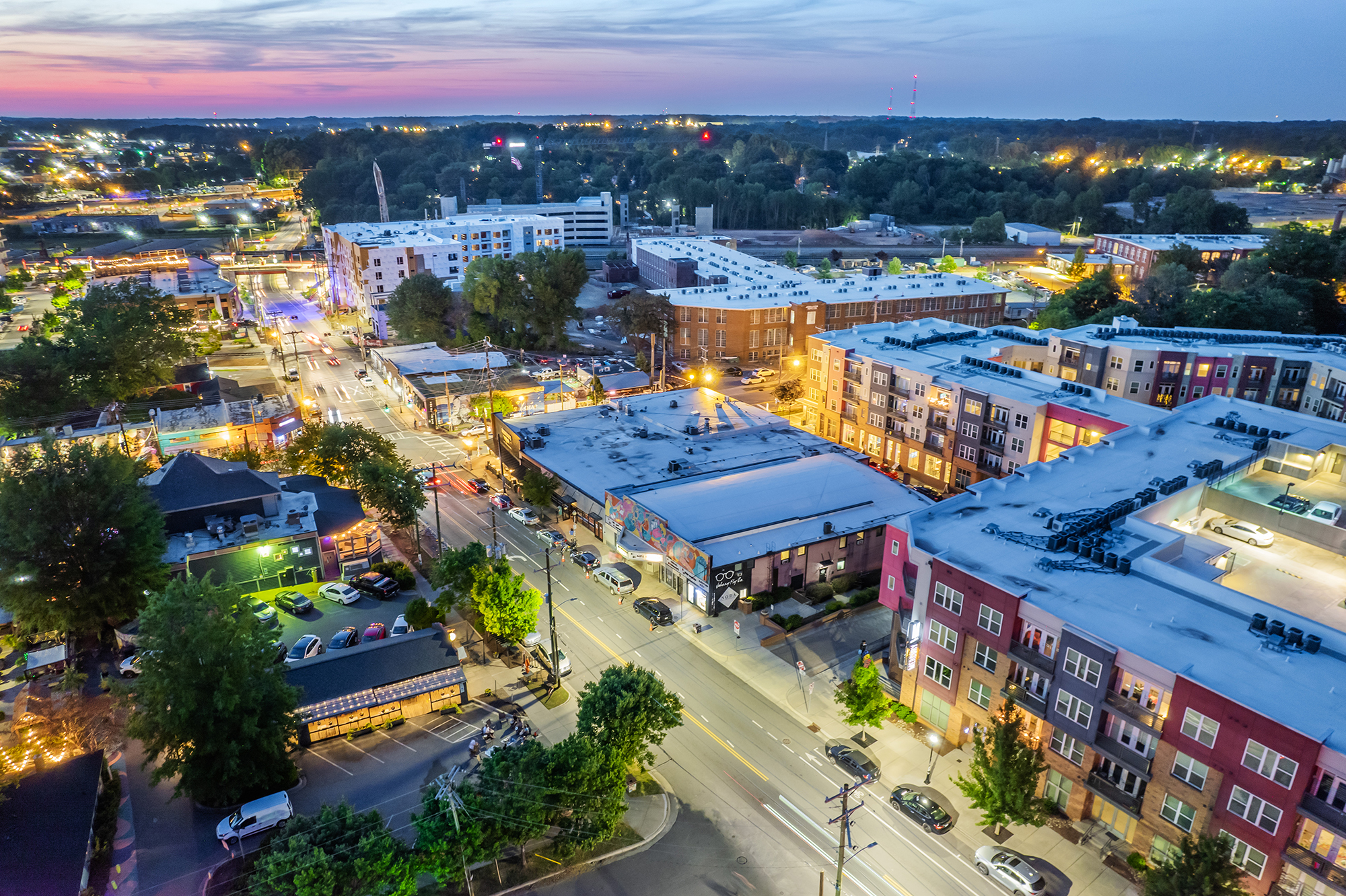
Commercial Roofers in NoDa, NC
Commercial roofers serving NoDa, NC should document leak sources, wet insulation, drainage, edge details, penetrations, and repair history before recommending a scope. Commercial roofing contractors serving NoDa, NC with commercial roof repair, replacement, coatings, maintenance programs, inspections, and documented roof reports.
Commercial Roofers Charlotte
Commercial Roofing Contractors NoDa, NC
Commercial roofing contractors serving NoDa, NC with commercial roof repair, replacement, coatings, maintenance programs, inspections, and documented roof reports.
Roof work in Commercial Roofing Contractors NoDa, NC is planned around access, response timing, commercial building mix, and the condition of the existing roof system.
Commercial roofers serving NoDa, NC should document leak sources, wet insulation, drainage, edge details, penetrations, and repair history before recommending a scope. NoDa's former textile mill buildings along 36th and 35th Streets are some of the oldest unreinforced masonry commercial structures in Charlotte. The roof conditions in this building class reflect that age - and they require a different approach than any other Charlotte submarket.
NoDa - North Davidson - is Charlotte's arts and entertainment district, centered on the 36th Street and 35th Street corridor north of Uptown. The neighborhood's defining buildings are former textile mill structures from the 1910s through 1930s: multi-story brick construction with unreinforced masonry walls, sawtooth skylights on some of the larger mill structures, internal drainage systems that were designed for a rainfall standard nobody uses anymore, and roofing that has been modified, recovered, patched, and modified again by every successive owner or tenant.
The Blue Line extension - the Gold Line Phase 2 expansion that added stations at 25th Street and 36th Street in NoDa - increased transit access to the neighborhood and accelerated the commercial development around those stations. The buildings closest to the 36th Street station along North Davidson Street are in active adaptive reuse and new construction simultaneously. A 1920s textile mill on one block, a 2022 mixed-use commercial tower on the next.
The brewery and restaurant density in NoDa is the highest in the Charlotte market. Birdsong Brewing, Salud Beer Shop, and the restaurant cluster on 36th Street put commercial kitchen and fermentation exhaust loads on rooftops that the original textile mill buildings were never designed to accommodate. The penetration count per square foot of roof area in an active NoDa brewery building is higher than almost any other building type in the market, and each penetration is a potential failure point if the flashing is not maintained.
The first visit produces a practical roof record: current conditions, visible failure points, drainage notes, access concerns, and the repair or replacement path that fits the building.
Owners get a written scope that separates urgent water-control work from longer-term capital planning, so the roof decision is not made from guesswork.
The closeout package keeps the next decision clear with before photos, after photos, material notes, warranty coordination, and recommended maintenance timing.
For occupied buildings, staging, access, odor control, and tenant communication are part of the roof plan before crews arrive.
For portfolio owners, the goal is consistent documentation across properties, not a one-off opinion that cannot be compared later.
Textile Mill Roof Conditions - What We Find
The original NoDa textile mill buildings were constructed on a tight industrial budget with roofing systems that were functional but not over-engineered. The original flat sections ran coal-tar pitch BUR on concrete deck - some of the best-aging roofing material from that era, but it is now 80 to 100 years old. The sawtooth glazing sections on the larger mill buildings are a separate problem: the original metal glazing frames are almost universally corroded at the sill, and the condensation channel at the bottom of each glazing bay has been collecting water and debris for decades.
The modifed bitumen recovers that went over NoDa mill buildings in the 1990s were applied without full moisture surveys in most cases - the 1990s commercial roofing market in Charlotte was not routinely pulling moisture cores before recover. That means some of those recovers are sitting on wet insulation that has been degrading underneath for 25 years. We pull moisture cores in a dense grid before writing any scope on NoDa mill buildings because the existing condition under the top membrane is often worse than the surface suggests.
The internal roof drains in NoDa textile mill buildings are cast iron and are routinely 60 to 80 years old. Cast iron drain bodies corrode from the inside - the corrosion is not visible without removing the drain strainer and inspecting the collar and hub. We replace every cast iron drain body that is original to the building on any NoDa mill replacement project. A 70-year-old drain body that fails the first year after a new membrane is installed creates an interior flooding event that the new membrane cannot prevent.
Brewery and Restaurant Exhaust Penetrations
A brewery roof in NoDa has penetration flashing conditions that do not exist anywhere else in the Charlotte commercial market. Fermentation tank venting, grain dust exhaust, glycol chiller lines, and CO2 relief vents create a cluster of penetrations per square foot of roof area that exceeds most industrial buildings. The heat and chemistry from brewery exhaust accelerates membrane degradation in the zones immediately around each penetration if the flashing is not specified for the exposure.
We use EPDM pitch-pocket flashing and lead-lined boot flashings in brewery exhaust penetration zones rather than standard TPO flashings - the thermal and chemical resistance profile is better suited to the exposure. For grain dust exhausts where fire risk is a factor, we coordinate with the brewery's equipment vendor before specifying flashing materials to confirm compatibility with any fire-suppression requirements at the exhaust termination.
Restaurant kitchen exhaust in NoDa's converted retail and mill buildings creates grease exposure at the exhaust termination that degrades standard TPO and EPDM membrane within a 24-inch radius of the exhaust. We install stainless or aluminum grease guard pans at every restaurant kitchen exhaust penetration on maintenance and replacement projects - the pan contains grease runoff that would otherwise sit on the membrane surface and accelerate its degradation.
New Construction Along the 36th Street Station Corridor
The blocks immediately surrounding the NoDa 36th Street station have seen new mixed-use construction that puts modern membrane systems - 60-mil TPO or PVC on concrete deck - next to 100-year-old mill buildings. The new construction is in its first warranty cycle. The work on these buildings is documented annual maintenance, not replacement.
The interface between old and new construction in NoDa creates a specific drainage design challenge. New mixed-use buildings at grade elevation adjust their site drainage to current standards, but the adjacent historic mill buildings retain original drainage routes. In one case we assessed on Davidson Street, the new construction's modified site grading was directing more surface water toward the historic mill building's foundation than the original site configuration - which added hydrostatic pressure to a masonry foundation that was not designed for it. We note these cross-property drainage conditions in our condition reports when we find them.
Do you work on the historic textile mill buildings in NoDa?
Yes. The NoDa mill building stock is some of the most complex existing commercial roof condition we see in the Charlotte market - unreinforced masonry, multi-layer roofing histories, aged cast iron drainage, and high exhaust penetration counts from brewery and restaurant tenants. We pull moisture cores before writing any scope on NoDa mill buildings because the under-membrane condition is not predictable from surface inspection.
My NoDa brewery building's roof has a lot of exhaust penetrations. How do you handle those?
We use EPDM pitch-pocket and lead-lined boot flashings in brewery exhaust penetration zones because of the thermal and chemical exposure. Grease guard pans go at restaurant kitchen exhausts. We inspect all penetration flashings on every annual maintenance visit - in a brewery building, the penetrations are the highest-risk zone on the roof.
NoDa commercial roof inspection or emergency response?
NoDa is 10 minutes from our Uptown office. We have worked on the textile mill buildings along 36th and 35th Streets and know the specific conditions in this building class. Call 704-710-8487 or request a written condition report.
Request a Written Scope