

Hail Damage Roof Insurance Claims
Hail damage roof insurance claim documentation for Charlotte commercial buildings - impact mapping, membrane assessment, and adjuster-ready reports.
Commercial Roofers Charlotte
Hail Damage Roof Insurance Claims work starts with a documented roof walk and ends with a scope owners can use.
The Piedmont sits inside a genuine hail corridor - spring and early-summer supercell activity moving across the Carolinas regularly drops damaging hail on Charlotte and the surrounding Mecklenburg County suburbs, and commercial low-slope roofs take that impact differently than a shingle roof does. TPO and PVC membranes don't always show visible cracking after a hailstorm; the damage is often a subsurface bruise that weakens the membrane at the impact point without an obvious surface tear. That gap between what's visible and what's actually damaged is where hail claims get underpaid if the documentation isn't thorough.
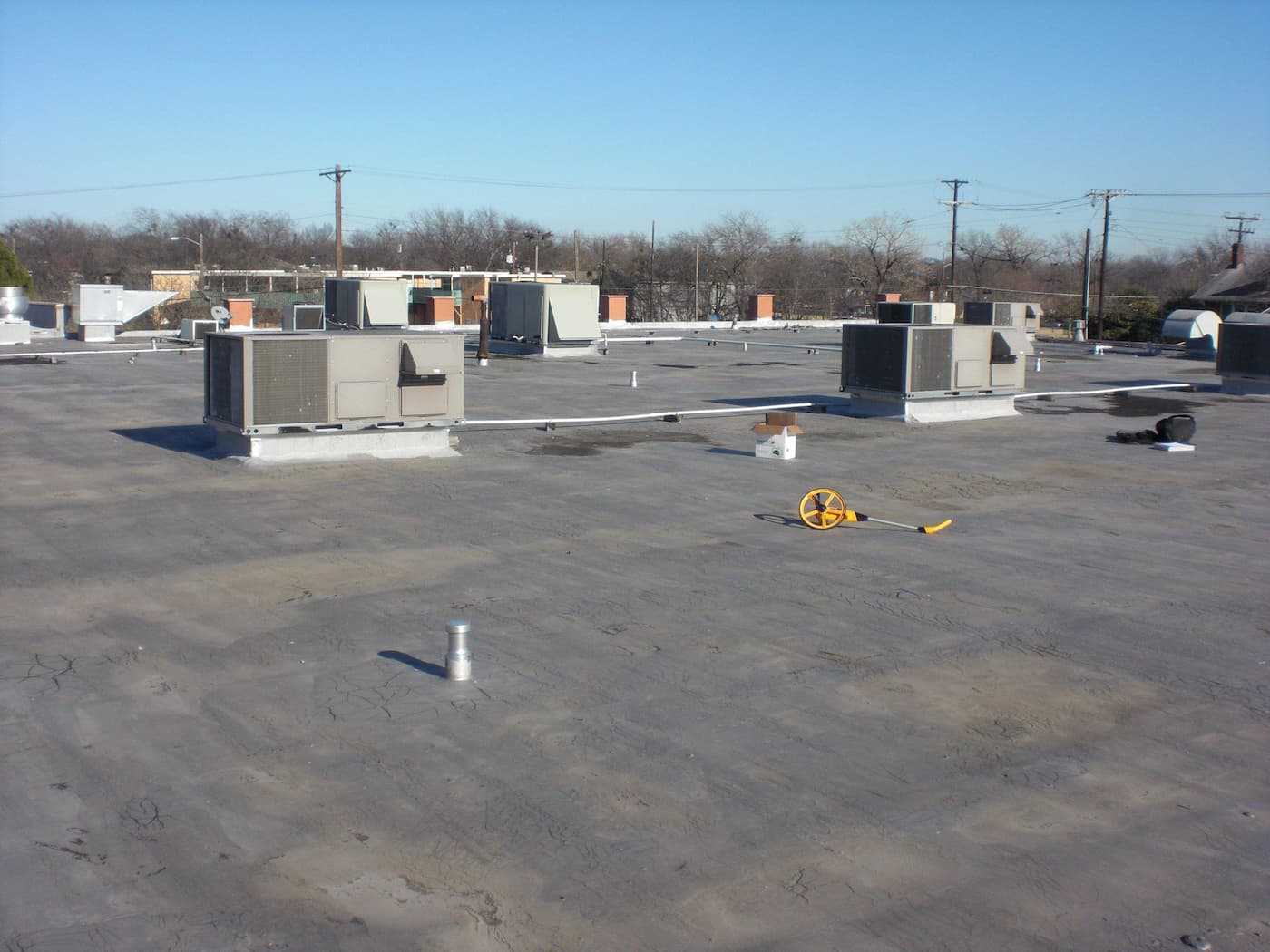
Our hail assessment starts with a full roof walk in low-angle light, which is when impact impressions on TPO and PVC membrane are easiest to see - circular depressions where the hail compressed the membrane and the insulation underneath it. We map impact density by roof zone rather than spot-checking a few areas, because hail damage is rarely uniform across a large commercial roof; wind during the storm concentrates impacts on certain slopes or parapet-facing sections while leaving others comparatively clean. That zone-by-zone density map is what shows an adjuster the difference between isolated cosmetic marks and damage that affects the roof's remaining serviceable life.
On membranes where impact severity is hard to confirm visually, we take cross-section samples at representative impact points - a small membrane core that shows whether the hail compression reached through to the substrate. Adjusters processing commercial hail claims often ask for this level of physical evidence before approving a full-roof scope rather than a spot-repair, and we prepare it as part of the standard assessment rather than waiting for a request that delays the claim.
Hail claims on commercial buildings are also where matching becomes a real cost issue. A roof that's fifteen years into a twenty-year membrane's service life may not have a manufacturer match available for a partial repair, and code often requires more insulation than what's currently installed once a section is opened. We document those constraints as part of the hail scope so the claim reflects a roof section that can actually be built to current code and matched to the surrounding membrane, not a repair estimate that assumes conditions that no longer exist.
We're your roofing contractor, not a public adjuster - we document and substantiate the roof damage so you and your adjuster work from an accurate scope.
Hail Damage Roof Insurance Claims in Charlotte, NC The Piedmont sits inside a genuine hail corridor - spring and early-summer supercell activity moving across the Carolinas regularly drops damaging hail on Charlotte and the surrounding Mecklenburg County suburbs, and commercial low-slope roofs take that impact differently than a shingle roof does.
TPO and PVC membranes don't always show visible cracking after a hailstorm; the damage is often a subsurface bruise that weakens the membrane at the impact point without an obvious surface tear.
We map impact density by roof zone rather than spot-checking a few areas, because hail damage is rarely uniform across a large commercial roof; wind during the storm concentrates impacts on certain slopes or parapet-facing sections while leaving others comparatively clean.
That zone-by-zone density map is what shows an adjuster the difference between isolated cosmetic marks and damage that affects the roof's remaining serviceable life.
Adjusters processing commercial hail claims often ask for this level of physical evidence before approving a full-roof scope rather than a spot-repair, and we prepare it as part of the standard assessment rather than waiting for a request that delays the claim.
Older built-up roofs and modified bitumen systems, still common on some of Charlotte's older industrial and warehouse-conversion buildings in South End and near the rail corridors, show hail damage differently - granule loss on the cap sheet, exposed asphalt, and accelerated aging at the impact point.
Hail claims on commercial buildings are also where matching becomes a real cost issue.
How do you document hail damage on a Charlotte commercial roof for an insurance claim?
We map impact density by roof zone using close-range, low-angle-light inspection, photograph representative impact locations with measurement the project teams, and where the membrane type requires it, take cross-section samples that show whether the impact compressed through to the substrate. The report is formatted to match what commercial property adjusters expect to see for a hail claim.
What does hail damage actually look like on a TPO or PVC commercial roof?
Moderate hail - roughly one inch in diameter and larger - leaves circular impact depressions in the membrane surface where the hail compressed the material and the insulation beneath it. These marks are frequently invisible from ground level and hard to spot without close-range inspection in the right light, which is why a cursory roof walk often misses hail damage that a full inspection catches.
Is hail damage on a commercial roof always visible right after the storm?
Not always. Hail impact creates stress points in the membrane that accelerate seam failure and UV degradation over months, meaning some effects of a hailstorm don't show up as an active leak until well after the event. That's part of why the initial assessment documents impact density even where the membrane hasn't failed yet - the claim should reflect the full extent of the damage that occurred, including the areas that aren't leaking yet.
Will my hail claim cover a full commercial roof replacement or just a repair?
That depends on impact density, membrane age, and whether a partial repair can be matched to the surrounding roof without a visible or performance mismatch. We document all three factors so the scope reflects what the roof actually needs, and your adjuster and insurer make the coverage determination from that record.
Do you handle the negotiation with our insurance company on a hail claim?
No - we document the hail damage, participate in adjuster walkthroughs, and provide any supplemental technical evidence the claim needs. We're the roofing contractor, not a public adjuster, so the claim negotiation itself stays between you and your insurer or your public adjuster.
Request a Written Scope