

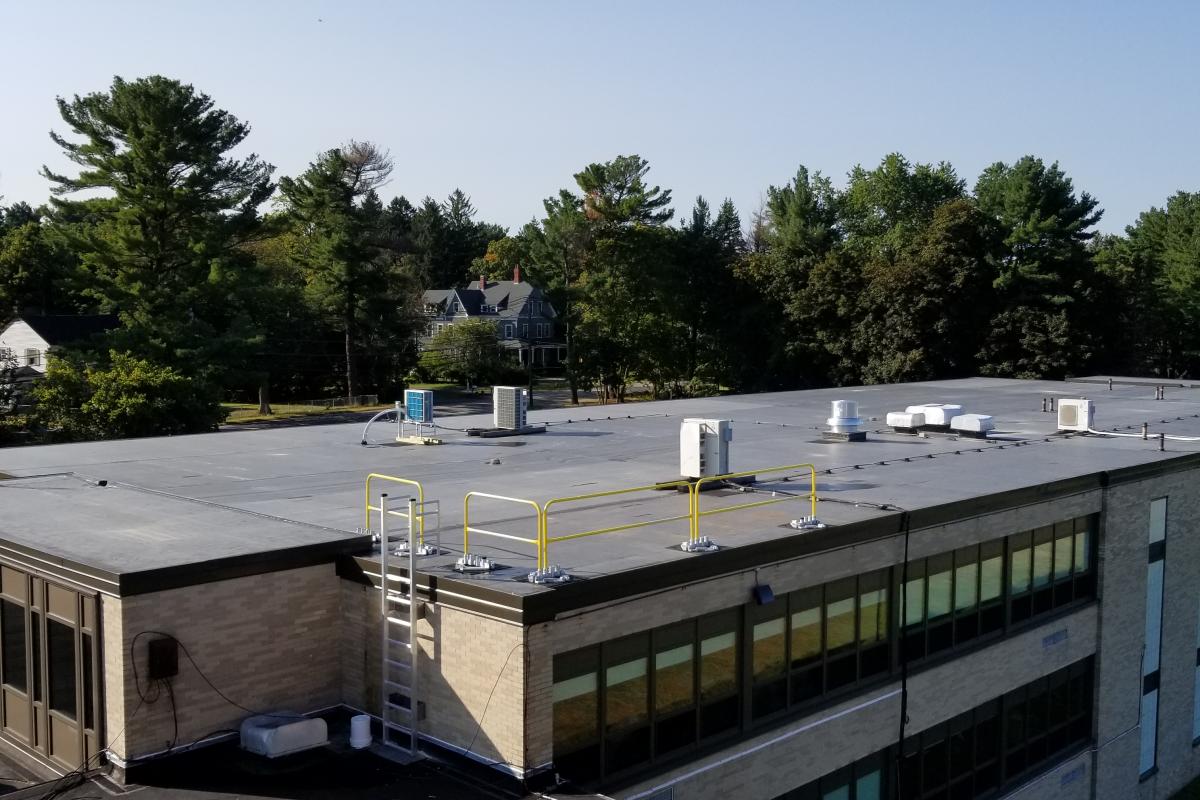
Government and Municipal Building Roofing
Commercial roofing for city halls, courthouses, fire stations, police stations, and public facilities throughout Charlotte, NC.
Commercial Roofers Charlotte
Government and Municipal Building Roofing work starts with a documented roof walk and ends with a scope owners can use.
Charlotte-Mecklenburg's government building portfolio has expanded dramatically alongside the region's population growth, encompassing the Charlotte Mecklenburg Government Center on East Fourth Street, a network of Mecklenburg County courthouses and district courthouses, Charlotte Fire Department stations scattered from Ballantyne to University City, the Charlotte-Mecklenburg Police Department division stations, Charlotte Area Transit System maintenance facilities, and numerous branch libraries operated by the Charlotte Mecklenburg Library system. Each category of building brings distinct operational constraints, occupancy considerations, and roofing specifications that require contractors experienced with publicly owned assets rather than generic commercial buildings.
The City of Charlotte and Mecklenburg County both follow the North Carolina General Statutes governing competitive bidding for public construction, with sealed bids required for formal projects above the applicable threshold. Bids are advertised through the Charlotte Business INClusion portal and the city's e-procurement system, and contractors must be pre-registered to download bid documents and submit responses. North Carolina also requires that public construction projects above the threshold be formally designed by a licensed architect or engineer, meaning roofing contractors respond to a complete set of bid documents rather than scoping work independently. Our team reads project specifications thoroughly, submits requests for information during the bid period, and delivers bid packages that address every compliance requirement in the project manual.
North Carolina does not operate a statewide prevailing wage program for locally funded construction, but Mecklenburg County and the City of Charlotte have both applied for and received federal funding streams that trigger Davis-Bacon requirements on specific projects. CDBG-funded facility improvements, FAA-related airport and transit authority buildings, and HUD-assisted housing authority structures all carry federal wage determination obligations. Charlotte Area Transit System projects have historically involved federal transit grants that bring full Davis-Bacon compliance requirements. We maintain certified payroll systems and sub-tier audit procedures calibrated to handle federally funded projects and submit documentation to the applicable federal oversight agency on schedule without exception.
Charlotte's climate sits in a transitional zone between the humid subtropics to the south and the cooler piedmont conditions to the north. Summer surface temperatures on dark membrane roofs at Charlotte government buildings regularly exceed 160F, driving significant air conditioning loads at facilities like the Mecklenburg County Jail on Dowd Road and the Charlotte Transportation Center. At the same time, winter ice storms - Charlotte sees freezing rain events several times per season - create ice dam conditions at parapets and penetrations that low-slope roofs must be designed to handle. The North Carolina Energy Conservation Code requires minimum R-values and solar reflectance index performance for commercial roofs, and city sustainability policies encourage exceeding code minimums on municipal buildings to reduce long-term operating costs.
For portfolio owners, the goal is consistent documentation across properties, not a one-off opinion that cannot be compared later.
The first visit produces a practical roof record: current conditions, visible failure points, drainage notes, access concerns, and the repair or replacement path that fits the building.
Owners get a written scope that separates urgent water-control work from longer-term capital planning, so the roof decision is not made from guesswork.
The closeout package keeps the next decision clear with before photos, after photos, material notes, warranty coordination, and recommended maintenance timing.
For occupied buildings, staging, access, odor control, and tenant communication are part of the roof plan before crews arrive.
Can a new single-ply membrane be installed over an existing BUR roof on a Charlotte building?
Yes, if the moisture survey shows the existing BUR insulation is dry and the BUR plies are structurally intact. Most major TPO and EPDM manufacturers have published recover specifications that allow their membrane to be installed over a sound BUR substrate. The recover specification typically requires a cover board - high-density polyiso or gypsum - over the existing BUR surface before the new membrane is installed. We verify the recover specification with the manufacturer before scoping and obtain manufacturer confirmation that the recover configuration qualifies for the target warranty term.
How many cores do you pull on a Charlotte BUR moisture survey?
Minimum five locations on a roof under 10,000 square feet. On larger roofs we target one core per 2,000 to 2,500 square feet, concentrated in areas showing surface deflection, prior repair work, or drainage anomalies. On BUR roofs with a history of localized leaks, we pull additional cores around the reported leak locations and at all four parapet corners - the highest-probability moisture entry points on older Charlotte BUR systems.
Does BUR work require a permit?
Replacement and recover projects above the City of Charlotte's threshold - currently $30,000 in contract value for commercial work - require a building permit filed with the relevant jurisdiction. We handle permitting as part of our scope for all BUR replacement and recover projects in Charlotte, Mecklenburg County, and the surrounding municipalities. Repair work below the permit threshold does not typically require a permit, but we document all repair work to the same standard regardless of permit status.
BUR assessment for an older Charlotte commercial building?
We will walk the roof, pull moisture cores, and produce a written assessment with recover-vs-tear-off recommendation - for any BUR system in Uptown, South End, NoDa, or anywhere else in the Charlotte metro.
Planning Government and Municipal Building Roofing
Government and Municipal Building Roofing should be evaluated through the roof condition, the building use, the owner's timing, and the level of documentation needed to make a decision.
The written record should make the next step clear without relying on broad claims or generic sales language.
Request a Written Scope