

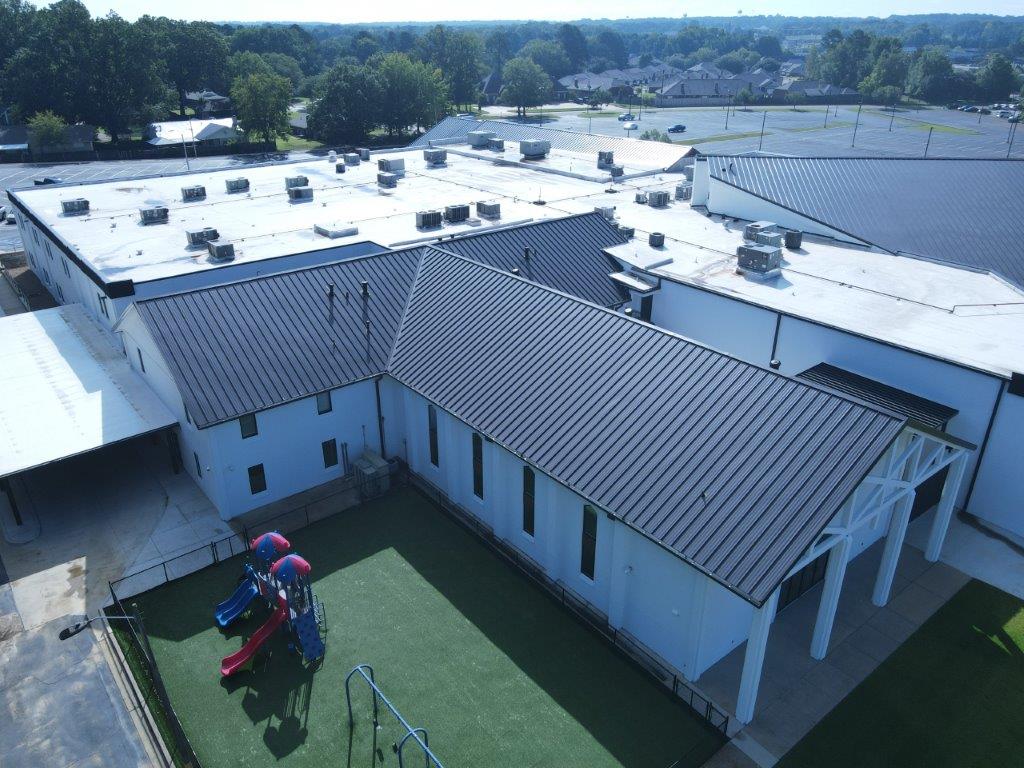
Religious Building Roofing
Commercial roofing for Charlotte churches and religious facilities - historic Uptown congregations, Charlotte megachurches, and suburban worship centers - slate, copper, membrane, and metal roofing.
Commercial Roofers Charlotte
Religious Building Roofing roof work is shaped by occupancy, access, drainage, tenant protection, and the warranty path that fits the building.
Charlotte's religious building inventory spans 19th-century uptown congregational buildings with slate and copper roofing to the large suburban campus megachurches with 100,000-square-foot flat roof sections.
Religious buildings in Charlotte represent two ends of a wide spectrum. On one end: the historic uptown congregations - the First Presbyterian Church on West Trade Street, the Tryon Street United Methodist Church adjacent to the BofA Corporate Center, the Cathedral of St. Patrick on South Tryon - whose buildings date to the late 1800s and early 1900s and whose steeple, slate, and copper roofing systems require preservation-aware repair rather than commercial replacement. On the other end: the suburban campus megachurches - Elevation Church, Calvary Church, Carmel Baptist, Calvary Church on Pineville-Matthews Road - whose main sanctuaries and campus buildings include large flat-roof sections running 60-mil TPO or EPDM on steel deck.
I approach these two categories differently because the buildings are different. A repair on the slate hip roof of a historic Uptown congregation requires matching the original slate grade and color, sourcing compatible flashing materials, and executing details that respect the building's architectural character. A replacement on the flat-roof section of a megachurch campus is a commercial reroofing project - governed by the same membrane specifications, drain sizing, and warranty requirements as any other commercial building in Charlotte, with the added constraint that the building has to be protected from weather on Sundays regardless of where the production sequence sits.
What unites religious buildings across the spectrum is the governance structure. Religious property decisions are made by boards, vestries, sessions, and deacon bodies - not by a single facilities director. I expect the decision process to take longer than a comparable commercial transaction, and I build that expectation into my project timeline projections. Rushing a religious institution's governance process does not produce better outcomes.
The closeout package keeps the next decision clear with before photos, after photos, material notes, warranty coordination, and recommended maintenance timing.
For occupied buildings, staging, access, odor control, and tenant communication are part of the roof plan before crews arrive.
For portfolio owners, the goal is consistent documentation across properties, not a one-off opinion that cannot be compared later.
The first visit produces a practical roof record: current conditions, visible failure points, drainage notes, access concerns, and the repair or replacement path that fits the building.
Owners get a written scope that separates urgent water-control work from longer-term capital planning, so the roof decision is not made from guesswork.
Historic Uptown Church Roofing - Slate, Copper, and Preservation Work
The historic congregations along Trade Street, Tryon Street, and the Uptown fringe - buildings that predate Charlotte's 20th-century commercial development - have roofing systems that are materially and architecturally distinct from any other building type I work on in this city. First Presbyterian's slate roof sections, Tryon Street United Methodist's copper flashing and standing seam sections, and the Cathedral of St. Patrick's clay tile areas are all systems that require specialist-level repair competence, not general commercial roofing.
Slate repair requires matching the original slate type, grade, and color. Vermont slate, Welsh slate, and Spanish slate all have different visual and performance characteristics. Installing the wrong slate on a repair - a common shortcut that uses whatever is available from a local salvage yard - produces visible patches that the congregation will notice immediately and that do not perform identically to the surrounding original field. I source replacement slate from suppliers who maintain documented grade inventories and provide the provenance documentation that historic preservation contexts require.
Copper flashing replacement on Uptown church buildings requires matching gauge, weight, and patina treatment to the existing copper. New bright copper on a historic building looks wrong from the street immediately. Pre-patinated or naturally aged replacement copper, matched to the original gauge weight, blends within 12 to 24 months. I specify the patina treatment and source the material before starting any copper replacement on a historic church - not after the old copper is off the building.
Charlotte Megachurch Campus Roofing
Elevation Church operates multiple campuses across the Charlotte metro, including the main Blakeney location, the University City campus, the South End campus, and the Ballantyne campus. Each campus has flat-roof building sections ranging from 20,000 to over 60,000 square feet. Calvary Church on Pineville-Matthews Road and Carmel Baptist Church in south Charlotte are comparable in scale - large sanctuary buildings with additional campus structures that together represent significant roofing acreage.
The operational constraint that distinguishes megachurch flat-roof work from comparable commercial buildings is the Sunday morning production blackout. These campuses run multiple services from early morning through midday on Sundays, with parking lots at capacity and facilities in active use. No roof work - not even inspection - happens during Sunday service windows. I build full Sunday blackouts into production schedules for every megachurch project and communicate this as a non-negotiable to my crews.
Campus megachurches frequently have phased construction histories - a main sanctuary built in one decade, an education wing added in another, a youth center or additional sanctuary added more recently. The roof systems on these phased buildings are not always the same vintage, the same membrane type, or the same warranty status. I inspect and document each building section separately and produce a consolidated capital plan that shows the replacement timing for each phase rather than treating the campus as a single uniform condition.
Budget and Governance Considerations for Charlotte Religious Properties
Religious institutions in Charlotte - like everywhere - make major capital decisions through committee structures that operate on longer timescales than commercial real estate transactions. A board that meets quarterly needs a condition assessment that supports a multi-meeting decision process, not a one-week call-to-action. I produce written condition reports for religious institutions that are structured to be useful across multiple presentation cycles: an executive summary for the governing body, a detailed condition section for the facilities committee, and a capital forecast that shows timing and cost range on a 3-to-10-year horizon.
Matching grants and preservation funding are available for historic religious buildings in Charlotte through the Mecklenburg County Historic Preservation Commission and through national preservation programs for landmark religious properties. I am not a grant administrator, but I produce the condition documentation and scope narratives that support grant applications when building owners are pursuing preservation funding for repair or restoration work.
Many Charlotte religious institutions defer roof maintenance longer than comparable commercial properties because there is no lender or lease covenant requiring documented building system maintenance. The consequence of this deferral is that when failures occur, they are often more extensive than early intervention would have produced. I offer maintenance contract options specifically sized for religious institution budgets - annual inspection and drain maintenance programs that prevent the emergency repair scenarios that are most disruptive to congregation operations.
Our historic Uptown church has a slate roof that leaks at several points. Can it be repaired without full replacement?
Often yes. Individual slate failures - broken or slipped slates, failed flashings at dormers or chimneys - are repairable without full replacement if the underlying wood deck is sound and the remaining slate field has adequate life expectancy. We inspect the full slate field, document the failure locations and the condition of the surrounding slates, and produce a repair scope that extends the existing roof rather than replacing it when that is the honest recommendation.
How do you schedule roof work around Sunday services?
Full Sunday blackout. No work on or above the building during service windows. For campus buildings with Saturday services or midweek events, those windows are also blocked. We build the production schedule around the congregation's calendar - not around the most efficient production sequence for our crew.
Does our Charlotte church need a commercial roofing contractor or a specialized restoration contractor?
It depends on the building. For a historic Uptown congregation with slate, copper, or clay tile roofing, a contractor with documented preservation repair experience is important - we have that experience and the material sourcing relationships that go with it. For a suburban campus megachurch with flat-roof TPO or EPDM sections, the work is commercial low-slope roofing and we handle it as such.
Charlotte church or religious building roof inspection?
Our project managers will walk the roof, document conditions by material type and zone, and produce a written report calibrated to your governing body's decision process - for any religious building in the Charlotte metro.
Request a Written Scope